HANOI: Doctors at the Vietnam–Germany Friendship Hospital said on Thursday (June 18) they have successfully performed emergency surgery to reattach the nearly severed hand of a 22-month-old child, whose wrist was catastrophically injured in a cup-sealing machine accident.
The child's hand had been almost completely severed at wrist level, remaining attached only by a small strip of skin after the toddler’s arm became trapped in a plastic cup-lid sealing machine.
The machine uses both powerful mechanical pressure and high temperatures to seal the tops of plastic cups.
During an initial examination, doctors observed that the child’s fingertips had turned bluish and appeared collapsed, classic signs of acute loss of blood supply.
Given the patient’s very young age, doctors were unable to fully assess the injury at the scene.
Then, a multidisciplinary team comprising specialists in anaesthesia and intensive care, reconstructive microsurgery and orthopaedic trauma was immediately convened.
Once the necessary tests confirmed the child was fit for surgery, the child was transferred directly to the operating theatre, where general anaesthesia was administered before surgeons removed the dressings for a comprehensive assessment and carried out emergency intervention.
Vu Trung Truc, Deputy Head of the hospital’s Department of Maxillofacial Surgery, Plastic and Aesthetic Surgery, said the case presented three major challenges.
Although the hand had not been completely detached mechanically, it had effectively suffered a complete amputation from a circulatory standpoint because all blood vessels supplying the hand had been destroyed.
As a result, the severed hand could not be preserved under ideal iced-storage conditions typically used in complete amputation cases.
The hand had therefore been subjected to prolonged “warm ischaemia” at room temperature, significantly increasing the risk of tissue death and reducing the likelihood of successful reattachment compared with properly preserved amputated limbs.
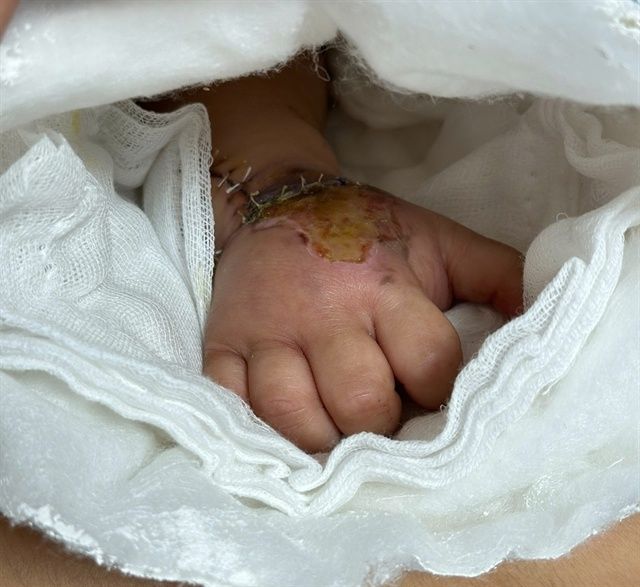
The patient's hand is pink and recovering well after surgery.
Compounding the difficulty, the injury involved not only crushing trauma but also extensive thermal burns caused by the heat generated by the sealing machine.
This made identifying and reconnecting damaged blood vessels exceptionally challenging due to the severe destruction of surrounding tissues, he said.
The procedure was made even more demanding by the patient’s age.
In a child under two years old, blood vessels at the wrist measure only around 0.7-0.8 millimetres in diameter, comparable to the size of an adult’s finger vessels, requiring highly sophisticated super-microsurgical techniques and intense concentration from the surgical team.
After more than five hours of complex surgery, doctors successfully restored blood flow through the vessels and repaired the damaged nerves.
By the sixth day after surgery, the child’s hand had regained a healthy pink colour and warmth, with good circulation.
The toddler had also begun to show the first small finger movements.
“This is an extremely encouraging sign for the long-term recovery of hand function,” Truc said.
The case has prompted doctors to issue an important safety warning to parents, urging them to keep electrical appliances and industrial machinery, including grinders, pressing machines and rice cookers, out of the reach of young children.
Parents should be particularly vigilant during periods when family routines are disrupted, such as house moves or major holidays, when children may be exposed to unfamiliar hazards.
In cases involving traumatic limb amputation, doctors advise that immediate first aid should be administered to control bleeding and that patients should be transferred as quickly as possible to specialised surgical centres in order to make the most of the critical “golden period” for limb salvage. - Vietnam News/ANN