
Chinese President Xi Jinping’s visit to North Korea may have helped cement China’s “indispensable” role in ensuring regional stability and highlighted its importance to his host’s economy, analysts said.
The Chinese president wrapped up his visit on Tuesday afternoon after reaching what he said was a “critical consensus” with North Korean leader Kim Jong-un.
Xi told a lunch at the Kumsusan State Guest House that he was ready to work with Kim to to “jointly guide China-North Korea relations towards greater development, injecting new and powerful momentum into the socialist causes of both countries”.
He said the pair had reached agreement on “developing China-North Korea relations in the new era” and “exchanged in-depth views on maintaining regional and global peace and stability”, according to Chinese state broadcaster CCTV.
Meanwhile, Kim said the visit had sent a clear signal to the world about their closer alignment.
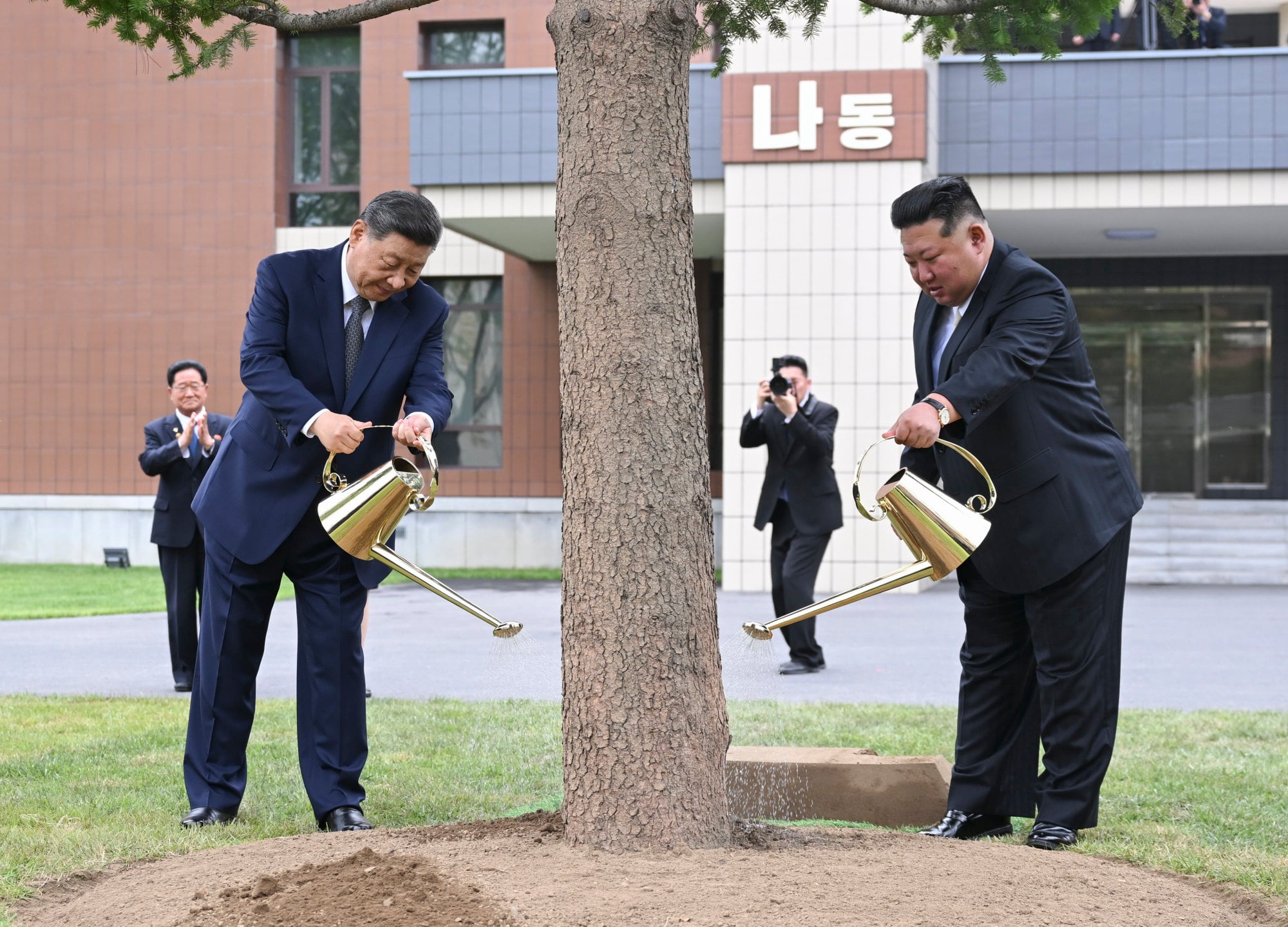
Earlier that day, the two leaders visited the newly built campus of the Central Cadres Training School of the Workers’ Party of Korea – the top academy for officials – and laid a floral tribute at the China-North Korea Friendship Tower, which honours the Chinese troops who fought in the Korean war.
“President Xi’s visit underscores at least one crucial reality: China’s role is absolutely indispensable in resolving the Korean peninsula issue,” a Chinese specialist on relations between the two countries said.
“Particularly when it comes to easing tensions and maintaining regional stability, China’s influence remains irreplaceable.”
The analyst, speaking on condition of anonymity because he was not authorised to speak to the media, also described China as North Korea’s “most important neighbour and gold card”.
Xi’s visit was his first to North Korea in seven years and his first trip abroad this year. It also came just weeks after his back-to-back summits with Donald Trump and Vladimir Putin in Beijing.
The trip is also important for Pyongyang as it tries to turn around the economy after years of isolation.
United Nations sanctions, imposed in 2006 following the country’s first nuclear test, remain the greatest obstacle to its economic growth.
Earlier this year, Kim told a Workers’ Party congress that the “heavy and urgent historic tasks of boosting economic construction and the people’s standard of living” were a priority.
“With Pyongyang’s security now largely stabilised, the primary focus has turned to economic development, where strengthening ties with China is absolutely critical,” the analyst said.
Commerce Minister Wang Wentao’s presence in the delegation was also a probable sign of future cooperation and possibly even the adoption of China’s economic development model, he added.
“It’s hard to say for sure right now because North Korea certainly can’t be completely open, but in certain areas and to a certain extent, learning from China’s experience and practices is likely one of Pyongyang’s future considerations,” he said.
The Chinese delegation also included Xi’s de facto chief of staff Cai Qi, Defence Minister Dong Jun, Foreign Minister Wang Yi and Zheng Shanjie, the head of the National Development and Reform Commission.
The visit might also usher in a period of “heightened cultural and economic exchange”, potentially even opening North Korea’s doors to Chinese tourists, the analyst added.
Choong‑Koo Lee, a research fellow at the Korea Institute for Defence Analyses, said Beijing held sufficient economic leverage to anchor the North within its sphere of influence.
Pyongyang has been trying to avoid becoming overdependent on China and has moved to strengthen its relationship with Moscow in recent years.
Russia is now North Korea’s largest source of tourists and Kim has sent thousands of troops to support the war against Ukraine.
But Lee said: “China provides North Korea with its principal export market, as well as intermediate goods that Russia cannot readily supply. China has also been the primary source of stable foreign investment in North Korea.
“Even with the potential of expanding Chinese tourism to North Korea, China’s economic role for North Korea cannot be replaced by Russia.”
William Yang, a senior analyst for northeast Asia at the International Crisis Group, said the meeting with Kim would help reinforce Beijing’s image as “the only great power capable of engaging with countries on opposite ends of international politics”.
He said: “It also reflects the unique and strategic position that Xi occupies: he is now one of the very few world leaders who can convene high-level, potentially high-impact, dialogues with other powerful world leaders, and who holds the power to shape the course of and dynamics in some of the most consequential relationships in the world.”
Yang also argued that the visit would help North Korea show that it had enough geopolitical clout to draw the leader of the world’s second-largest economy out of Beijing.
He said it might have helped persuade Kim that China was his most important international partner by appealing to his wish to be seen as powerful and important both domestically and internationally.
On Monday, the Chinese leader described Beijing’s commitment to North Korea and Kim as “unwavering” and pledged to strengthen ties in all areas.
Meanwhile, Kim said closer relations with China were the country’s most important strategic mission and one he was committed to seeing through, the state-run Korean Central News Agency reported.
After his visit to Beijing last month, Trump said he and Xi shared the goal of denuclearising the Korean peninsula.
But official Chinese statements released after both the Trump and Kim summits did not mention the topic – raising speculation Beijing may be softening its stance.
Instead, Xi said both China and North Korea should enhance strategic coordination to safeguard their own sovereignty, security and development. -- SOUTH CHINA MORNING POST