




The Pentagon signalled on Monday that it was adding Alibaba, BYD, Baidu and dozens of other Chinese companies to its list of entities it says are linked to China’s military, widening a blacklist that increasingly targets sectors at the heart of US-China technological competition.
In a Federal Register notice scheduled for publication on Wednesday, the US Department of Defence designated a broad range of Chinese firms as “Chinese military companies” under Section 1260H of the National Defence Authorisation Act.
These include electric vehicle makers, artificial intelligence companies, battery manufacturers, biotech firms and solar suppliers. The designation can complicate companies’ access to US capital markets and government business, although it does not automatically trigger sanctions.
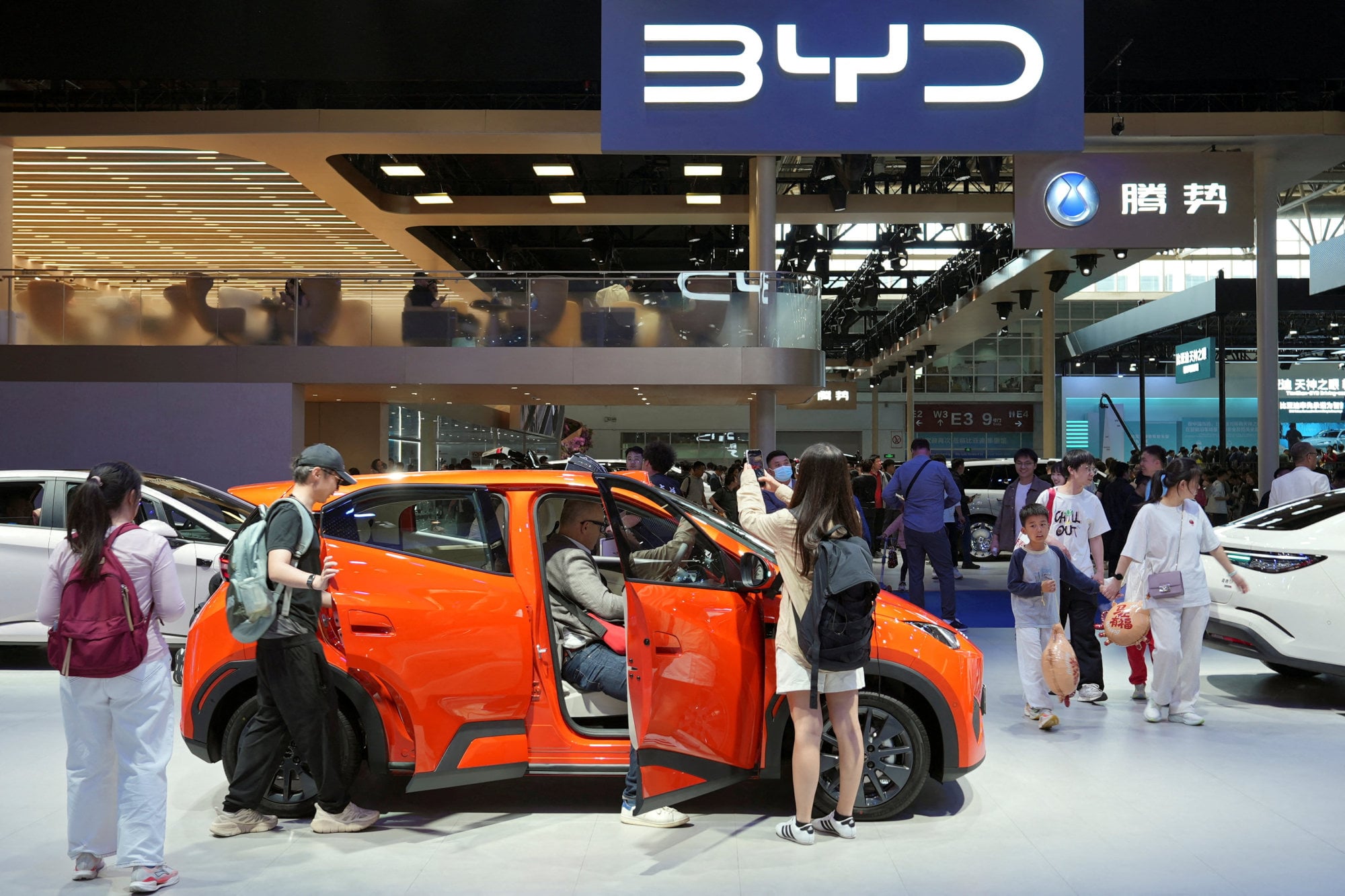
Among the most prominent additions were e-commerce giant Alibaba, search and AI company Baidu, electric vehicle manufacturers BYD and Nio, pharmaceutical research and manufacturing company WuXi AppTec, robot maker Unitree, networking equipment maker TP-Link and solar companies JA Solar and Trina Solar. The list also included battery makers CALB and EVE Energy, lidar firms Hesai and RoboSense, and display-panel manufacturer BOE Technology Group.
Alibaba owns the South China Morning Post. “There’s no basis to conclude that Alibaba should be placed on the Section 1260H List,” it said in an emailed response to the SCMP.
“Alibaba is not a Chinese military company nor part of any military-civil fusion strategy. We will take all available legal action against attempts to misrepresent our company.”
The Pentagon said the companies met statutory criteria for designation based on factors including alleged affiliations with Chinese state entities, military-civil fusion programmes, the People’s Liberation Army or government industrial initiatives.
Several companies were cited for participation in programmes such as China’s “Little Giant” or “Single Champion” schemes, which Washington increasingly views as supporting Beijing’s strategic technology ambitions.
The move marks a significant expansion of a list that has evolved from focusing largely on state-owned defence and telecommunications groups to encompassing a much wider range of commercial technology companies.
The latest additions underscore growing US concerns about China’s advances in sectors including artificial intelligence, biotechnology, electric vehicles, robotics, batteries, semiconductors and renewable energy.
One of the newly listed companies, WuXi AppTec, strongly disputed the designation and said it would challenge the Pentagon’s decision.
WuXi AppTec said it did not meet the statutory criteria for designation and rejected allegations that it was affiliated with China’s military, defence industrial base or military-civil fusion programmes.
“The alleged basis for our 1260H list designation is factually incorrect,” the company said, adding that it was an independent, publicly traded business serving customers in more than 30 countries.
Baidu also said the suggestion that it is a military company was similarly baseless. “We categorically reject the inclusion of Baidu,” a spokesperson said in an email. “We will not hesitate to use all options available to us to have the company removed from the list.”
China accuses US of extreme national security measures
The Chinese embassy in Washington said it “firmly opposes” Washington’s overstretched view of national security and use of “discriminatory lists”.
“Chinese companies that do business overseas have been strictly observing laws and regulations of their host countries,” embassy spokesman Liu Pengyu said. “The US should stop its wrong practice and create a fair, just and non-discriminatory environment.”
The US has often levelled similar accusations against China.
While significantly expanding the list, which now spans 20 pages, the Pentagon also removed 10 entities from the previous version issued earlier this year, including China International Information Services, China National Chemical Engineering, China Traffic Construction USA, two subsidiaries of state-owned energy giant CNOOC, Cosco Shipping Finance, Costar Group, Glarun Technology and Taiji Computer.
The US Defence Department did not provide detailed explanations for the removals in the public notice, but said companies may seek reconsideration and submit evidence that they no longer met the criteria for designation.
Analysts said this was a redo of an update issued by the Pentagon in February, which was withdrawn within hours to avoid undermining prospects for the approaching summit between Chinese President Xi Jinping and US President Donald Trump, set for March and subsequently rescheduled for last month.
Monday thus mirrors its earlier withdrawn counterpart, except for the addition of top Chinese memory chipmakers ChangXin Memory Technologies, Yangtze Memory Technologies and a handful of others.
“It looks like it’s essentially the same list, with a few tweaks,” said Bonnie Glaser, managing director with the German Marshall Fund of the United States. “The administration is trying to continue some of these competitive measures introduced by the Biden administration. Trump probably doesn’t want to be seen as weak.”
With another Xi-Trump summit potentially scheduled for September in Washington, however, a key calculation for the White House is how hard it can push China – with blacklists, export controls, and any additional round of Taiwan arms sales – without angering Beijing to the point that it cancels the September summit.
“The question is, do they accurately predict Beijing’s reaction?” Glaser added. “The question is, what can they get away with?”
The Pentagon’s latest update follows a series of increasingly high-profile additions in recent years.
In the previous version of the list issued in January 2025, attention was attracted for adding Tencent Holdings, battery giant Contemporary Amperex Technology Ltd (CATL), and memory chipmaker ChangXin Memory Technologies, among others, as Washington intensified scrutiny of Chinese firms perceived to have links to Beijing’s military-industrial ecosystem.
Under the law, the Defence Department must update the list at least annually through 2030. Companies on the list can seek reconsideration and submit evidence to challenge the basis for their designation.
The Pentagon’s 1260H list is one of several maintained by the US as the two giants devise and hone tools to partially decouple in strategic areas. In addition, the Commerce Department maintains an “Entity List”. And the US Treasury Department has its OFAC Sanctions & NS-CMIC List.
Beijing responds with its own ‘Unreliable Entity List’
Faced with growing US restrictions and lists, China has responded with its own “Unreliable Entity List”, managed by the Ministry of Commerce. It also has added provisions aimed at countering foreign sanctions.
This allows Chinese courts and companies to sue overseas multinational corporations for damages if they comply with US export controls deemed harmful to Chinese commercial interests.
Last month, Beijing enacted the blocking measure for the first time formally after US sanctions targeted five Chinese oil refineries involved in importing and processing Iranian crude oil. While the move was unlikely to have any immediate effect – the refineries have limited exposure to US firms and the dollar system – analysts said it signalled that Beijing was taking a more assertive approach to countering sanctions.
“By activating its blocking measures for the first time since adopting the rule in 2021, China is demonstrating a lower threshold for deploying its legal and regulatory toolkit to counter US sanctions,” Eurasia Group said in a report. “Over time, this will increase the likelihood that firms face binary choices between complying with US sanctions and risking Chinese countermeasures.” -- SOUTH CHINA MORNING POST


