




China’s top diplomat said on Monday that Beijing and Brasilia should “jointly repel external challenges”, as the two countries opened a high-level strategic dialogue in Beijing.
Foreign Minister Wang Yi made the remark during a visit by his Brazilian counterpart, Mauro Vieira, who arrived in the Chinese capital this weekend for the fifth Global Strategic Dialogue between the two governments.
“Practical cooperation in all areas has been steadily enhanced, and the two peoples have never been so close,” Wang said. He added that Beijing supported Brazil in safeguarding its national sovereignty.
The dialogue, a political coordination mechanism, runs until Tuesday. The previous round was held in Brasilia in January 2024.
Vieira and Wang co-chaired the talks at the Diaoyutai State Guesthouse, one of the main venues of Chinese diplomacy. The session followed separate meetings with Vice-President Han Zheng and Commerce Minister Wang Wentao.
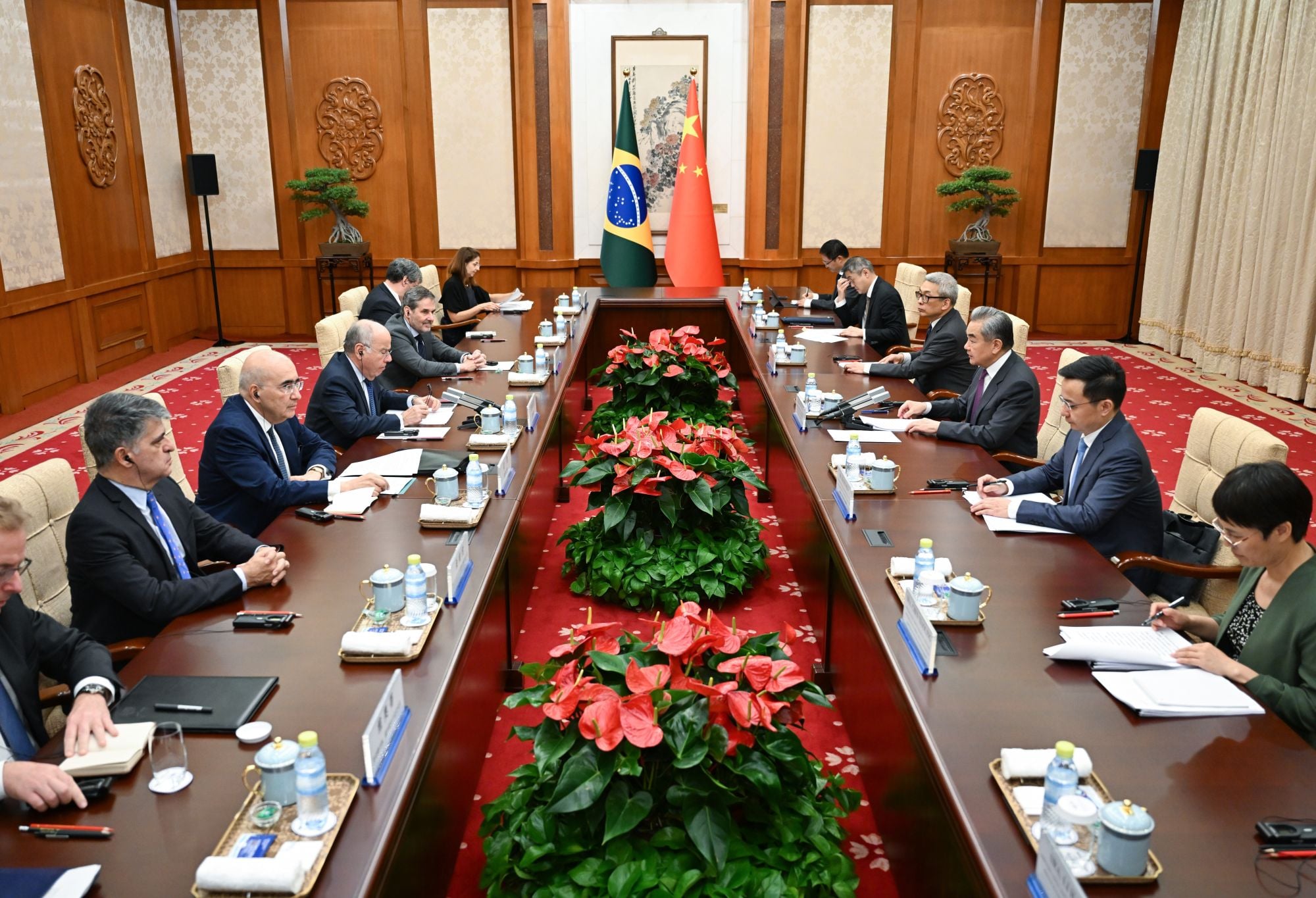
Wang Yi said the partnership had “solid foundations” and extended beyond trade into technology and innovation.
He said both countries had “shown responsibility in defending the interests of the Global South and multilateralism”, and also thanked Brazil for its commitment to the One China principle.
The Chinese minister also pointed to preparations for the China-Brazil Cultural Year, which spans 2026, and said Beijing wanted to deepen cooperation with Latin America, with Brazil as a leading regional partner.
Vieira described the relationship as structural rather than episodic. He said the partnership had “developed significantly in recent years, becoming a close and fundamental partnership in Brazil’s international relations”.
He said the pace of contact between the two presidents pointed to a deeper trust. “The regularity of contacts between our presidents, with three state visits in three years, illustrates the highest level of confidence and mutual respect between our countries,” Viera said, referring to Brazil’s President Luiz Inacio Lula da Silva.
The Brazilian minister said multilateralism was under unprecedented attack. In that context, he said, the joint construction of a community with a shared future was “more relevant than ever amid the current international turbulence”.
Fertiliser supply tops economic agenda
The trip carried an urgent commercial purpose, with Brazil seeking to secure fertiliser supplies disrupted by the conflict between the United States and Iran.
China is one of Brazil’s biggest suppliers of the input, but Beijing restricted fertiliser exports in March after Iran closed the Strait of Hormuz, squeezing a sector central to Brazilian agriculture.
Brazilian Foreign Ministry officials said Vieira had been discussing solutions with trading partners to help the farm sector.
Last week, he met with industry representatives in Sao Paulo at the Federation of Industries of the State of Sao Paulo (Fiesp) to hear their concerns. Two weeks earlier, the minister travelled to Kazakhstan and Uzbekistan, both fertiliser producers, in search of alternative sources.
The visit also comes days after US President Donald Trump’s administration classified two Brazilian criminal groups, the PCC and the CV, as terrorist organisations, a move that ran counter to Lula’s position.
Trade ties, global governance to the fore
Vieira met Wang Wentao to discuss the economic relationship, which now exceeds US$160 billion a year.
The two sides also addressed reform of the World Trade Organization, a body weakened in recent years by unilateral US tariff measures. China’s chief trade negotiator, Li Chenggang, attended the talks.
Bilateral trade reached US$170.9 billion in 2025, a record for the tenth consecutive year, according to Brazil’s Ministry of Foreign Affairs. Brazil recorded a surplus of about US$29 billion, driven by farm exports.
The countries are founding members of Brics and its development bank, the NDB, based in Shanghai and headed by former Brazilian president Dilma Rousseff.
Receiving Vieira at the Great Hall of the People, Han said the meeting should open “a new phase of strategic cooperation between China and Brazil”. He added that the talks aimed to “implement the important consensus reached by the heads of state of the two countries”.
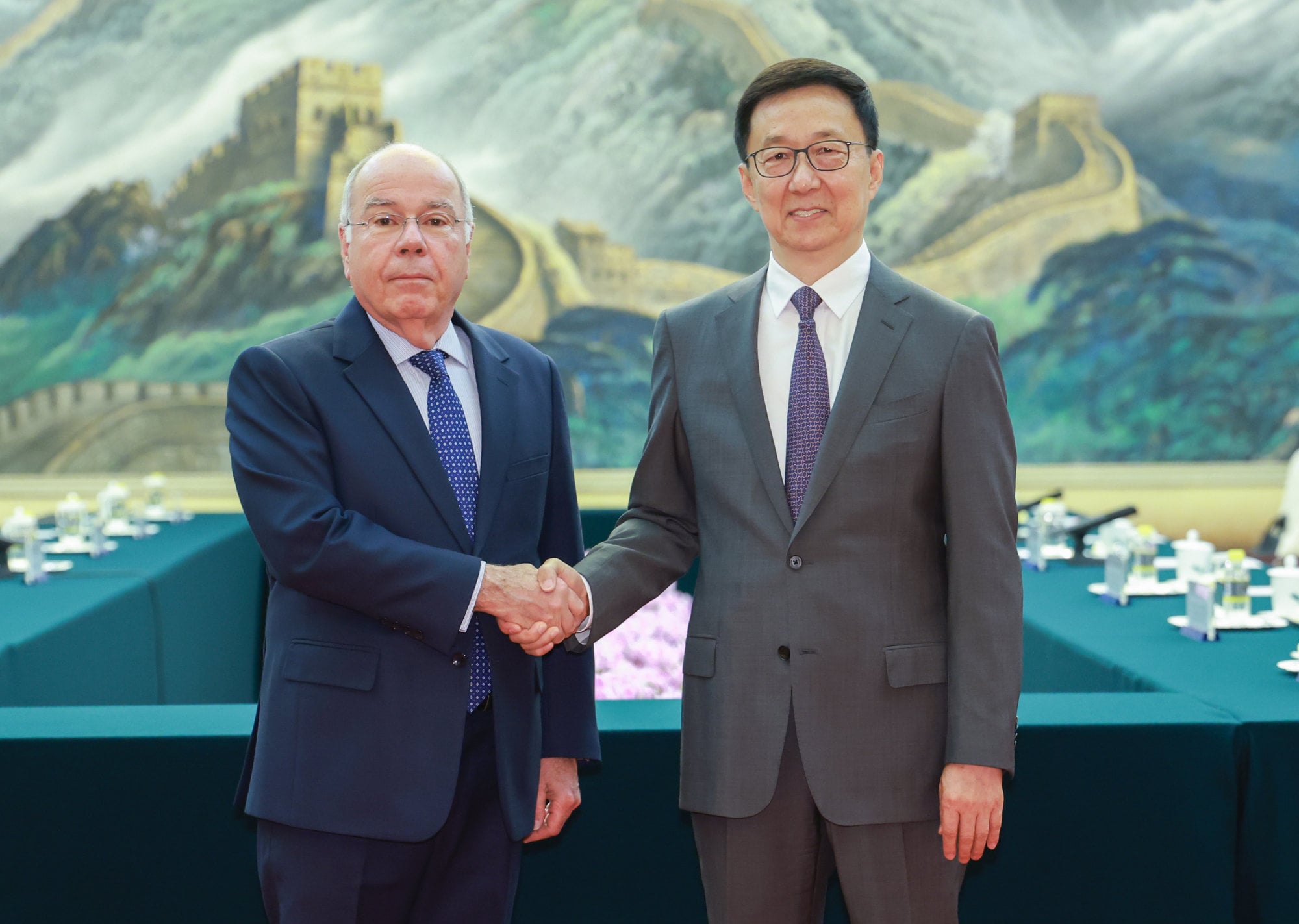
Han said both sides “should make better use of existing mechanisms to raise the technological content and added value of their ties”.
Vieira renewed an invitation, first made by Vice-President Geraldo Alckmin, for Han to visit Brazil. The trip would coincide with the eighth meeting of the China-Brazil high-level coordination commission, known as Cosban, planned for later this year.
Before reaching Beijing, Vieira stopped in Paris to meet Michelle Bachelet, the former Chilean president and a candidate for UN secretary general.
Supported by Brazil and Mexico, Bachelet faces resistance from China over a report she signed in 2021 while serving as UN High Commissioner for Human Rights.
At the time, she said that Beijing was potentially committing violations of the rights of the Uygur ethnic minority in Xinjiang, which angered Beijing. -- SOUTH CHINA MORNING POST


