
Chinese robotics companies lack both sufficient data and a good “brain” to improve the interaction of their products with the physical world, according to industry insiders at the World Artificial Intelligence Conference (WAIC), which concluded on July 20 in Shanghai.
The most critical challenge for the embodied AI industry was to “link hardware, data, models and real-world scenarios into a closed-loop iterative system”, said Wang Xiaogang, co-founder of SenseTime and chairman of its robotics spin-off Ace Robotics, in an interview with the South China Morning Post on July 18.
Currently, a vast amount of training data is collected from human demonstrations. But for that data to effectively translate into better embodied AIs, hardware design for robots must be jointly optimised alongside data-collection methods and physical structure, according to Wang.
He added that robot deployment across real-world scenarios, where data originated, remained too limited.
“The key question is how to unlock these scenarios and replicate them at scale,” he said.
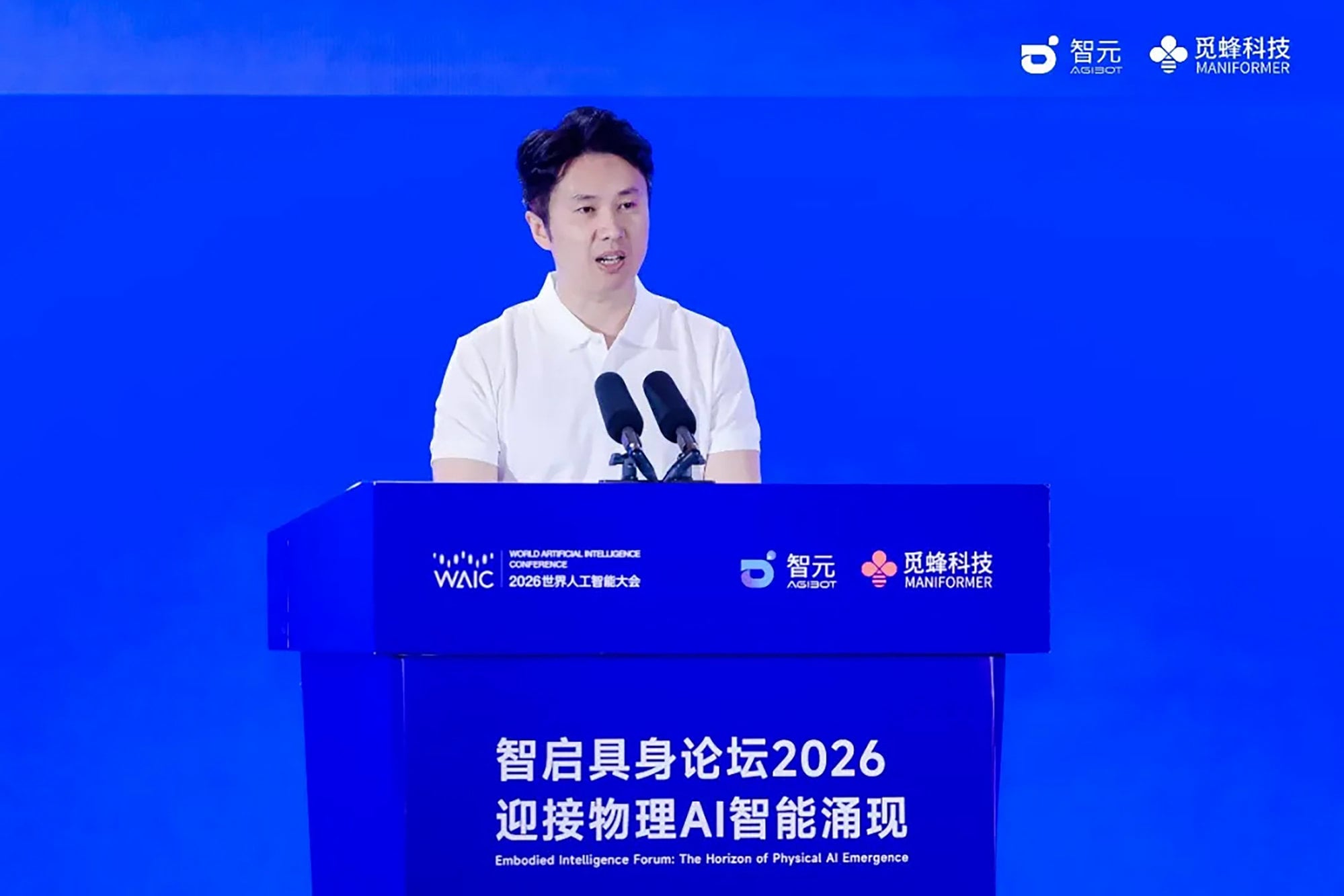
The amount of available multi-modal data about the physical world was far from adequate, compared with that used in large language models, according to Yao Maoqing, partner and senior vice-president of Shanghai-based humanoid robot maker AgiBot. This created one of the bottlenecks in the current training of the so-called world models that were expected to allow next-generation humanoid robots to model and navigate their surroundings, he said.
“The development of embodied intelligence also needs to draw on how humans think, integrating insights from cognitive science, neuroscience and other disciplines, rather than relying solely on large-scale data training,” said Zhang Zhengyou, chief scientist of Tencent Holdings and director of the firm’s Robotics X Lab, in an interview with SCMP.
Another challenge was a gap between the video content fed to robots and the real-world data that they actually need, Yao said in a panel discussion at WAIC on July 17.
Other experts pointed out a weak link between the brains and the bodies of humanoid robots in physical environments.
“The smartest AI of today is, at its core, still a ‘brain in a tank’,” said Zhang. “We cannot rely solely on an intelligence that can merely talk. True intelligence emerges when language, vision, spatial understanding, physical control and environmental feedback work together.”
Chinese firms from tech giants to start-ups have been racing to break through bottlenecks in the fast-growing robotics sector, which is pushing for mass production and accelerated commercialisation through wider adoption across various industries this year.
Ace Robotics introduced its action-oriented world model Kairos 3.1 during the conference, as the company aimed to unify generative, physical and cognitive intelligence rather than developing those capabilities separately.
“By combining these capabilities in one model, we can achieve exceptionally high efficiency, as it enables self-reflection and self-evolution,” Ace Robotics’ Wang told the SCMP. “When the model makes a mistake, it understands why it failed and knows what corrective steps to take next, creating a true closed loop.”
Tencent, meanwhile, released a suite of embodied AI offerings designed to connect a robot’s perception, reasoning and movement. The line-up includes Hy-Embodied-VLM-1.0 for understanding its surroundings, Hy-Embodied-RxBrain-1.0 for reasoning and planning, and Hy-Embodied-VLA-0.5 for translating plans into physical actions.
Tencent also introduced Apexio, an always-on embodied agent, and TairosAgent, a framework for coordinating models, skills and hardware across different robots.
“What RxBrain aims to do is to bring together the ability to ‘reason’ and the ability to ‘imagine’,” Tencent’s Zhang said.
The embodied AI models were part of Tencent’s full-stack embodied intelligence solution, which it said spanned from cloud infrastructure to models, platforms and applications.
Tencent has always focused on connections “between people [today], and in the future between people and robots, as well as among robots themselves”, Zhang said. – South China Morning Post