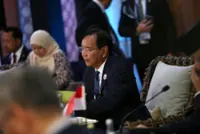
BANGKOK: Thailand’s foreign minister says Cambodia’s move to seek Unclos compulsory conciliation over maritime claims could undermine efforts to restore relations and discuss border security.
Sihasak Phuangketkeow (pic), deputy prime minister and foreign minister, who has just arrived in Paris, France, to attend the OECD Ministerial Council Meeting 2026 (MCM), gave an interview on Tuesday (June 2) about Cambodian Prime Minister Hun Manet’s letter to Thailand and the United Nations secretary-general to begin compulsory conciliation proceedings under the 1982 United Nations Convention on the Law of the Sea (Unclos).
Sihasak said Cambodia had announced that it would begin compulsory conciliation with Thailand over overlapping maritime claims. However, Thailand still viewed Cambodia’s decision as one that would not genuinely help resolve the problem.
He said many of Cambodia’s claims in its statements were inconsistent with the facts. Thailand had terminated the 2001 MoU because there had been no progress under the agreement for more than 20 years for various known reasons. Thailand’s real intention in ending the MoU was to restart negotiations on the overlapping maritime area on a fresh basis.
Cambodia, however, had claimed that Thailand terminated the MoU because it did not intend to comply with its obligations. Sihasak said that was not the case.
He said both sides had to accept the reality that the 2001 MoU had produced no progress. Since both countries are parties to Unclos, Thailand believed they should negotiate under the Unclos framework and first give bilateral talks a chance.
If those talks failed, both sides could then agree to move towards other mechanisms, ranging from voluntary conciliation, where the two countries could discuss the matter and set up a conciliation panel, to compulsory conciliation. However, he stressed that direct negotiations should be given an opportunity first.
Sihasak said compulsory conciliation takes time. In the case of Timor-Leste and Australia, the process took nearly two years.
“That means for another two years, we will not be able to delimit the maritime boundary or jointly develop the overlapping area. So why not try negotiations first? If we try, we may be able to reach an agreement sooner,” he said.
He added that Cambodia’s intention was therefore questionable, as it appeared to want to set its own conditions and create an advantage for itself.
“What I want to say is that this does not lead to a solution. Since Cambodia has decided to take this path, it must also be responsible for that decision,” Sihasak said.
He said Cambodia was refusing to allow talks on maritime boundaries, while at the same time wanting to restore relations, discuss border security and address land-boundary issues.
“If we are sincere with each other, we should be ready to begin talks to build trust. But Cambodia has started in this way, so it is unavoidable that this will affect talks on restoring relations, border security and the beginning of discussions on boundary issues. What Cambodia has decided to do runs counter to what it has been asking of Thailand,” he said.
“We are ready to respond, but there must be sincerity. This is Thailand’s position. We genuinely intend to negotiate to resolve the problems because these issues are not easy to solve.
“If Cambodia talks about resolving problems by peaceful means, then the true peaceful way is dialogue between neighbouring countries. We should look for a way forward. If we cannot find one, then we can move to other available mechanisms. I therefore do not understand whether Cambodia’s intention in moving towards compulsory conciliation is truly aimed at solving the problem,” he said.
Sihasak said Thailand was already prepared, as it had expected Cambodia might take this route.
Thailand had been preparing for some time for what it would do if Cambodia chose this path, including who Thailand’s conciliator should be and who would have the necessary qualifications and expertise.
He said that, in addition to attending the OECD meeting, he would also meet Thailand’s French legal adviser to discuss preparations and possible scenarios.
Thailand’s position, he said, was based on the understanding reached when the prime ministers of both countries met during the Asean summit in Cebu, the Philippines, where both sides spoke of sincerity in resolving issues through dialogue and building mutual trust.
At that time, Thailand’s prime minister had already discussed the 2001 MoU with the Cambodian prime minister and explained Thailand’s intention. Thailand did not cancel the MoU suddenly, Sihasak said. It cancelled it to restart negotiations and give talks between the two countries a chance to move forward.
“Now it can be seen that Cambodia has closed the door on many things, including talks on maritime boundaries. If it goes to the compulsory conciliation mechanism, Thailand is ready. We are not shaken.
“But Cambodia has also closed the door on talks on other issues that it wants to see progress on. This is its decision, and it must be responsible for that decision,” Sihasak said.
He added that when he travelled to the United Nations in New York, he held talks with Prak Sokhonn, Cambodia’s deputy prime minister and foreign minister. Sihasak said he had asked why both sides could not first try holding talks. If talks truly failed, then other mechanisms could be used.
If talks took place, both countries could also discuss other matters of importance to Cambodia. But Cambodia’s current route was, in effect, closing the door.
“When we talk about peaceful means, dialogue is the best peaceful method. But by choosing this path, Cambodia is closing the door to discussions on other matters. Its sincerity and its efforts to cooperate are not consistent with what it has said,” he said.
Asked whether this meant Cambodia had closed the door on talks through the Thai-Cambodian Joint Boundary Commission (JBC), Sihasak said Cambodia wanted talks because the two countries had conflicts and clashes that had caused losses.
Resolving these problems and the issues arising from the clashes required discussion, he said. The issue was not only boundary demarcation under the JBC mechanism, but also border security.
He said that if Cambodia claimed Thailand had violated the ceasefire agreement, the joint statement clearly stated that both sides should maintain their positions as of the ceasefire date, and Thailand had kept its troops in the same positions.
“These matters cannot be resolved simply by asserting rights. They must be addressed gradually through talks because they have their background. This is certainly not just about boundary demarcation. It is about border security and building trust,” he said.
Sihasak said this was Thailand’s realistic position. Thailand had no intention of playing games with Cambodia. Instead, he said, it seemed Cambodia was treating the matter as a game with winners and losers, or perhaps for domestic political purposes.
Thailand’s position, he said, was to look to the future. Moving forward would not be easy. It required effort and a good atmosphere. Cambodia needed to realise that its chosen path would inevitably have effects in other areas because there was no trust, and trust was essential for solving Thai-Cambodian problems.
Sihasak said Cambodia could have informed Thailand directly and discussed what each side would do under the relevant mechanisms. Instead, Cambodia chose to announce the matter to the world and to the diplomatic corps, seeking to gain an advantage and present itself as the legitimate side taking the initiative.
He said this had long been Cambodia’s approach. On one hand, Cambodia said it wanted to restore relations. On the other, it continued to take action on international platforms without end.
“We have to ask when these things will end. When will we stop playing games?” he said.
He acknowledged that this would not be easy and that Thai people understood it could not happen immediately. If Cambodia had genuine intent, it would not act in the way it was doing now.
Cambodia claimed that peaceful means were the best approach, but Sihasak said he questioned Cambodia’s intentions.
“If Cambodia goes down this path, we will go all the way. Please have confidence in the government and in the Foreign Ministry’s actions. We are ready.
“If Cambodia comes this way, we are confident in what we will present and confident in our ability to protect Thailand’s interests,” he said.
Sihasak said that even if the compulsory conciliation process took place, the final finding would not be legally binding. It could become a basis for both countries to continue negotiations.
The question, he said, was whether the process would provide a complete solution. In the end, each country would have the right to accept or reject the outcome, and the two sides might still need to continue talks based on the findings of the compulsory conciliation.
“So why don’t we talk first and see whether we can make any progress before entering these mechanisms?” he said.
Reporters said Sihasak had decided to cut short his trip to the OECD meeting by one day and return to Thailand earlier than originally scheduled.
He is expected to arrive in Thailand on the morning of June 5 to brief foreign diplomats in Thailand following the Cambodian leader’s statement. He is also expected to hold an official press conference afterwards. - The Nation/ANN