




As the war in Iran disrupts global oil and chemical supplies, China’s coal-heavy energy sector is seizing an unprecedented opportunity. In the first of a two-part series, Dannie Peng visits the Changji Hui autonomous prefecture in Xinjiang – one of the country’s four major bases for large-scale, modern coal-chemical production – to see first-hand how a vast industrial ecosystem is rapidly taking shape.
A four-hour drive northeast of Urumqi, the regional capital of Xinjiang, leads to a colossal open-pit mine. There, a fleet of electric, autonomous mining trucks moves with silent, clockwork precision, self-navigating the terrain and hauling mountains of overburden to distant stockpiles.
This is one scene in a larger transformation unfolding across the Gobi Desert. In China’s far west, futuristic and green technologies are modernising coal mining and maximising the resource’s potential through chemical processing.
The scale of the infrastructure is immense. The world’s highest-voltage power line already carries electricity from the region to eastern China, while work is under way on the country’s biggest pipeline to transport coal-derived natural gas from northern Xinjiang to developed eastern cities.
The Zhundong National Economic and Technological Development Zone sits upon coal reserves that – by weight – far surpass the oil riches of the Persian Gulf. A giant national energy and chemical hub is rapidly taking shape.
The zone, situated on the southeastern edge of the Junggar Basin in Xinjiang’s Changji Hui autonomous prefecture, is a gargantuan undertaking. Spanning three counties and covering a planned 15,500 sq km (5,984 square miles), the zone stretches 220km (137 miles) from east to west, carving a massive industrial footprint into the arid landscape.
Comprising five mining areas, it houses China’s biggest contiguous coalfield. With estimated reserves of 390 billion tonnes – accounting for 7 per cent of the national total – it is frequently cited as being capable of sustaining China’s immense energy appetite for a century.
By comparison, data from the Opec Annual Statistical Bulletin for 2025 indicates that the total proven oil reserves of key Persian Gulf nations amount to around 117 billion tonnes, when calculated using global crude oil conversion standards.
As the conflict in Iran disrupts the global supply of oil, gas and downstream chemicals, the local government of Xinjiang is accelerating the development of a fully integrated, low-carbon coal-to-chemicals production chain using cutting-edge technology in the remote interior of the country.
The move is expected to bolster China’s energy self-reliance and security, leveraging its unique natural energy advantages and the ability to rapidly mobilise resources for investment and construction.
In this ambitious development blueprint, large-scale collieries are taking the lead in pushing for advanced electrification and automation to reduce reliance on diesel.
Most of the coal extracted is then transported to a nearby power or chemical plant – where it is either turned into electricity to fuel downstream metallurgy or used directly as feedstock for manufacturing a wide range of basic and high-end chemicals.
While the zone received national approval in 2012, its true metamorphosis has occurred over the past few years, according to Liu Hao, a veteran in local coal logistics with extensive connections to power and chemical plants.
According to Liu, as major heavy industrial plants were built in rapid succession, numerous new job opportunities, shops and residential districts gradually emerged. One example is Wucaiwan.
Five years ago, it was little more than a dusty site dotted with rudimentary shelters.
Today, it is a new town spanning 1,800 sq km, undergoing rapid urbanisation born of energy development. It is home to the zone’s management committee and a general airport is set to open there in May.
Dozens of enormous power stations and coal-chemical complexes line its main arteries, standing as monuments to the area’s administrative and economic importance.
“Although Xinjiang possesses abundant coal reserves and its output has risen significantly in recent years, its remote location and limited rail infrastructure have constrained exports,” said Kevin Tu, managing director of Agora Energy China, a Beijing-based energy and climate research organisation.
“As a result, local governments have opted to convert coal on site into power or chemical products.”
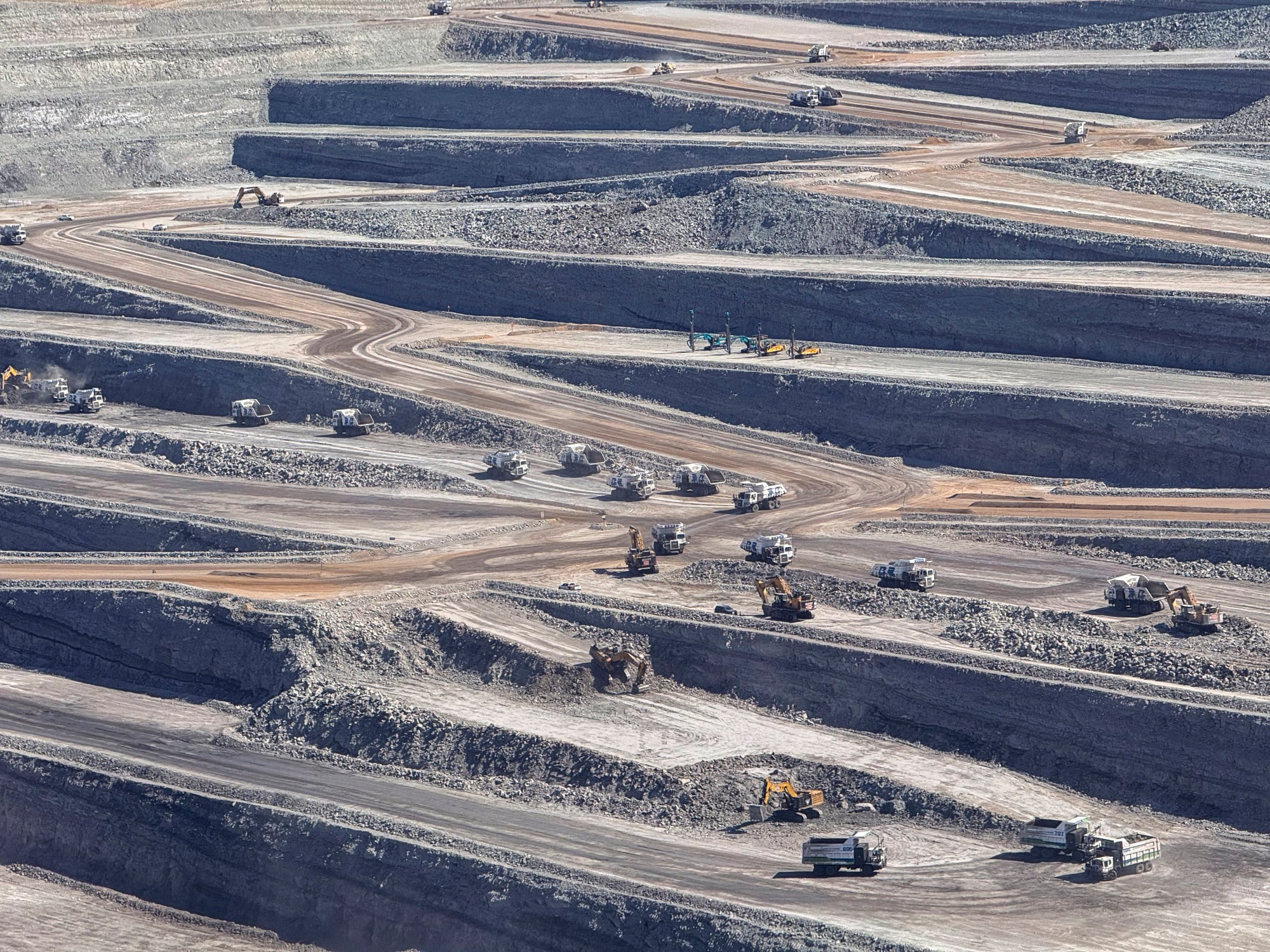
A vast open-pit mine, which has one of the highest production capacities not only in Xinjiang but in all of China, is surrounded by endless barren salt flats, with virtually no other buildings or supporting facilities nearby.
It is also largely shielded from fluctuations in international oil prices, thanks to the electrification of mining operations.
On a late April afternoon, the air was – as usual – thick with dust that swirled across the open coalfield. While mining activity was frantic, few people were visible; instead, electric autonomous mining trucks from various manufacturers came and went, transporting overburden from the site to designated stockpile areas.
These vehicles scan site maps for routes daily and head to battery-swapping stations whenever their charge dips below 30 per cent. Robotic arms there replace depleted, container-sized batteries in six minutes, with one new battery sustaining three hours of work.
Since August last year, this coalfield has deployed nearly 300 such trucks for haulage. One key supplier, Shanghai-headquartered Boonray Intelligent Technology – a leading Chinese provider of electric and autonomous mining technology – has a fleet of 120 trucks operating here.
An engineer surnamed Zhang overseeing the Boonray fleet said that although these autonomous trucks could not yet match the efficiency of traditional manned diesel versions, they needed far fewer staff to operate – with just four people in the control centre managing the entire fleet.
Moreover, these vehicles are powered by electricity generated by the mine’s own power plant.
He said the mine had every incentive to pursue this technological transition, given the benefits to worker safety, cost-effectiveness and environmental protection.
The shift is systemic. Roughly 70 per cent of the site’s equipment is now electrified, with a target of 90 per cent by the end of the year. This “intelligent mining” involves more than just hardware, according to Zhang, it is also supported by real-time monitoring and sophisticated information technology infrastructure.
Nearby, further projects for coal-to-formaldehyde and natural gas are already breaking ground.
In fact, within this Zhundong energy zone, 17 approved coal mining projects have a combined annual production capacity of more than 400 million tonnes. Yet, due to the long distances and high costs involved in transporting coal to other regions, the strategy has shifted towards on-site processing.
An industry map drawn by a local management committee in April last year revealed a dense cluster of industrial enterprises in the zone along major mining areas.
These cover the entire industrial chain from upstream mining to downstream sectors such as coal-fired power generation, coal-based chemical processing and advanced materials manufacturing, thereby creating a high-value-added industrial loop.
To the north of Wucaiwan, there are more than a dozen medium- and large-scale coal-fired power plants owned by leading enterprises in China’s power sector, such as the State Energy Group and State Power Investment Corporation.
After coal is converted into electricity here, a portion is destined for more than 3,300km towards the east via the Zhundong-Wannan line.
In September 2019, the power line – the world’s first ±1,100 kilovolt ultra-high-voltage direct current link, dubbed the “Everest of electricity” – began operations as the second “Xinjiang power export” corridor.
Starting in Changji and ending in Anhui province, it features the highest voltage level, largest transmission capacity and longest transmission distance in the world. The electricity it has delivered is said to be enough to meet the annual household needs of 133 million families.
A large proportion of the electricity is instead used to power nearby energy-intensive metallurgical and new material sectors. This includes the production of aluminium, a material widely used in aircraft, car parts, building frames and cables, as well as polysilicon, a high-purity polycrystalline form of silicon used as a raw material in the solar photovoltaic and electronics industries.
The four major aluminium producers in the zone, including the Sichuan Qiya Aluminium Industry Group, have a combined annual production capacity of almost 3 million tonnes – accounting for over 6.5 per cent of the national total.
“Selling raw coal is not a good business,” logistics veteran Liu said. “A tonne of coal sells for just over 400 yuan (US$59), whereas the market price for a tonne of aluminium can reach around 10,000 yuan.”
A significant amount of coal skips power generation entirely for the chemical industry, serving as raw material for urea, melamine, coal-to-olefins, coal-based methanol and other products.
A typical example is Xinjiang Yihua Chemical Co. Due to the high alkali metal content of local coal, the gasification process is highly corrosive. To address this, the company worked with institutions such as the Institute of Engineering Thermophysics at the Chinese Academy of Sciences in Beijing to overcome technical challenges, streamline production and reduce pollutants in syngas and waste water.
Clean-energy conversion is the final integral piece of Zhundong’s industrial puzzle. In 2025, National Energy, Tianchi Energy and other companies broke ground on coal-to-gas projects, reaching a capacity of six billion cubic metres per year – reportedly equivalent to the total output of all similar projects operating across the country.
Construction of the Zhundong gas trunk pipeline, the largest outbound pipeline for China’s coal-to-gas production base, also began last September. The 780km pipeline runs from the Jiji Lake station in Changji to Hami, a prefecture-level city in eastern Xinjiang, where it joins China’s West-to-East Gas Pipeline.
The South China Morning Post approached local authorities for further details, but the request was declined on the grounds that the subject was “sensitive”.
A local official highlighted that the zone served as a national energy base and that, as the matter involved national security, they were not authorised to speak to the media.
But an official investment promotion document of the zone seen by the SCMP indicated that future priorities would lie in developing modern coal chemicals, aluminium- and silicon-based advanced materials, high-end equipment manufacturing and hydrogen production.
However, Tu, from Agora Energy China, cautioned that Xinjiang’s environmental carrying capacity – particularly the scarcity of water resources in its desert regions – posed a major constraint that could not be resolved through technological means alone.
He stressed that energy development in the region should proceed with greater caution, rather than prioritising rapid, large-scale expansion. -- SOUTH CHINA MORNING POST



