



GALELA, North Halmahera (The Straits Times/ANN): Two missing Singaporean hikers were confirmed dead in the eruption of Indonesia’s Mount Dukono, the head of the local search and rescue agency told The Straits Times on May 10.
Iwan Ramdani, head of the Ternate search and rescue office, confirmed the news to ST and said the two hikers’ bodies were found about 50m from the summit. He added that the bodies had been retrieved and were being taken down the mountain.
Risman Umar, a resident who took part in the rescue operation, told ST before the bodies were retrieved: “Both victims were buried under the debris. Two large boulders are pinning and crushing their bodies.
“They were first found by the rescue team at about 12.40 pm. Half of their bodies were buried under volcanic ash. The evacuation could not be carried out because of heavy rain, which made the volcanic material unstable and prone to landslides.”
In footage seen by ST, Indonesian rescuers are working on a steep slope of black volcanic ash near the summit as rain and mist cover the mountain.
Soldiers, police officers and local volunteers gather around a narrow hole in the ash where the two hikers are believed to be buried. Some dig by hand, while others stand nearby on the slippery slope.
The two Singaporeans were part of a group of 20 – nine Singaporeans and 11 Indonesians – who trekked on May 7 despite a climbing ban imposed by the local authorities on April 17 and a standing 4km no-go exclusion zone around the crater.
The two hikers had not been seen since Mount Dukono erupted on the morning of May 8, showering climbers near the summit with hot rocks, ash and volcanic debris. An Indonesian woman was found dead on May 9. The rest of the trekkers were evacuated from the volcano.
Singapore’s Ministry of Foreign Affairs said in a statement on May 9 that seven Singaporeans who were evacuated were on their way to Jakarta and expected to return to Singapore on May 10.
The recovery effort on May 10 was fraught with difficulty from the outset.
The first obstacle came long before rescuers could reach the crater of one of Indonesia’s most volatile volcanoes.
Just after dawn, the joint Indonesian search-and-rescue team set out once again for Mount Dukono to locate the two missing hikers.
But heavy rain overnight had turned the narrow dirt road leading to the mountain into deep mud.
From the main volcano monitoring post in Mamuya village, it is about 10km to the first observation post at the foot of Mount Dukono. The route cuts through dense forest and plantations, and large sections are accessible only by rough dirt tracks.
On the morning of May 10, even that journey proved difficult, as ST found. About 5km from Mamuya, the motorcycle that an ST journalist was on was forced to turn back after the road became impassable because of flooding and thick mud left by the rain.
Higher up the mountain, conditions were no better.
“The rescue team has reached Post 5, which is around 1km from the crater, but they have turned back a little towards the shelter because it is raining and flooding up there,” said Mochamad Thilio, a Tobelo officer from Indonesia’s Brimob police mobile brigade who was coordinating communications with the team.
Two small mounds of volcanic sand near the crater of Indonesia’s Mount Dukono, just 3m from where an Indonesian woman was found dead, became the focus of recovery efforts.
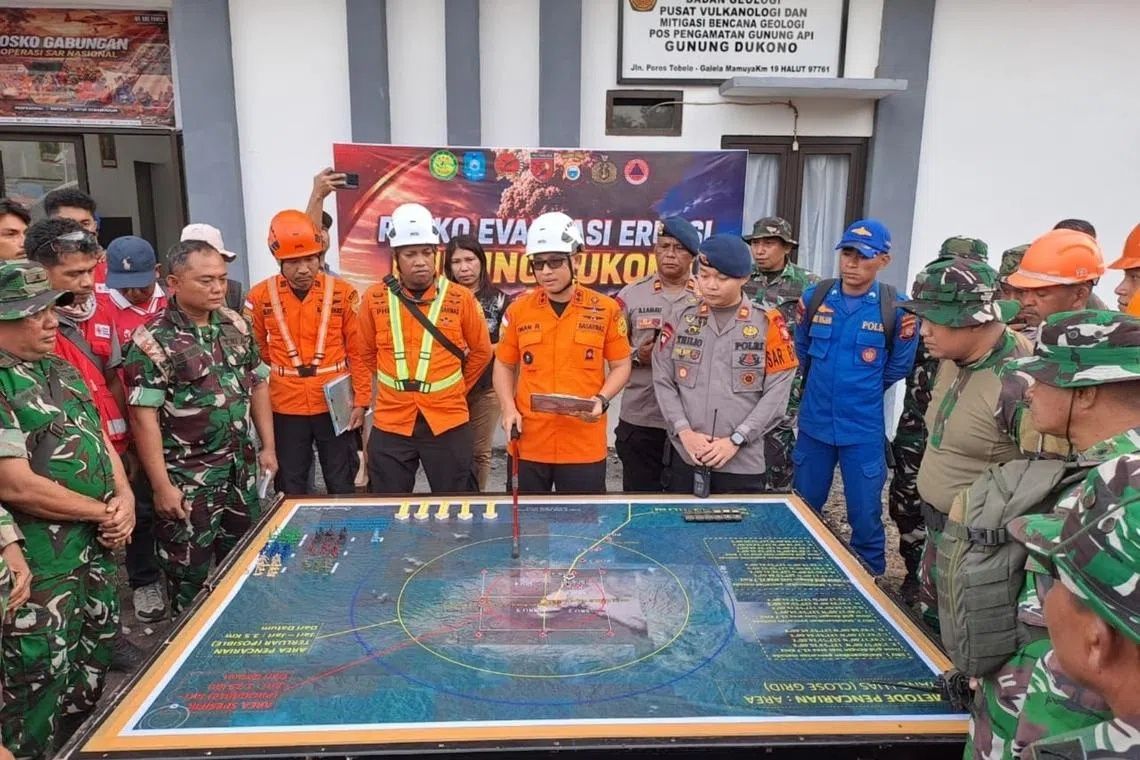
Indonesia’s search and rescue agency, Basarnas, said on May 10 that 150 personnel had been deployed, divided into four search-and-rescue units, to comb an area extending about 1.25km from the point where the hikers were last seen.
In a briefing before the search resumed, Iwan said the operation on May 10 was focused on the area around the crater rim.
“We hope the two foreign nationals can be found on the third day of this operation,” he said.
Iwan said rescuers were working under dangerous conditions as the volcano continued to erupt intermittently.
“The safety of the rescue team remains the priority because weather conditions and volcanic activity continue to produce hot ash and other material,” he said.
Members of a joint rescue team found the Indonesian woman at about 2.30pm local time on May 9, around 50m from the rim of the crater.
Heavy rain had forced rescuers to stop work and take shelter after hours of combing through deep volcanic sand. When the rain eased, only the lower half of the woman’s body, from her feet to her waist, was visible above the ash.
Her remains were recovered and taken to the eruption command post before being transferred to a hospital in Tobelo.
With daylight fading and volcanic activity still high, the team decided to suspend further work.
Footage released by the agency showed more than a dozen Indonesian rescuers moving in single file through dense mountain forest, their orange helmets and uniforms standing out against giant ferns and moss-covered trees.
On the narrow and muddy trail, they stepped carefully over fallen logs and slick volcanic soil as they carried the victim on a stretcher down the mountain slopes.
The scene underscored the immense difficulty of the operation to recover the victims of the eruption of Mount Dukono, an active volcano on the remote island of Halmahera in eastern Indonesia. -- The Straits Times/Asia News Network

