A trial of a US citizen of Chinese descent accused of creating a covert police station in Manhattan opened on Wednesday, considering evidence of what the US government says is part of Beijing’s bid to expand its influence well beyond Chinese shores.
Lu Jianwang, 64, faces three charges in the US Eastern District Court of New York: acting as an unauthorised agent of China; conspiracy to act as a foreign agent; and obstruction of justice. He is accused of using the fourth floor of a building in Manhattan’s Chinatown to monitor and harass overseas Chinese, using the room as an unauthorised police station. Lu has pleaded not guilty.
A co-defendant in the case, Chen Jinping, pleaded guilty to working as an unauthorised agent for China in December 2024. He has not yet been sentenced.
Testifying for the US Government on the trial’s first day, Julian Ku, a Hofstra Law professor in international law, outlined to the court the functions and operations of China’s United Front Work Department, the Ministry of Public Security (MPS), the Ministry of State Security (MSS), the Chinese People’s Political Consultative Conference and its Fujian affiliate.
China’s MPS, using overseas affiliates, attempts to identify “friends and allies” who are “favourably inclined” towards the Chinese government and Communist Party,” Ku said.
“They’re interested in people who they think are threats,” he added. “They’re very interested in organising groups who might be seen as a threat.”
On cross-examination, John Carmen, one of Lu’s lawyers, suggested that Ku was anti-China, that he relied on an anti-China research report, that his expertise was flawed and that a major responsibility of the New York office was to help renew Chinese drivers’ licenses.
“Lu was arrested for essentially failing to file a form,” he told the diverse jury of men, women, whites and African Americans, claiming the US government was invoking “guilt by association”.
Asked by Carmen about the workings of the MSS and MPS and what their US counterpart might be, Ku said the MPS was a bit like the FBI, but one that extended all the way down to the lowest levels and that he did not know a great deal about the MSS because it was a relatively secretive organisation and few did.
“MSS operates both within and outside China. The CIA does not operate inside the US, hopefully,” Ku said. “Chinese people know that MPS and the Chinese government keep track of them overseas.”
The building where the alleged Chinese police station operated was in a plain building, some six storeys tall, lodged between a spa, a hotel and a coffee shop. The office has since been shut down. US prosecutors say it received orders from Beijing to harass pro-democracy dissidents, pointing to a banner inside the facility that read: “Fuzhou Police Overseas Service Station, New York, USA.”
Lu’s lawyers countered that it was just a community centre where members of the Chinese diaspora could handle basic administrative tasks and play mahjong and ping-pong.
The trial in Brooklyn federal court opened over three years after Lu was arrested at his Bronx home. The cause of the delay was not immediately clear. The charge against him of destroying evidence was tied to WeChat messages sent by his supposed Chinese government handler, whom he allegedly sought to erase.
Lu, who lived in the US for decades, “was living in New York City but he was working for the Chinese government,” prosecutor Lindsey Oken said in an opening statement.
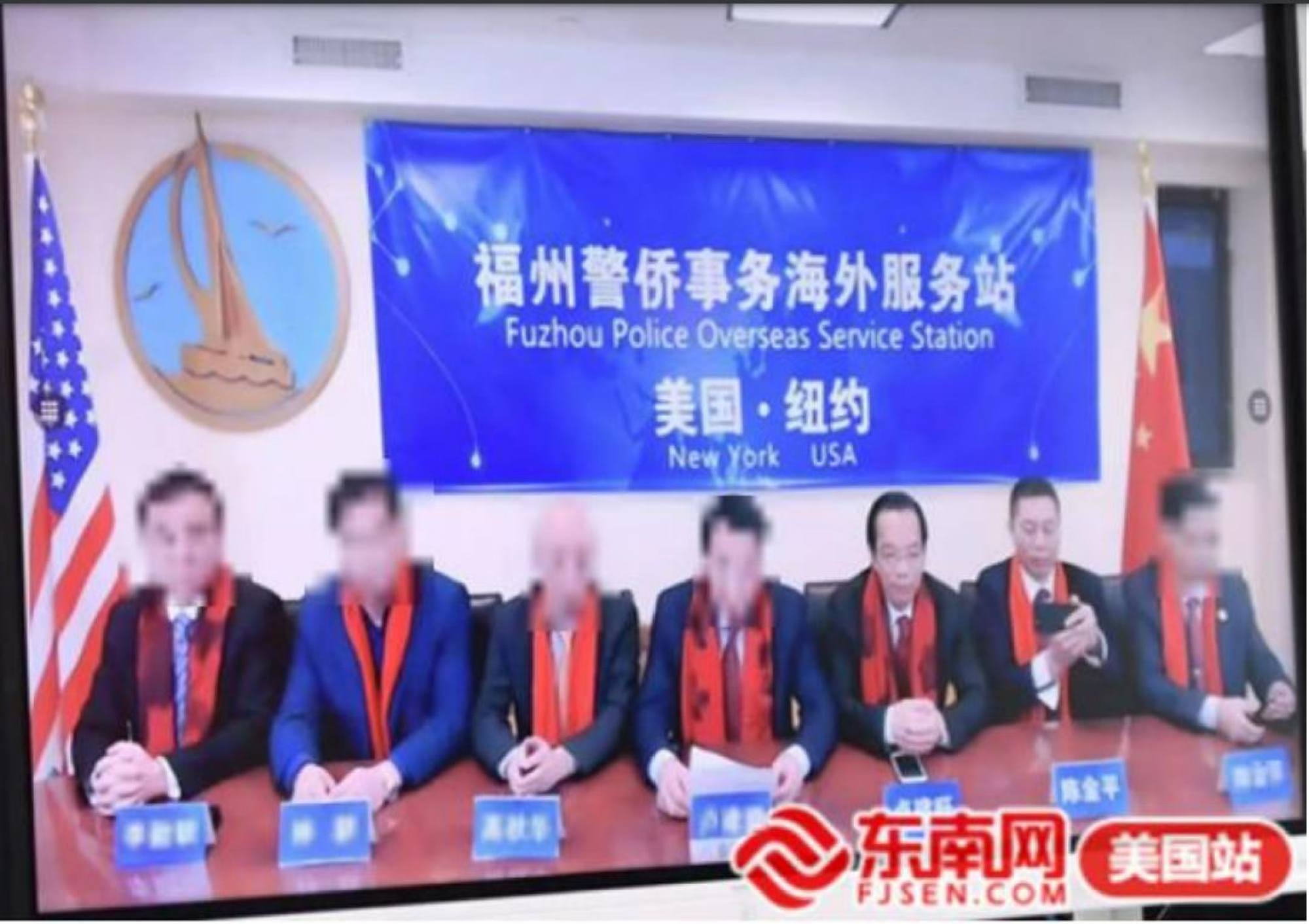
The prosecution claimed that Lu and Chen opened the centre in 2022, after Lu travelled to his native Fujian province, where MPS had announced plans to open 30 such overseas police stations worldwide, according to the prosecution.
The New York outpost shared offices with the America ChangLe Association, a community organisation that Lu helped run.
Some 30 older Chinese attended the trial, some holding small American flags. Lu, who also goes by Harry Lu, wore a dark suit, pale blue tie and glasses. He speaks limited English and listened through an earpiece as an interpreter translated the proceedings into Fujian dialect.
Carmen countered that any misstep was merely a mundane bureaucratic slip-up. Lu’s lawyer added that the FBI search of the facility on October 3, 2022, “turned the place upside down”. Lu and Chen were arrested in April 2023.
The Chinese embassy in Washington said China abides by international law and respects the judicial sovereignty of all nations.
“China is a country governed by the rule of law,” said spokesperson Liu Pengyu, adding that he was not familiar with the specifics of the case. “There are no so-called ‘secret police stations’.”
But shortly after the two were arrested, China vowed to retaliate if the US continued to press charges against Chinese police officers accused of harassing and intimidating dissidents in America after 44 others were charged in what the US characterised as a “transnational repression scheme” bothering Chinese nationals living in the US. -- SOUTH CHINA MORNING POST