
SINGAPORE: Video producer Eu-Jin Lim and his wife Eunice Wong live in a home bursting with life.
The couple has eight children from under the age of two to 12. They live with Lim’s parents in their landed house with two domestic helpers, making up a very unlikely Singaporean household.
Life threw them a curveball when Wong was pregnant with her eighth. A scan early in her pregnancy showed numerous abnormalities in the foetus.
“The scan showed the limbs were short and bendy; abnormal levels in my triple marker blood test also confirmed the physical defects. It was rather surprising as I did not have any issues (with the pregnancy),” said Wong, 43, an operations manager at a private gym.
She told The Straits Times they were advised to terminate the pregnancy as the foetus “was not viable”.
The couple did not consider it for a second.
“Even our friends in the medical fraternity asked if we were sure we wanted to keep Eva, not knowing if she would make it. But as Catholics, we believe life begins at conception,” Wong said.
Wong, who went through “a couple of miscarriages”, said that during her latest pregnancy she was prepared for yet another miscarriage, “but the baby kept holding on”.
It was not until baby Eva was born in February 2025 that she was diagnosed with campomelic dysplasia (CD), a rare, severe genetic condition that affects the development of bones and cartilage throughout the body.
Calling the condition “ultra rare”, Dr Koh Ai Ling, a consultant from the Department of Genomic Medicine at KK Women’s and Children’s Hospital (KKH), said it affects between one in 40,000 and one in 200,000 people worldwide.
“People with CD typically have shortened, bowed limbs; a small chest cavity; characteristic facial features, such as a flat face, small jaw, and cleft palate; and abnormalities of the spine.
“As the chest is small and underdeveloped, the lungs often cannot grow properly, which means most affected infants have severe breathing difficulties,” she added.
Approximately 77 per cent to 95 per cent of infants with CD die in the neonatal period (first 28 days of life) or within the first year. While survival past infancy is rare, some cases of long-term survival have been reported.
Studies have shown that cognitive defects and intellectual disabilities are frequently reported in survivors, though they are not universal.
Dr Koh said the condition is brought about by mutations in the SOX9 gene, causing it to not function properly.
As a result, the body’s skeletal system and reproductive organs do not develop normally.
The condition is not inherited from either parent.
“The majority of affected babies do not survive beyond the first few months of life, though some individuals with milder forms do survive into adulthood,” Dr Koh said.
Through ultrasound scans, characteristic features such as bowed limbs, a small chest, and abnormal skull shape – that are suggestive of rare skeletal conditions – can be detected during pregnancy, typically from the second trimester onwards.
However, ultrasound alone may not always give a definitive diagnosis. For that, genetic testing in the laboratory is needed.
This can involve either chorionic villus sampling – the removal of a small sample of placenta tissue – or an amniocentesis, where a small amount of amniotic fluid is removed from the uterus.
“I did not opt for the a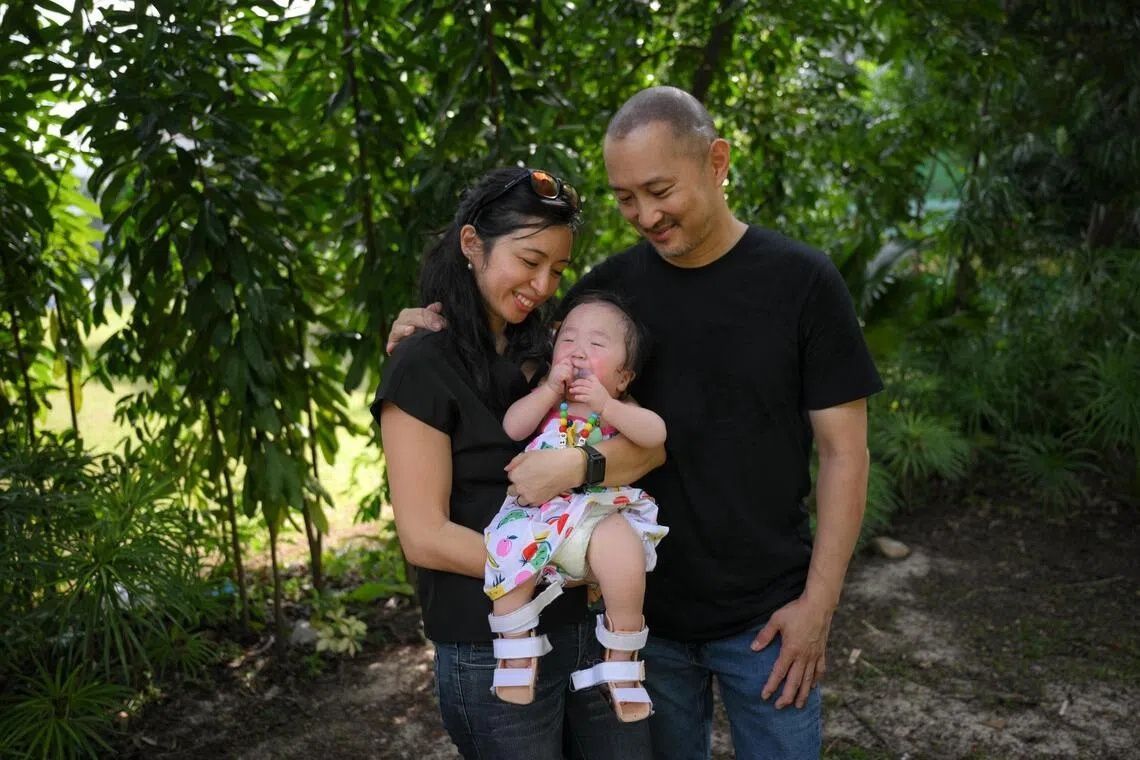
Agreeing, Lim, 54, said: “The test was not going to help the baby’s condition in any way. Because of it being invasive and the risks, we decided not to take it.”
Preparing the children to welcome their ‘special sister’
Lim and Wong decided to prepare the children – Ethan, 12; Elijah, 10; Evron, nine; Ezekiel, seven; Emmanuel, six; Eusebius, four; and Esther, two – for the arrival of their “special sister” Eva.
“We sat them down and told them that she will be a special child, and mummy and daddy will need to spend a lot of time and money on her,” Wong said.
“We told them that when she comes, there will be no more football camps, computer workshops and private tuition, and that they will have to learn to pay more attention in school.
“We taught them to pray and ask for a healthy baby, but the boys were more concerned with asking to change Eva into a little brother instead,” she added, laughing.
Eva was a breech baby, and Wong had to undergo a Caesarean section.
Immediately after she came into the world, Eva was taken to the intensive care unit, where she spent the next two months.
She has the typical facial features of a baby with CD: a large head with a high forehead, flattened face, and a small, underdeveloped jaw. She also has bowed legs, which are being managed with splints to guide limb development.
Eva, who is now 15 months old, uses a ventilator when she sleeps.
“She was about six months old when she stopped breathing. I had to give her CPR (cardiopulmonary resuscitation). The boys had just returned from school when they witnessed the scene. Now, they are aware that Eva needs constant monitoring, and they help out,” said Wong, who was trained in occupational therapy.
Associate Professor Cristelle Chow, a senior consultant with the General Paediatrics Service (Children’s Complex and Home Care Services) at KKH, told ST that Eva’s respiratory function may worsen over time.
“She will require increased respiratory support 24 hours a day, seven days a week, when that happens, and perhaps a tracheostomy, depending on the family’s goals of care,” she said.
Eva also has a gastrostomy, which is an artificial opening into her stomach through the abdominal wall, to allow her to feed, bypassing her mouth and throat.
Dr Koh said there is currently no cure for CD, and treatment before birth is also not available.
“What can be done after birth is only supportive and palliative care, tailored to how severe the case is. Many babies require immediate breathing assistance at birth, including mechanical ventilation or a tracheostomy, as the small chest restricts lung function,” she said.
Some children may undergo surgery to address specific issues such as cleft palate, spinal instability, or limb deformities.
Eva is being closely monitored by multiple specialists “to ensure that she continues to grow and develop like any other child”, Prof Chow said.
Said Wong: “Eva is very feisty and would ‘fight’ with her siblings. Cognitively, we don’t know, but she knows what she wants and points. We are enjoying her company and taking her one day at a time.” - The Straits Times/ANN