
WELLINGTON (The Straits Times/ANN): New Zealand Prime Minister Christopher Luxon has promised that his country will not stop supplying Singapore with food, whatever the uncertainties from the war in Iran.
In return, Singapore will impose no export limits on fuel to New Zealand, Mr Luxon said, ahead of his three-day visit to Singapore. He arrives on May 3.
In an exclusive interview with The Straits Times on April 29 in his Beehive office, he described New Zealand’s commitment to supplying food to Singapore in a crisis as a “rock-solid guarantee”.
“We acknowledge we feed a lot of people around the world. We are the best farmers in the world. We are the most carbon-efficient. We have huge agri-tech innovation. We can help support Singapore should they need it at any time,” he said.
He said the two countries have agreed to work together on maintaining supply chain resilience and ensuring the continued flow of essential goods, especially in times of crisis.
Mr Luxon said his visit to Singapore comes at a time when the global order is shifting “from a multilateral system to a multipolar system”, from one based on rules to one shaped by competing powers, making it more important for small, like-minded countries to work together.
He added that countries such as New Zealand and Singapore, while small, can play an outsized role by working together to uphold and shape the rules-based international system.
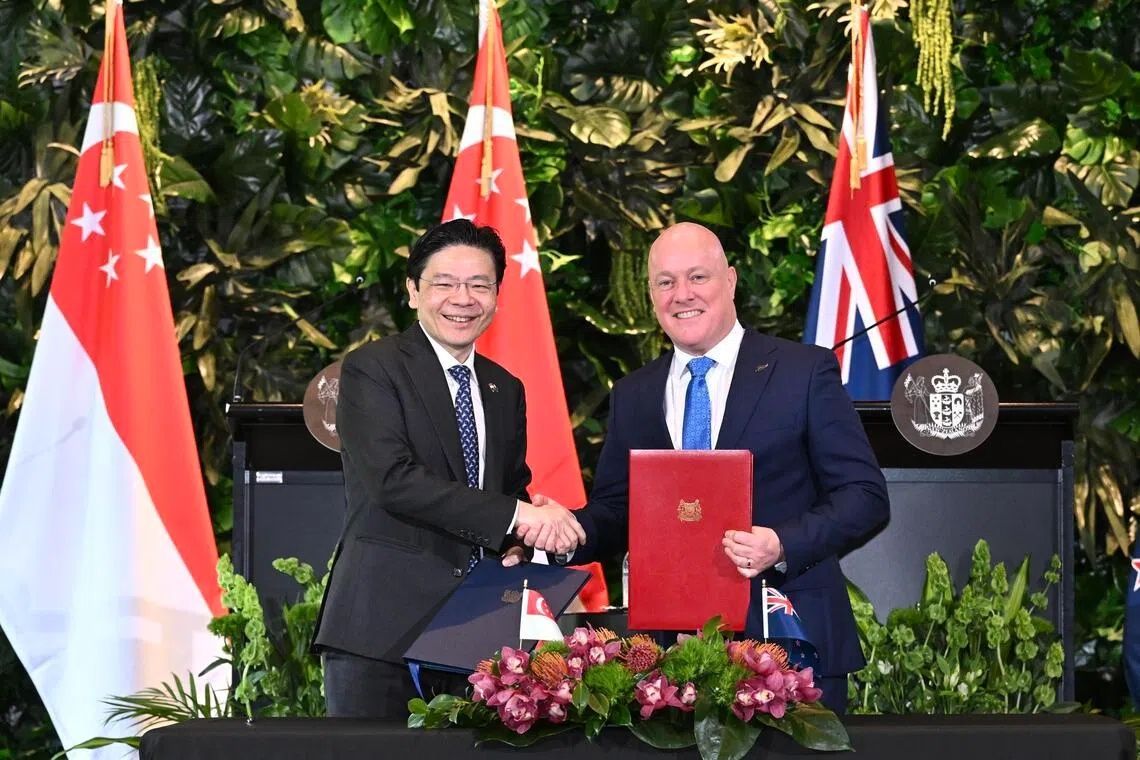
Mr Luxon will travel to Singapore for the inaugural Singapore-New Zealand Leadership Forum, where he will meet his counterpart, Prime Minister Lawrence Wong, and President Tharman Shanmugaratnam, the New Zealand government announced in a media statement on April 29.
Working together to ensure continued flow of essential goods
During the visit, the two leaders will witness the signing of the Agreement on Trade in Essential Supplies (AOTES), designed to keep trade in food, fuel and pharmaceutical products flowing during crises and supply chain disruptions. The agreement was first concluded in October 2025 during PM Wong’s introductory visit to New Zealand.
New Zealand receives about a third of its fuel needs from Singapore refineries, including diesel, critical for freight, farming and food production.
“Obviously, there are no export limits being placed on New Zealand as a consequence of this agreement,” Mr Luxon said. “Equally, we have said that in the time of crisis, should Singapore ever have a disruption to its food supply chain, New Zealand will be there. We will absolutely be delivering on our end of the deal as well.”
Mr Luxon emphasised that the agreement is unique to the bilateral relationship.
“Singapore is a real priority for New Zealand. We don’t have that agreement with any other country – that is a first for us,” he said.
Asked if this would give New Zealand priority access to fuel in a supply crunch, Mr Luxon said: “That is the point of this agreement. We are prioritising each other in the case that we need to support and back up each other. In our case, it is food. In your case, it is fuel.”
In practical terms, Mr Luxon said New Zealand would redirect its food supply chains towards Singapore in a crisis, ensuring critical supplies reach the city-state if needed.
Singapore imports more than 90 per cent of its food from 187 countries, according to the 2024 Singapore Food Statistics report.
New Zealand provides around 14 per cent of Singapore’s food imports, said New Zealand’s Ministry of Foreign Affairs and Trade.
According to Stats NZ, dairy is New Zealand’s top export to Singapore, accounting for NZ$814 million (S$612 million) in the year ended December 2025, making up about 31.6 per cent of its total exports. Other top food exports include fruits and nuts, fats and oils, as well as meat and edible offal.
Fuel security has come under scrutiny since the US and Israel began their campaign against Iran on Feb 28, with public data showing fluctuating stock levels and prompting debate over whether New Zealand should step up its fuel response and curb consumption.
As at April 26, New Zealand had 52.8 days of petrol, 46.1 days of diesel and 49.1 days of jet fuel either already in the country or en route, according to its Ministry of Business, Innovation and Employment’s latest weekly fuel update, well above minimum legal requirements of 28 days for petrol, 21 days for diesel and 24 days for jet fuel that fuel importers must hold.
The government has remained in a “watchful” phase one of its four-step fuel response plan, meaning there are no restrictions on fuel use.
New Zealand gets about 80 per cent of its fuel supply just from South Korea and Singapore.
Mr Luxon said confirmed orders extend through May, with additional supply planned into June. New Zealand has also secured an extra nine days of diesel supply beyond minimum requirements, “to make sure we can power up our agricultural sector to produce food”.
As the world’s third-largest oil trading hub and sixth-largest refinery export hub, Singapore has reciprocal agreements with other countries, which supply the Republic with crude oil and other essential products in return for refined products.
Fertiliser supply has also been in focus, given New Zealand’s reliance on imports such as urea from Saudi Arabia. Urea is a widely used nitrogen fertiliser for livestock feeds and horticulture crops.
Mr Luxon said New Zealand has about four months’ supply on hand, which he described as sufficient to support the agriculture sector.
Will agreement commitments hold under shortage pressure?
Asked whether the AOTES commitments would hold under domestic pressure in a real shortage, Mr Luxon pointed to the “deep trust” underpinning the relationship with Singapore.
“We have deep trust and alignment with Singapore. It is a critical partner for New Zealand,” he said, noting investment flows and the role of Singapore as a regional hub for New Zealand businesses.
Singapore is the country’s largest trading partner in South-east Asia. Two-way trade reached NZ$11 billion in the year ending December 2025.
Mr Luxon also said both countries share similar approaches to major powers, as “we cooperate with both the US and China where we can, but also differ where we must”.
“We don’t agree with the Americans on tariffs. We made that point very clear. And while we have disagreements from time to time with the Chinese, it is a longstanding relationship of more than 50 years.”
On growing fears of foreign interference from China, as frequently identified by the New Zealand Security Intelligence Service, he said New Zealand does not tolerate foreign interference from any power and will act publicly or privately when it sees this.
“We do it consistently and predictably,” he said, citing the example of a cyberattack linked to China on New Zealand’s parliamentary system in 2021.
The trip to Singapore, while coinciding with the global fuel crisis, was planned months earlier, following PM Wong’s visit to Auckland in October 2025.
Personal rapport with PM Wong
Mr Luxon highlighted his personal rapport with his Singapore counterpart, noting that the two are “good friends” and “talk often”, and first got to know each other when he was opposition leader and Mr Wong was finance minister.
During Mr Wong’s Auckland visit, “he came to my house, and we had a 3½-hour dinner, just the two of us together”, Mr Luxon said.
The leaders had another informal dinner catch-up in South Korea on the sidelines of Asia-Pacific Economic Cooperation meetings in October 2025.
Mr Luxon will be accompanied on this trip by a delegation of 30 senior business and government leaders.
He seeks to broaden the relationship beyond just leaders and ministers, adding that the focus will be on delivering practical and real outcomes under the six pillars of the comprehensive strategic partnership, which are: trade and economics; defence and security; science, technology and innovation; people-to-people relations; climate change and green economy; and supply chains and connectivity.
Despite global uncertainty, Mr Luxon said he still sees opportunity for New Zealand in the world.
Citing New Zealand’s abundant natural resources, strong institutions and talented people, he said New Zealand is a fantastic safe haven for investment and talent at a time “when the world feels very volatile and uncertain”.
New Zealand’s food and fibre sector accounts for 83 per cent of total exports in the year to June 2025, or NZ$62 billion in revenue, according to its Ministry for Primary Industries. The sector includes dairy, meat and wool, horticulture, forestry, seafood, and arable and processed food.
He added that the world is at an “inflection point”, shifting from rules to power, and from global efficiency to national resilience.
In that environment, he said partnerships like the one with Singapore could have a role in shaping what comes next.
Asked about his falling poll numbers ahead of a general election in November, he dismissed concerns over policy continuity.
“I don’t think you should be worried about that whatsoever,” he said. -- The Straits Times/Asia News Network