PHNOM PENH: Since fighting erupted on the border between Cambodia and Thailand last July, and again in December, China has been present in almost all negotiations, although only as observers to the Kuala Lumpur Peace Accord, when the US played the role of active mediator.
President Donald Trump personally attending the Oct 26 signing of the accord, seemingly as part of his ongoing efforts to earn a Nobel Peace Prize.
The peace created by the accord was shattered in December, when heavy fighting erupted once again.
China then hosted trilateral foreign ministerial talks, leading to the Fuxian Consensus, signed on Dec 29. The agreement saw both combatants commit to resolving their issues through peaceful means, and also led to the release of 18 captured Cambodian soldiers.
Shortly afterwards, in January, the Trump administration pledged $45 million to support the stabilisation of the border.
US efforts now appear to be focused on its ongoing war with Iran, leaving China as the power most committed to resolving the ongoing dispute.
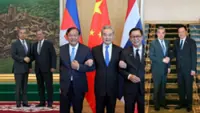
China’s foreign minister Wang Yi and defence minister Dong Jun visited Cambodia on April 22-23, with Wang then travelling to Thailand.
During his time in Phnom Penh, Wang reaffirmed China’s commitment to playing a mediation role and setting the negotiation table for both sides.
“China will continue to work in its own way to help Cambodia and Thailand rebuild mutual trust and improve relations, and stands ready to provide more platforms for direct communication between the two countries,” said Chinese foreign ministry spokesperson Guo Jiakun, following Wang’s departure from Phnom Penh.
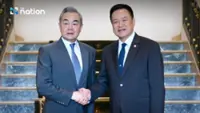
When in Bangkok, Wang met with Thai Prime Minister Anutin Charnvirakul who was told that China hoped that Thailand will intensify efforts to combat online gambling and telecom fraud, creating a favourable environment for China-Thailand relations.
“As a common friend of both Thailand and Cambodia, China is willing to continue providing a platform for the two sides to engage in dialogue, rebuild mutual trust and improve relations,” explained Guo.
What is the ‘Chinese Way’ of restoring regional trust?
“Chinese diplomacy does not normally apply pressure on the conflict parties; their way of facilitation is normally quiet, urging both sides to solve issues peacefully and on an accepted consensus. They have applied this technique to the intervention and resolution of other international conflicts,” said Kin Phea, director of the International Relations Institute at the Royal Academy of Cambodia.
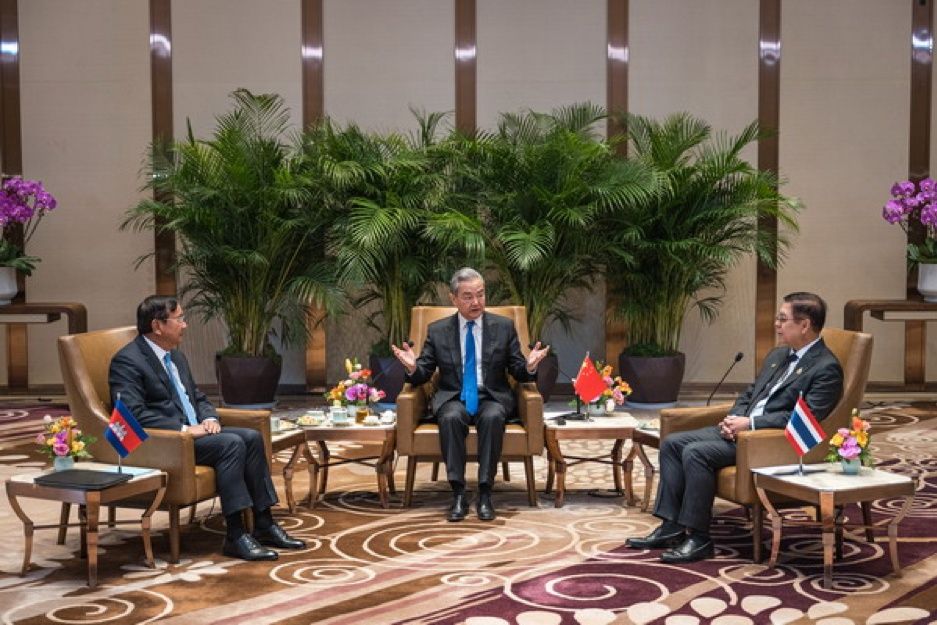
Phea noted that China had facilitated a consensus between Thailand and Cambodia, specifically the Fuxian Consensus, in which both countries accepted the conditions for border disputes resolution. He viewed China’s way of solving issue as a step-by-step approach supported by a silent follow-up mechanism, such as what is called Track II diplomacy, held for the second time in Beijing last week.
Second Beijing Track II meeting
A high-level non-governmental delegation from Cambodia, Thailand, and China met for Track II dialogue in Beijing from April 20-21. They aimed to explore pathways to resolve the longstanding border conflict between Cambodia and Thailand through peaceful initiatives rather than military means.
More than 70 participants, including 17 from Cambodia, 15 from Thailand, and over 40 from Chinese institutions — primarily from the China Foreign Affairs University (CAFU) and Chinese media outlets, as well as NGOs, were in attendance.
The event built directly on the earlier “Fuxian Consensus” and sought to foster a peaceful public opinion environment that supports de-escalation and long-term stability in the region.
The Cambodian delegation emphasised that sustaining peace requires both continued diplomatic engagement and responsible public communication. It called for strengthened efforts to promote accurate, balanced and peace-oriented reporting while addressing disinformation that risks heightening tensions.
“The Cambodian delegation remains committed to dialogue, mutual respect and the peaceful resolution of differences. The Track II platform plays an important complementary role in supporting official diplomacy, generating ideas and fostering a conducive environment for reconciliation,” said delegate Chheng Kimlong, president of the Asian Vision Institute.
“We underscored that maintaining peace requires not only political will at the state level but also responsible communication and constructive public engagement,” he added.
The Cambodian delegation expressed appreciation to the hosts and all participants for their constructive contributions and reaffirmed its readiness to continue working with regional partners “toward lasting peace, stability and shared prosperity”.
Im Sothearith, an advisor to the Club of Cambodian Journalists (CCJ) noted that responsible reporting can build trust while irresponsible reporting, especially involving sensationalism, fake news and bias, can reignite conflict.
“We stressed the importance of promoting accurate, balanced and peace-oriented information while actively countering disinformation that may inflame tensions or undermine trust between communities,” he said.
“We must actively challenge the sensationalism that often dominates regional headlines. As media professionals, it is our duty to provide our public with objective reporting rather than reactive provocation that treats complex border disputes as zero-sum games,” he added.
A look back at the Fuxian Consensus
The Fuxian consensus is a five-point diplomatic agreement reached on Dec 29, 2025, aimed at ending the 2025 border conflict between Cambodia and Thailand.
It was finalised during a trilateral meeting at Fuxian Lake in Yunnan, China, and involved the foreign ministers and senior military officials of China, Cambodia and Thailand.
The agreement outlines a step-by-step roadmap for restoring regional stability and bilateral relations:
1. Consolidating the Ceasefire: Prioritising the full implementation of the Dec 27 ceasefire agreement to prevent renewed hostilities.
2. Resuming Normal Exchanges: Reopening communication channels at all levels to restore the livelihoods of displaced border populations.
3. Rebuilding Political Trust: Fostering a positive atmosphere through diplomatic channels, specifically in preparation for the Fifth Lancang-Mekong Cooperation (LMC) Leaders’ Meeting in Thailand.
4. Improving Bilateral Relations: Creating the necessary conditions to eventually resume normal diplomatic ties.
5. Safeguarding Regional Peace: Anchoring future interactions in international norms (UN and Asean charters) to maintain long-term stability. - The Phnom Penh Post/ANN