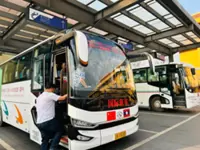
VIENTIANE (Laotian Times): Laos and China have launched a new international bus route connecting Xiang Hung City in Yunnan Province to Xiang Kok village in Luang Namtha, creating a direct overland link along a previously less accessible corridor.
Officials marked the launch on 11 April at the ASEAN Comprehensive International Transport Service Center in Xishuangbanna, Yunnan. The opening coincided with the 65th anniversary of diplomatic relations between Laos and China and the ongoing China–Laos Friendship Year.
How the Route Works
The route spans about 280 kilometers, starting from Jinghong City in Xishuangbanna and crossing into Laos through the Mengman Chahe Port before reaching Xiang Kok village.
The service runs one round trip daily, with a one-way journey taking seven to eight hours. A one-way ticket costs 158 yuan, around LAK 300,000 (USD 22).
The route offers direct, point-to-point travel, removing the need for multiple transfers that previously made the journey difficult for passengers.
Chinese media reported that He Shenglong, Director of the Comprehensive Transportation Department of Yunnan Provincial Department of Transportation, said the route strengthens cross-border transport systems, improves port efficiency, and enhances service standards.
He said the route will help attract investment, boost tourism, and support trade and logistics along the corridor.
Laos and China began discussions on cross-border transport cooperation in May 2025 in Kunming. Officials inspected proposed routes in July, followed by trial operations for the Jinghong–Xiang Kok route in December the same year.
Authorities officially launched the service this month.
The new service marks the second cross-border bus route between the two countries but differs from the earlier Mohan–Boten shuttle.
The Mohan–Boten route connects railway stations over a short 16-kilometer distance and mainly serves passengers using the Laos–China Railway.
Meanwhile, the Xiang Hung–Xiang Kok route operates as a standalone intercity service along a western corridor that previously lacked direct public transport, opening access to areas once limited to traders and local communities.
Boosting Trade and Tourism
Authorities expect the route to support cross-border trade, increase tourist flows, and create new business opportunities.
Luang Namtha, a key gateway for trade and eco-tourism in northern Laos, stands to benefit from increased visitor traffic. The route also strengthens connectivity between Yunnan and Southeast Asia.
Officials said the new service will support sustainable economic development and deepen cooperation between Laos and China. -- Laotian Times