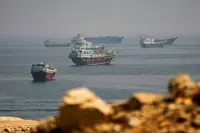
NEW DELHI/ BEIJING: The ongoing blockade by the United States of ships entering and exiting Iranian ports risks inflicting more misery all around in the form of higher energy prices.
Two of Asia’s largest economies – China and India – are likely to feel the impact differently, with ripple effects on global energy supplies.
China is a key trading partner of Iran. Multiple Chinese and Western sources estimate that about 90 per cent of Iran’s crude oil exports end up in China – up from some 30 per cent a decade ago, after US sanctions squeezed out most other buyers.
Iranian crude accounts for roughly 13 per cent to 15 per cent of China’s total oil imports, according to industry estimates.
Even with Iran effectively closing the strait since the start of the war on Feb 28, the Islamic republic has allowed selected vessels from China through.
At least two very large crude carriers owned by Chinese shipping giant Cosco successfully passed through the waterway on April 11, becoming the first state-linked tankers to leave the Middle East Gulf since the outbreak of the conflict, according to Lloyd’s List Intelligence vessel-tracking data.
One was carrying Iraqi crude oil while the other was carrying Saudi crude, according to the data, which does not indicate if the tankers visited Iranian ports.
Cosco has at least five other vessels still waiting inside the Persian Gulf.
On April 14, a US-sanctioned tanker linked to China was reportedly transiting the strait, although it is unclear if it visited Iranian ports or if it is carrying cargo, Bloomberg reported.
The US began blocking all maritime traffic entering and exiting Iranian ports from 10pm Malaysia time on April 13 after talks in Islamabad failed to yield any breakthrough.
The extent of the impact will depend significantly on how effective the US blockade is, given the use of shadow fleet vessels, and how it affects trade flows.
But any tightening of US restrictions will surely pressure China’s crude imports, said Sumit Ritolia, lead analyst for refining supply and modelling at maritime analytics firm Kpler.
“If China faces tighter enforcement or logistical disruptions, it will increasingly source from alternative suppliers,” he added, including those in West Asia, Russia, West Africa and the Americas.
This is expected to intensify competition for supplies among global crude oil importers, further driving up prices, including for energy-hungry India, which sources over 80 per cent of its crude oil and roughly half of its natural gas needs from abroad.
Impact on India
Iran has also allowed Indian vessels carrying oil and gas from ports in the Persian Gulf to pass through the strait.
More notably, two tankers carrying Iranian oil reached Indian ports last week – the first such official consignment since India halted Iranian crude imports in May 2019 under US sanctions pressure.
India, the world’s second-biggest importer of liquefied petroleum gas (LPG), also recently received a gas shipment from Iran by tanker.
These energy imports from Iran came after the US granted a one-month sanctions waiver on March 20, allowing the sale of Iranian petroleum products already in tankers to ease international oil supply disruptions and surging energy prices.
But this reprieve has proven short-lived with the US blockade now in place. The price of Brent Crude oil still hovers close to US$100 per barrel, up from roughly US$70 before the war that began on Feb 28.
Traffic through the Strait of Hormuz – accounting for one-fifth of the world’s oil and gas trade – has fallen by nearly 95 per cent from more than 130 vessels a day since the war, with around 2,000 ships trapped in the area, according to the International Maritime Organisation.
The US blockade and potential retaliation from Iran, which has threatened to attack ports in the Gulf, could further worsen the crisis.
Any escalation, especially in the strait, is likely to increase tanker rates and insurance costs, adding to costs for countries that import oil and gas from the Gulf.
The Russia factor
In the coming weeks, Ritolia expects upward pressure on international crude prices as well as tighter availability of discounted barrels, especially if Russian exports also face constraints.
In early April, Ukraine intensified its drone strikes against Russian oil-exporting ports on the Baltic Sea.
This market setting, he added, will result in a higher import bill for India, even if overall volumes remain stable.
“The net impact on India’s crude strategy is unlikely to come from losing Iranian barrels, but rather from paying more for alternative supplies amid tighter global market conditions,” he explained.
Dipti Deshpande, principal economist at analytics firm Crisil, said the US blockade threatens to aggravate the intensity of the conflict, with consequences for the Indian economy.
“Things seem to be rapidly transitioning to a scenario where the conflict continues till April-end with gas shortages slowing industrial production in India in the first quarter of this fiscal year,” she said, adding that India’s GDP growth for the financial year ending March 2027 could fall to 6.8 per cent from an earlier forecast for 7.1 per cent.
Limited stockpiles of petroleum products, particularly LPG, have worsened the impact of the conflict on India.
China is well-positioned
Analysts argue that China is capable of absorbing a short-lived disruption from any US move to blockade Iranian energy shipments, as it has a combination of stockpiles, diversified supply and state intervention tools.
Chinese refiners are unlikely to face an immediate shock as inventories and offshore storage provide a buffer, said Lin Ye, vice-president of oil markets at energy intelligence company Rystad Energy.
She estimates the 50.5 million barrels China has in floating storage is sufficient to cover roughly 17 days of operations at small independent “teapot” refiners.
If domestic crude and Russian crude are tapped, “teapots” could continue running at current levels for at least another six to eight weeks, she said.
While China is a critical buyer for Iranian crude, Beijing has not disclosed its oil imports from Iran since 2022, with this data coming only from third-party firms.
An often cited figure is Kpler’s estimate of 1.38 million barrels of Iranian oil that China purchased on average per day in 2025.
Private Chinese “teapot” refineries are the primary buyers of Iranian crude, which is also often trans-shipped through other countries before reaching China, with payment routed through multiple channels.
Professor Cui Shoujun, executive director at the Centre for Middle East and African Studies at Renmin University, also said China has strategic reserves and a coal-to-chemical industry that can cushion the short-term impact of a blockade.
“There would be some impact on China’s chemical industry, but higher prices for China’s processed exports could transmit inflationary pressures to importing countries,” said Prof Cui, suggesting that costs could be passed on globally rather than fully absorbed at home.
Professor Wang Yiwei, a former Chinese diplomat and director of Renmin University’s Institute of International Affairs, said if the blockade drags on, China will be impacted as it is a major importer of energy from the Gulf region – but so will other nations, including Iran and the US itself.
“But whenever there are sanctions or blockades, there will also be workarounds, whether informal channels or other flexible arrangements.”
Given that the blockade harms all parties, “the key question we should be asking is: can this blockade actually be sustained?” - The Straits Times/ANN