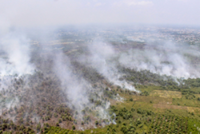
JAKARTA: Indonesia is stepping up preparations for an early and prolonged dry season, with the National Disaster Management Agency (BNPB) mobilising water-bombing helicopters to tackle escalating forest and land fires, reported Xinhua.
The country is vulnerable to such blazes, which are major contributors to global carbon emissions. This year, the threat is heightened as officials warn of a dry season arriving earlier and lasting longer than average.
The BNPB has readied 16 water-bombing and 12 patrol helicopters to be stationed in high-risk provinces. Additional aircraft will be deployed if the intensity of the fires increases, a BNPB official said on Monday (April 6).
Satellite data from the Ministry of Forestry indicates that fires razed approximately 32,637 hectares nationwide in January and February alone. West Kalimantan recorded the most extensive damage at over 10,600 hectares.
The severity of the current situation is reflected in a dramatic spike in hotspots. From Jan 1 to April 5, authorities detected 702 hotspots, a sharp increase compared to the 125 hotspots recorded during the same period last year.
The Meteorology, Climatology and Geophysics Agency (BMKG) said the El Nino Southern Oscillation (ENSO) and Indian Ocean Dipole are currently neutral, but modelling suggests ENSO may shift to an El Nino phase in the second half of 2026.
"We are entering the dry season in April and May, which is expected to peak in August," said BMKG head Teuku Faisal Fathani, noting that rainfall this year is projected to be significantly below the 30-year average.
Authorities have urged local governments and communities to remain on high alert, citing low rainfall and rising temperatures as critical risk factors.
Firefighters and local agencies have been advised to maintain close coordination to prevent a repeat of historical haze crises. - Bernama-Xinhua