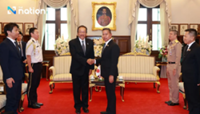
BANGKOK (Bloomberg): For the first time in weeks, Thailand’s top cabinet ministers could breathe a sigh of relief as they gathered Tuesday at Government House in Bangkok.
It was their first meeting since Prime Minister Anutin Charnvirakul won Sunday’s election by an unexpectedly wide margin - dubbed the "blue wave” in a nod to the color of his political party.
While Anutin appears in no rush to form a coalition government - which includes dolling out cabinet positions as part of the party horse trading - he’s made clear a core cadre of advisers will stay.
"Our pack of four will remain,” Anutin said on election night, referring to himself and the holders of three key portfolios: finance, commerce and foreign affairs.
Until Anutin first became prime minister in September, after the sudden ouster of his predecessor, Bhumjaithai had never led a government and lacked a track record in economic management. And it faced daunting challenges - negotiating a tricky trade deal with Donald Trump’s White House, a worsening economic malaise and a border conflict with Cambodia that packed loads of political risks.
To navigate those challenges Anutin tapped Finance Minister Ekniti Nitithanprapas, Commerce Minister Suphajee Suthumpun and Foreign Minister Sihasak Phuangketkeow.
"We have had the right people to tackle all those problems,” Anutin said.
Anutin’s pledge that the three would stay in place bolstered the sense policy continuity that buoyed markets after the election, sending the baht and Thai stocks sharply higher.
The three ministers "showed outstanding performance despite the short time they had,” said Win Phromphaet, executive chairman of Kasikorn Asset Management Co.
‘Technocratic Core’
With Ekniti continuing as finance chief, the government’s economic direction is expected to reflect his technocratic roots in the revenue and treasury departments: gradually shrinking budget deficits and prioritizing foreign investment. His close relationship with Bank of Thailand Governor Vitai Ratanakorn is also expected to keep fiscal and monetary policy aligned.
Ekniti’s return would act as a "critical volatility crusher” for Thai markets, said Kiatnakin Phatra Securities economist Pipat Luengnaruemitchai. "We expect fiscal discipline to remain a priority, with the 70% debt-to-GDP ceiling acting a firm anchor against excessive populist spending promises.”
For Suphajee, a former executive at International Business Machines Corp. and Dusit Thani Pcl, the focus is likely to remain on accelerating free-trade agreements, diversifying export markets, and negotiating lower US tariffs. Alongside Ekniti, she has also been working to attract investments, positioning Thailand as a "trusted partner” for companies seeking access to the wider Asian region.
Veteran diplomat Sihasak will anchor the government’s foreign-policy agenda, working to restore Thailand’s international standing and managing relations with the US and other major powers. The Cambodian border dispute, which fueled nationalist sentiment and boosted Bhumjaithai’s electoral support, will likely remain a key challenge.
"The retention of a technocratic core in key ministries is significant, as it signals governance competence and should help to shorten the time required to implement pending measures,” said Krystal Tan, economist at Australia & New Zealand Banking Group Ltd.
Still, Tan and others have cautioned that continuity alone will not unlock Thailand’s growth potential "without reforms to address structural constraints - such as low productivity growth, high household debt, skill shortages, and a challenging investment climate.”
At an event on Tuesday, the finance minister, Ekniti, acknowledged the challenges, saying the new government will "try to restructure” the Thai economy, but Anutin’s government hasn’t unveiled concrete plans that go beyond stimulus.
His government last year rolled out a popular program where the government subsidizes 50% of consumer purchases to boost economic activity. Bhumjaithai promised to bring that program back even bigger, expand access to low-cost financing for small businesses and give clean-energy subsidies for households - election platforms that largely avoid structural changes.
Preliminary results show Anutin’s Bhumjaithai winning nearly 200 seats in the 500-member lower house, around 50 short of a majority. Its current coalition partner, Klatham, which oversees agriculture, education and tourism ministries, is expected to contribute enough seats to bridge the gap.
Securing about 300 seats would ensure a strong governing majority capable of passing key legislation and weathering any defections. Potential partners include Pheu Thai, a former ally that local media reports could be offered portfolios such as higher education, industry or culture.
Anutin, however, is taking his time begin coalition talks, saying he wants to wait for clearer seat counts - a process that could take days or weeks. The Election Commission has up to 60 days to certify the final results. His measured approach likely reflects the scale of his victory, giving him room to assess how many additional seats his party will need.
--With assistance from Anuchit Nguyen. -- ©2026 Bloomberg L.P.