
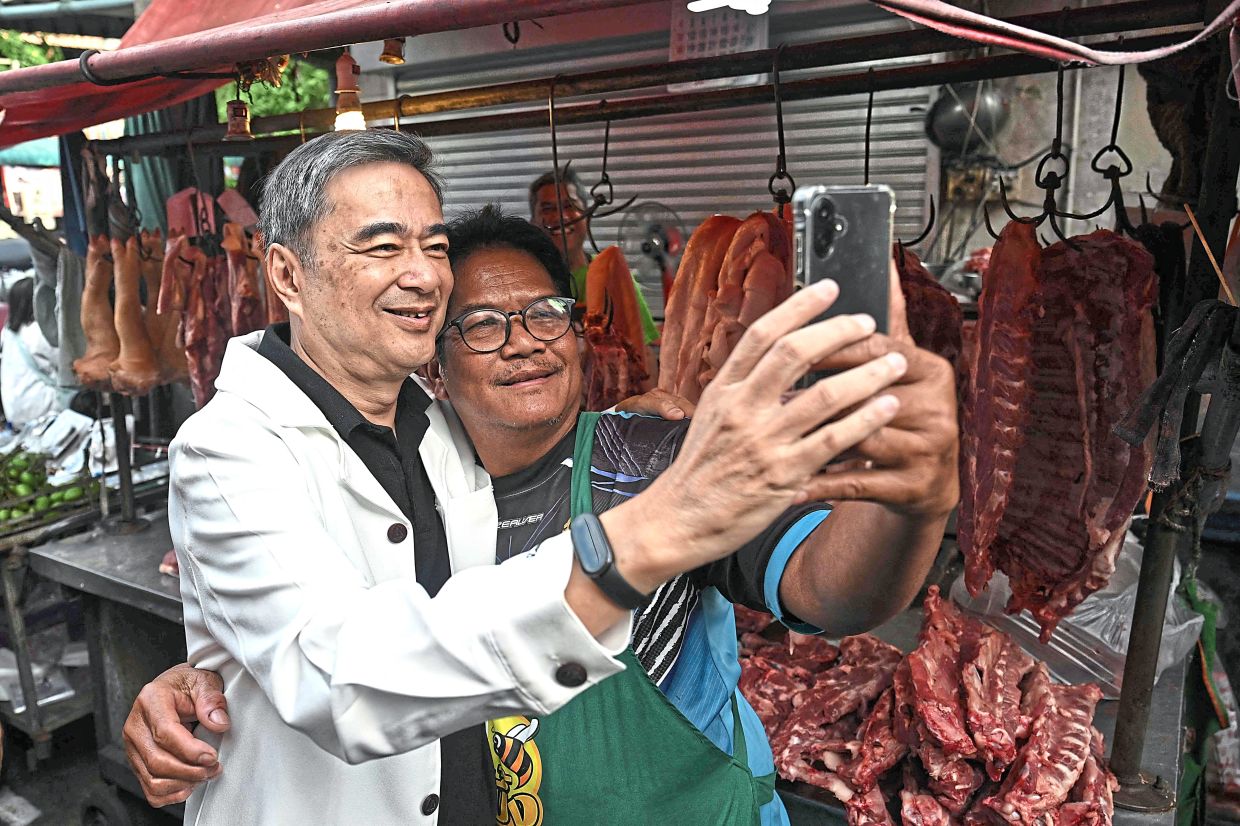
Passersby stopped former prime minister Abhisit Vejjajiva every now and again to ask for selfies as the salt-and-pepper-haired leader walked through a bustling market in Bangkok, campaigning for general elections this Sunday.
“Good to see you again, still handsome just like before,” said one noodle vendor, reflecting voters’ persisting warm feelings for the Oxford-trained economist, who is making an unexpected comeback to frontline politics.
Abhisit’s return has fuelled a revival of his Democrat Party, reshaping an electoral contest that formerly looked like a three-way tussle among the ruling Bhumjaithai Party, the progressive People’s Party and the populist Pheu Thai Party.
“I just want to offer a choice and revive the party,” Abhisit, 61, said as he strolled down a major road in the capital, greeting office workers on lunch breaks.
“Every time I meet people, they are frustrated with the lack of choice.”
Government worker Yuttapum Rattanamanee said he was one of four in his family backing the Democrats again because Abhisit came back to lead the party.
“When Abhisit left, the party lost its power because people no longer trusted the leadership,” the 37-year-old added. “Abhisit is capable, competent and honest.”
Thailand’s oldest political party, the Democrats had long dominated the south and Bangkok, before sliding into decline after a military coup in 2014.
Despite the goodwill, Abhisit is unlikely to get enough support to become prime minister, a survey showed last week.
But he has helped his party win back conservative voters after years of lacklustre efforts, said Olarn Thinbangtieo, a political scientist at Burapha University.

As prime minister from 2008 to 2011, Abhisit faced prolonged street protests by the “Red Shirt” populist movement backed by former premier Thaksin Shinawatra, who also founded Pheu Thai.
In 2010, he ordered a military crackdown on demonstrations in central Bangkok that killed 90, a toll rights groups blamed on “excessive and unnecessary lethal force” used by security forces seeking to restore order.
But Thai courts dismissed all the criminal cases faced by Abhisit and senior officials, with no convictions.
Abhisit stepped away from politics after the Democrats won just 52 of 500 seats up for grabs in the 2019 general election. In 2023, the party slid further, clinching just 25 seats.
Now the Democrats are resurgent, opinion polls largely driven by Abhisit’s personal appeal show.
A survey by the National Institute of Development Administration (Nida) ranked Abhisit third among likely prime ministerial candidates last week, while his Democrat Party took fourth place overall.
That suggests the party could emerge as a pivotal force in talks to form a coalition after an election that is expected to give no single party an outright majority.
The Democrats’ gains could come at the expense of the ruling Bhumjaithai, splitting conservative and older voters nationwide, Olarn added.
Nevertheless, the Nida survey put Abhisit a distant third to be prime minister, after frontrunner People’s Party leader Natthaphong Ruengpanyawut and second-ranked Prime Minister Anutin Charnvirakul.
Much of Abhisit’s support comes from his party’s traditional southern heartland, parts of which were ravaged by catastrophic floods in November, killing 145 in nine provinces.
In the key province of Songkhla, swamped by its highest single-day rainfall in 300 years, a January survey showed Abhisit as the top choice for premier, well ahead of the incumbent Anutin.
“It suggests that southern people are coming back, warming to us,” Abhisit added.
But winning in the capital, Thailand’s single largest electoral block with 33 seats and 4.5 million voters, which was almost entirely swept by a predecessor of the People’s Party in 2023, will be a tough task for the Democrats.
“Ideally, we would have liked more preparation,” Abhisit said, referring to the party’s campaign in Bangkok.
The snap elections came after Anutin dissolved Parliament in December, in the midst of a fierce border conflict with neighbouring Cambodia, which analysts said was timed to help the ruling party ride a wave of heightening nationalism.
Yet the current campaign is not solely based on nostalgia for Abhisit, who became prime minister aged 44, after a youthful start as an MP at 27.
“It’s about transforming the party as well as reviving it,” he said. “We’re bringing back the principles people once supported us for.” — Reuters