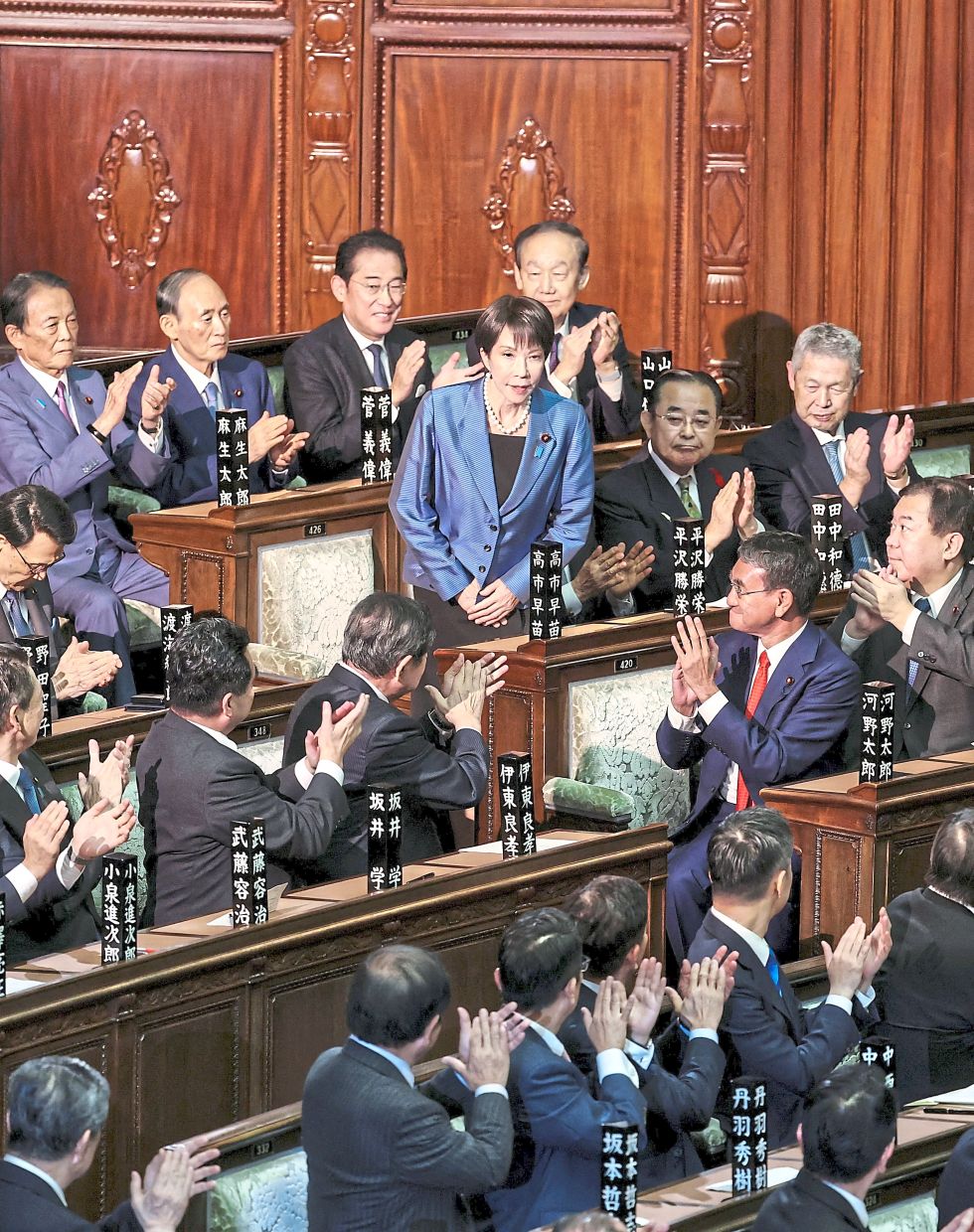
Hardline conservative Sanae Takaichi was elected the country’s first female prime minister, shattering the political glass ceiling and setting the country up for a decisive turn to the right.
An acolyte of former prime minister Shinzo Abe and an admirer of Britain’s Margaret Thatcher, Takaichi is expected to return to Abe-style government stimulus as she attempts to jumpstart an economy saddled with slow growth and rising prices.
While her victory yesterday marks a pivotal moment for a country where men still hold overwhelming sway, she named just two women to her Cabinet, far fewer than what she had promised.
Takaichi is also likely to usher in a sharp move to the right on issues such as immigration and defence, making her the latest leader in tune with the broader rightward shift in global politics.
She received 237 votes in the election in parliament’s 465-seat lower house yesterday and then won a similar vote in the less powerful upper house.
Her victory was secured after her Liberal Democratic Party, which has governed Japan for most of its postwar history, agreed on Monday to form a coalition with the right-wing Japan Innovation Party, known as Ishin.
Together the parties are two seats short of a majority in the lower house.
That means Takaichi’s success will depend on her winning the cooperation of more opposition lawmakers, said Tadashi Mori, a professor of politics at Aichi Gakuin University.
“The two parties do not command a majority in either chamber and to ensure a stable government and gain control of key parliamentary committees, they will need to secure more than half the seats,” he said.
Takaichi takes over when Japanese politics appears more fractured than at almost any other time in recent memory, thanks in part to the rise of the smaller, hard-right Sanseito Party, which has siphoned voters away from the LDP.
“Since former prime minister Abe passed away, we’ve felt that both national politics and the LDP have drifted leftward,” Sanseito head Sohei Komiya told broadcaster NHK, adding that he hoped Takaichi would steer national politics back to the middle.
“While we won’t hesitate to oppose her when necessary, we intend to maintain a friendly working relationship,” he said.
The LDP’s former coalition partner, the more moderate Komeito, broke up their 26-year-old alliance this month after the LDP chose the right-wing Takaichi as its new leader.
Takaichi named just two women to her Cabinet: fellow Abe disciple, Satsuki Katayama becomes the country’s first female finance minister while Kimi Onoda becomes economic security minister.
In her leadership campaign she promised to boost the number of women in the Cabinet to match socially progressive Nordic countries.
The percentage of female ministers in Nordic governments ranges from Denmark’s 36% to Finland’s 61%. Under Takaichi, women will make up 16% of Japan’s Cabinet, including her.
“Only two female ministers, no surprise,” said Yoko Otsuka a professor of welfare policy and gender studies at Ritsumeikan University.
“A female prime minister might slightly improve Japan’s Global Gender Gap Index ranking, but the reality barely changes.”
Takaichi’s endorsement of Abe-style fiscal stimulus has prompted a so-called “Takaichi trade” in the stock market, sending the Nikkei share average to record highs, the most recent yesterday.
But it has also caused investor unease about the government’s ability to pay for more spending in a country where the debt load far outweighs annual output.
Both the yen and bond prices have weakened as a result.
Any attempt to revive Abenomics could also run into trouble because the policy was devised to fight deflation, not higher prices, said Mori.
Some analysts say Ishin, which has advocated for budget cuts, could restrain some of Takaichi’s spending ambitions.
Takaichi has said defence and national security would be core pillars of any administration she led.
She pledged to raise defence spending, deepen cooperation with the United States and other security partners.
Rising political star Shinjiro Koizumi will serve as defence minister while veteran lawmaker Toshimitsu Motegi will be foreign minister.
Takaichi was sworn in as Japan’s 104th prime minister yesterday evening to succeed the incumbent Shigeru Ishiba, who last month announced his resignation to take responsibility for election losses. — Reuters