Soldiers guarded the country’s parliament and patrolled deserted streets amid a curfew in the capital Kathmandu, after two days of deadly anti-corruption protests forced Prime Minister KP Sharma Oli to resign.
The upheaval in the poor Himalayan nation was unleashed by a social media ban that was announced last week, but was rolled back after 19 people were killed on Monday as police fired tear gas and rubber bullets to control crowds.
Burnt-out vehicles and twisted metal littered the area around parliament, where army firefighters battled to douse a blaze in the main hall, while the building’s exterior was charred after protesters set it ablaze on Tuesday.
“I have been informed by the (parliament) security chief that the fire has destroyed the entire infrastructure. Nothing is left,” Ekram Giri, spokesperson for the lower house of parliament, said from his home in Kathmandu.
Several other government buildings, from the supreme court to ministers’ homes, including Oli’s private residence, were also set ablaze in Tuesday’s protests, with the unrest subsiding only after the resignation.
Flights were disrupted, with the main airport in Kathmandu shut until 6pm local time yesterday, an airport spokesperson said.
Armoured vehicles kept vigil in streets that were largely deserted yesterday, with shops and markets shut.
Firefighters were engaged at different locations, while the process of clearing roads was also under way, army spokesman Raja Ram Basnet said.
“We are trying to normalise the situation first. We are committed to protect the life and property of people,” Basnet said, adding that prisoners had set Kathmandu’s Dilli Bazar Jail on fire before the army controlled the situation.
In an appeal on X, the army said prohibitory orders would remain in force until today morning, adding that relevant parties were coordinating to tackle the situation after the protests and resolve the issue.
Media also said preparations were being made for authorities and protesters to hold talks, without giving details.
Reuters could not independently confirm the information.
Former Supreme Court Judge Balaram KC urged the protesters to set up a negotiation team, with the army helping to maintain law and order, and called for fresh elections.
“Parliament should be dissolved and fresh elections held,” said the constitutional expert.
“They should discuss forming the next caretaker government.”
Most of the protesters were young people voicing frustration at the government’s perceived failure to fight corruption and boost economic opportunities.
For years a lack of jobs has driven millions to seek work in countries such as Malaysia, the Middle East and South Korea, mainly on construction sites, so as to send money home.
“If shedding blood is good for our future, then it was right for me to participate in the protests,” Suman Rai, 20, who suffered injuries during the demonstrations, said as he lay on a hospital bed with his head and left wrist heavily bandaged.
India’s security Cabinet also met late on Tuesday to discuss the situation.
“Nepal’s stability, peace, and prosperity are of utmost importance,” Prime Minister Narendra Modi said in a post on X later.
“I humbly appeal to all my brothers and sisters in Nepal to maintain peace and order.”
Beijing also hoped Nepal’s social order and national stability will be restored as soon as possible, China’s foreign ministry said. — Reuters
More photos
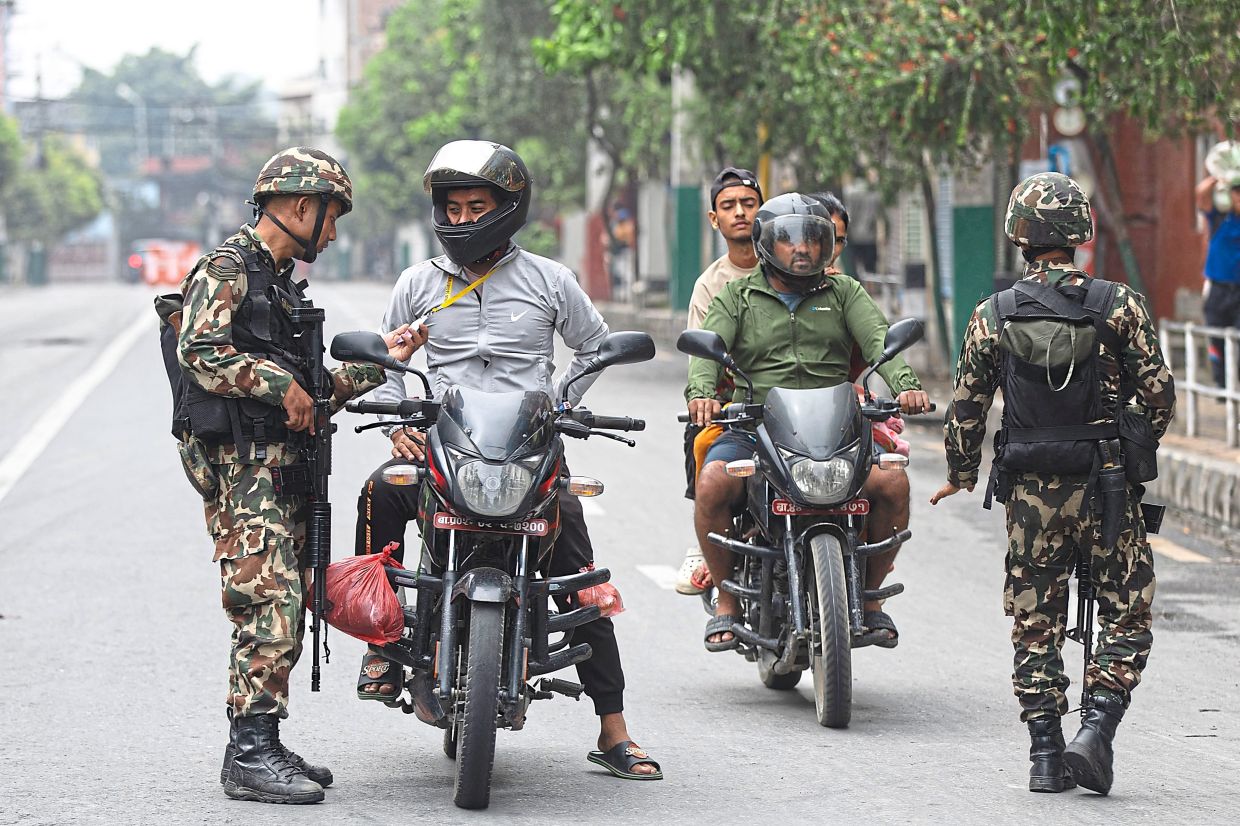


Army personnel checking commuters’ documents at a security checkpoint in the capital.-AFP
Protesters celebrating outside parliament following the killing of 19 people on Monday. -REUTERS/Adnan Abidi
A demonstrator waving Nepal’s flag at the Singha Durbar compound. -REUTERS/Navesh Chitrakar
People cleaning the Department of Transport Management office during a citywide curfew. -REUTERS/Adnan Abidi