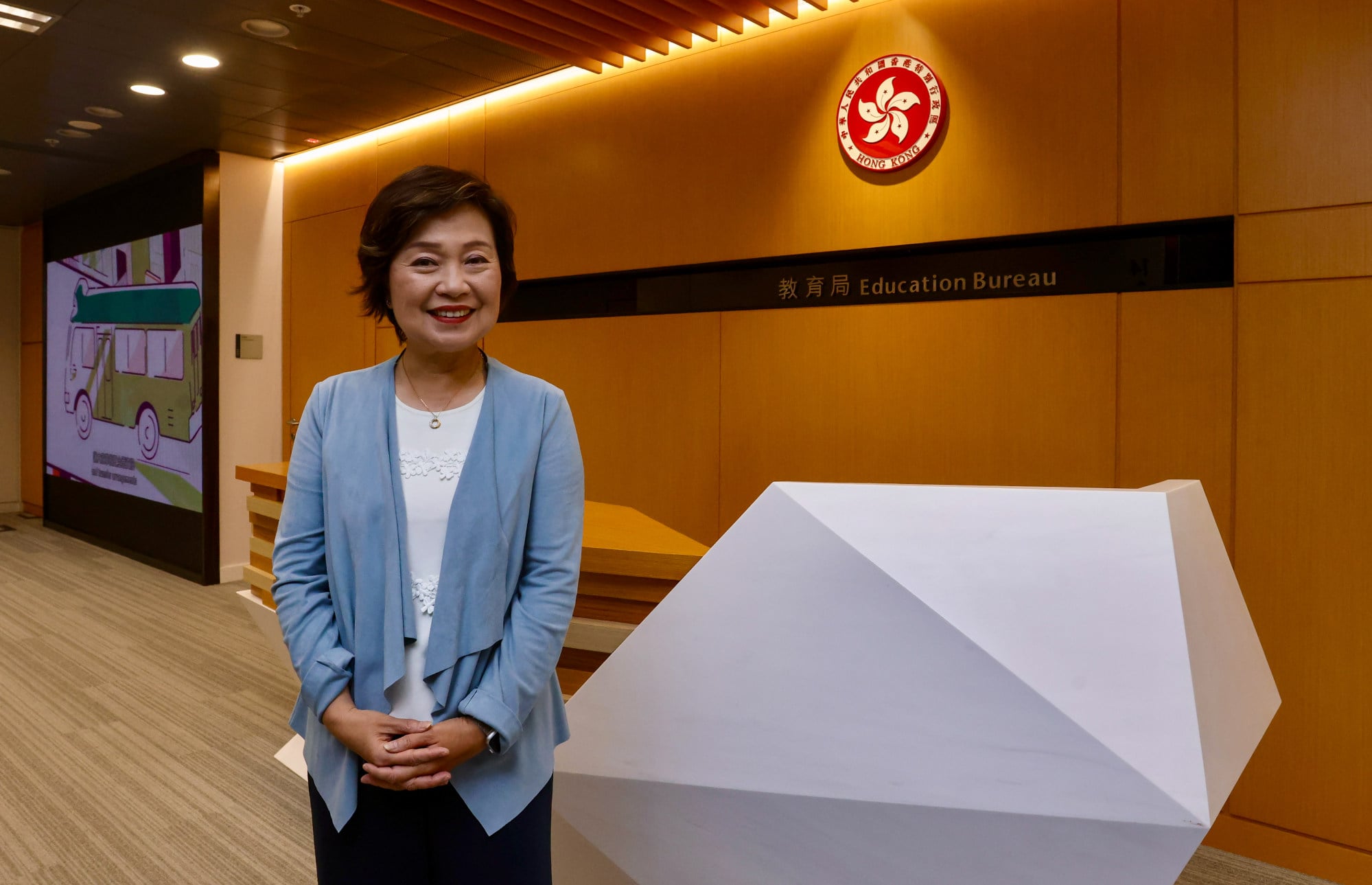
Hong Kong’s education minister has said that schools struggling with insufficient student enrolment must evaluate their own performance in meeting parents’ expectations rather than relying on government intervention.
Secretary for Education Christine Choi Yuk-lin also said the education sector should not insist on keeping the existing number of schools and emphasised a need for “metabolism” to ensure its vitality.
In an interview with local media last Friday, she said that the recent policy allowing schools that managed to operate four Form One classes to apply to run one more in the coming academic year was to “address parents’ needs and choice”.
Choi urged those schools with insufficient enrolment to reflect on their own performance, instead of simply hindering the development of more popular institutions.
“Schools finding it difficult to admit students throughout many years could not address parents’ and students’ needs. Why do they define themselves as weak schools and only ask authorities to take care of them? It should not be like this,” she said.
“Have they thought about the needs of the parents in their districts? What are the students’ needs and what could they provide for them and get their votes for the schools?”
Dismissing the concept of “equal distribution” of students, Choi acknowledged that parents would inevitably seek out better schools if their children were allocated to an institution they did not prefer. She referred to the common practice of “door-knocking,” where students seek admission to their preferred schools after the central allocation process.
“Parents will vote with their feet, there would be a ‘musical chair effect’ in the process. We have to face the situation that schools will compete for students if there are more supplies than demands,” she said.
“Why do we have to force the maintenance of the status quo? Why don’t we give a chance for the school sector to have a metabolism? Is it possible to keep those cells [the schools with insufficient students]. We want an energetic and vibrant system.”
She described the situation and the number of secondary schools having to face closure in recent years as “very mild”.
“We have to give a clear message that we [schools] have to be self-reliant and learn thoroughly what our students need,” she added.
The education sector, however, views the policy allowing popular schools to run an additional class as a threat to the survival of institutions already struggling with low enrolment, as it enables the former to admit even more students.
The Education Bureau previously estimated that the number of Form One students will decrease from 58,800 in 2025 to 49,800 in 2031.
Under current policy, secondary schools need at least two Form One classes, or a minimum of 26 students, to remain operational. Recent changes to the bureau’s policy will require schools to enrol at least 28 students for two classes in the coming academic year, increasing to 30 pupils in the 2026-27 academic year.
Schools failing to meet the two-class threshold must submit survival plans to the bureau.
Choi said that the bureau would apply a high threshold when assessing applications from schools seeking to operate an additional Form One class.
The school sector has expressed dissatisfaction over the lack of consultation before such a significant policy change on class operation was implemented.
Choi defended the bureau’s decision, citing data-driven efficiency.
“We do not consult [the sector] on every decision we make. Their responses were what we expected,” she said.
Hong Kong’s public primary and secondary schools are also facing a 10 per cent funding reduction in the coming academic year, with the sector anticipating further cuts.
Choi described it as an “optimisation of resources” instead of a funding cut, adding that authorities were considering greater flexibility in how schools used grants. - South China Morning Post