Unimaginable loss: A relative wailing during the funeral procession of Adil Hussain Shah, a daily-wage worker, who died when militants indiscriminately opened fire on a crowd of mainly tourists at his village, Hapatnar, in Kashmir. — AP
Security has been beefed up across Indian-controlled Kashmir a day after an attack killed at least 26 people, most of them tourists, as Indian forces launched a manhunt for the perpetrators of one of the deadliest attacks in the restive Himalayan region.
As investigators began probing the attack, many shops and businesses in Kashmir closed to protest the killings following a call from the region’s religious and political parties.
Tens of thousands of armed police and soldiers fanned out across the region and erected additional checkpoints.
They searched cars and in some areas summoned former militants to police stations for questioning, reports said.
Police called it a “terror attack” and blamed militants fighting against Indian rule.
“This attack is much larger than anything we’ve seen directed at civilians in recent years,”
Omar Abdullah, the region’s top elected official, wrote on social media.
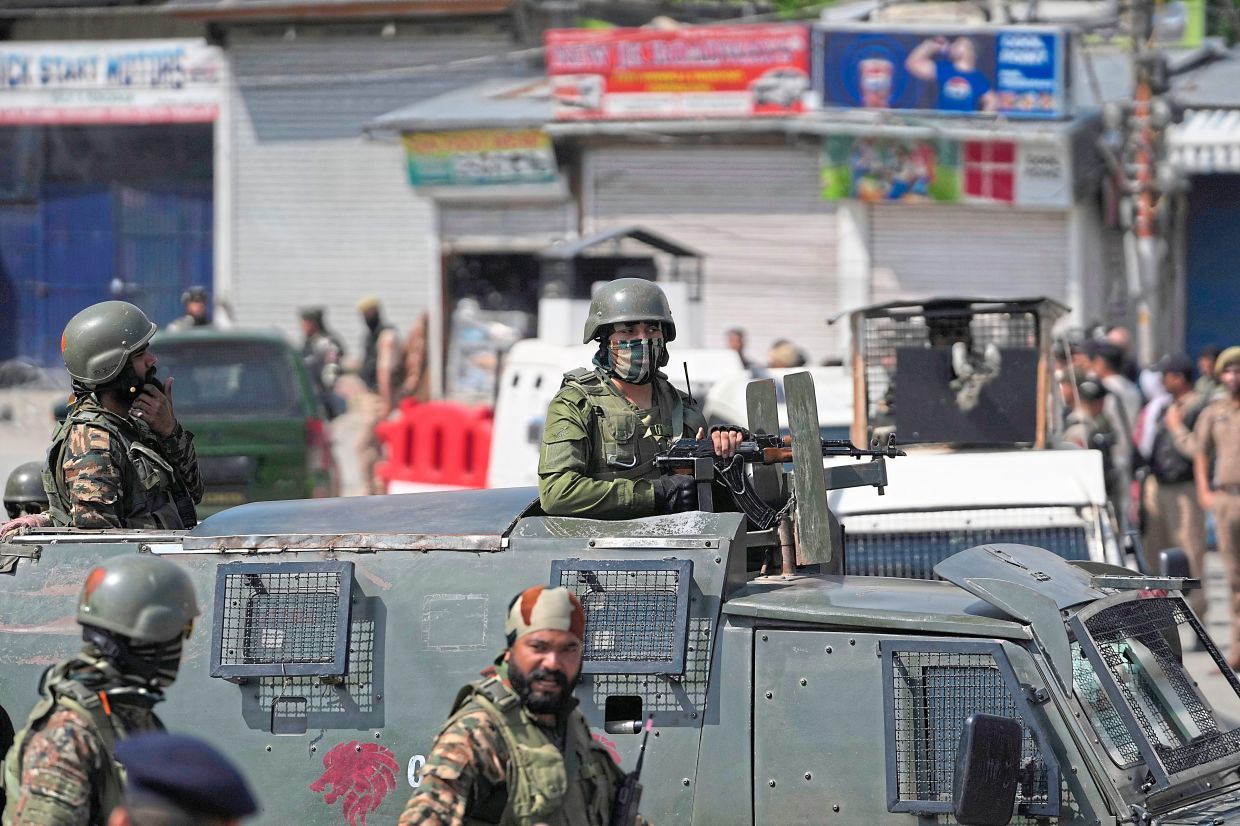 Indian soldiers standing guard in Srinagar. - AP
The two officers said at least four militants fired at dozens of tourists from close range.
Most of the killed tourists were Indian, they said, speaking on condition of anonymity in keeping with departmental policy.
At at least 24 bodies were collected in the aftermath of the attack and two people died while being taken for medical treatment.
There was no immediate claim of responsibility.
Police and soldiers were searching for the attackers.
“We will come down heavily on the perpetrators with the harshest consequences,” India’s home minister, Amit Shah, wrote on social media.
Global condemnation for Tuesday’s rare attack on the tourists came swiftly, while Indian Prime Minister Narendra Modi cut short his two-day visit to Saudi Arabia and returned to New Delhi early yesterday.
As a section of Indian media and some commentators immediately blamed Islamabad for directing such attacks, Pakistan extended condolences to the victims’ families.
“We are concerned at the loss of tourists’ lives,” Pakistan’s Ministry of Foreign Affairs said in a statement while wishing the injured a speedy recovery.
UN secretary-general Antonio Guterres strongly condemned the attack and stressed that “attacks against civilians are unacceptable under any circumstances,” UN spokesman Stephane Dujarric said.
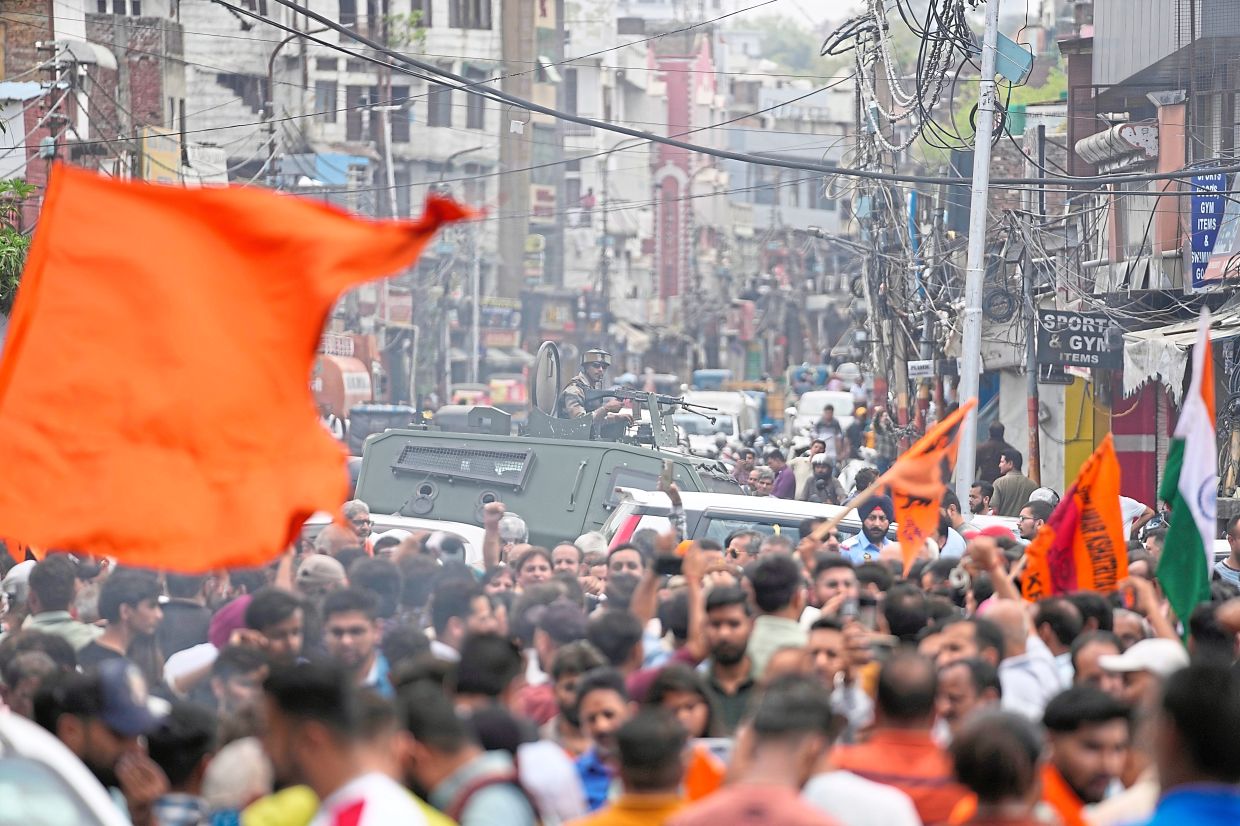 Indian youths gathering in protest against the Pahalgam terror attack in Jammu. - AP
Mirwaiz Umar Farooq, Kashmir’s top religious cleric, said on social media that “such violence is unacceptable and against the ethos of Kashmir, which welcomes visitors with love and warmth.”
Beijing’s foreign ministry also offered “sincere sympathies” yesterday following the deadly attack.
“We mourn the victims and extend our sincere sympathies to the families of the victims and the injured,” foreign ministry spokesman Guo Jiakun said, adding China “strongly condemns this attack”.
Kashmir has seen a spate of deadly attacks on Hindus, including immigrant workers from Indian states, since New Delhi ended the region’s semi-autonomy in 2019 and drastically curbed dissent, civil liberties and media freedoms.
New Delhi has vigorously pushed tourism and claimed it as a sign of normalcy returning, and the region has drawn millions of visitors who enjoy its Himalayan foothills and exquisitely decorate houseboats amid a strange peace kept by ubiquitous security checkpoints, armoured vehicles and patrolling soldiers.
Until Tuesday, tourists were not targeted.
Following the attack, panicked tourists started to leave Kashmir.
Monojit Debnath, a tourist from Indian city of Kolkata, said Kashmir was undoubtedly beautiful but his family did not feel secure anymore.
“We are tourists, and we should think about what safety we have here for us,” Debnath told the Press Trust of India news agency as he was leaving Srinagar, the region’s main city, with his family.
“It’s heartbreaking to see the exodus of our guests from the valley after yesterday’s tragic terror attack,”
Omar Abdullah, the region’s top elected official, wrote on social media.
“But at the same time we totally understand why people would want to leave.” — AP/AFP