YANGON/BANGKOK, Feb 14 (The Straits Times/ANN): The lifeline for thousands of Myanmar villagers fleeing violence after last year's military coup begins in kitchens like this.
On a street in Mae Sot in north-western Thailand, around the corner from a Burmese tea shop selling breakfast fritters, two women buzz around a giant wok bubbling with red curry. They stir in dozens of fried eggs.
Other volunteers pack the curry into foam boxes filled with steamed rice, careful to place one egg in each box.
The meals are stacked in a truck, which speeds towards the riverine border between Myanmar and Thailand. It is waved through by Thai soldiers, and quickly spotted by the displaced villagers withering in the midday heat on the opposite bank of the Moei River.
"Hta min! Hta min!" They cry out, alerting other villagers that their rice has arrived.
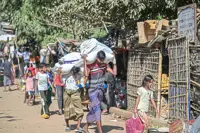
Men, women and children wade about one minute through the chest-deep water, stepping briefly onto Thai soil to collect their food. Then, with bags of boxed meals perched on their shoulders, they head back, toes feeling their way around the rocky riverbed.
Mae Sot was a bustling border town even before Myanmar's military seized power from the civilian government on Feb 1 last year.
Connected to Myanmar's Myawaddy district via two bridges, it often functions as a halfway house for migrant labourers on their way to jobs in other parts of Thailand.
Nearby plantations of onions, sugarcane and maize in Tak province are tilled by Myanmar workers. Many crossed the river regularly for work, before the Covid-19 pandemic triggered tighter controls over this porous border.
When the Myanmar junta began cracking down on dissidents, several fled to Mae Sot. Some prominent political activists even forwent asylum in Western countries to continue their work near the border.
Mae Sot's deep migrant networks, supported by Thai civil society and other groups, moved into high gear when clashes between the Myanmar military and ethnic armed groups sent thousands of villagers fleeing their homes.
In late December, the junta launched air strikes and heavy artillery attacks in Lay Kay Kaw, a town controlled by the Karen National Union (KNU), which has given shelter to dissidents within its territory.
Fierce clashes were also reported in subsequent weeks between the military and resistance forces in Kayah state, which neighbours Thailand's Mae Hong Son province. More than 9,700 civilians fled to Thailand.
Thai officials, wary of possible Covid-19 transmission, say fleeing villagers are given temporary shelter during fighting. But villagers question whether they are truly safe after the shooting stops.
Political dialogue in Myanmar remains elusive. While the military rampages through populations resisting its rule, young people who have joined guerilla forces nationwide are bent on overthrowing the junta. Myanmar's Institute for Strategy and Policy says that more than 3,500 civilians were killed last year, a record high in at least 30 years.
Junta troops departing towns and villages they had earlier occupied have been known to destroy homes, crops and livestock, or even plant landmines around the area.
The United Nations refugee agency UNHCR has so far not been allowed access to the civilians who fled recently to Thailand. On Jan 20, the UNHCR said the situation remained "extremely uncertain and volatile in Myanmar" and urged the Thai government to move the remaining 1,000 or so refugees in Mae Sot to "safer and more dignified temporary accommodation".
When The Straits Times visited the border at Mae Sot on Feb 7, most refugees had moved across the river to Myanmar soil. Many still felt it was unsafe to return home, and lingered on the sandy bank.
While a temporary encampment of blue tarpaulin there gave some shelter to refugees, conditions remained miserable - especially in wet weather.
"I couldn't sleep last night," 23-year-old undergraduate Si Thu Aung, who was staying on the Myanmar side, told ST. "My tent was damaged by the heavy rain, and I couldn't fix it. I had to sleep in the rain."
Like many others staying on that side of the Moei River - called Thaungyin in Burmese - he has to wade across the river to collect his daily meals. This may become more difficult when the river swells during the monsoon season from around May to October.
"I don't know if I can go home before the rainy season," he said, soaking wet after one such meal collection trip. "I might have to stay here for at least a year."
Small numbers of refugees stayed on Thai soil during ST's visit.
Their flimsy tents were nestled among tall vegetation, making them hard to spot from a distance.
While many fled with little more than clothes, one family managed to take along its goats.
But it was mostly a hardscrabble existence. Men heaped dried grass on their tarpaulin roofs to get some respite from the blazing sun.
"I want to go back home, but I am scared of the landmines," 27-year-old Thu Lay Phaw told ST. The farm worker had fled her village of Hpa Lu last December with her husband and three young children.
Her neighbour from Hpa Lu, Ma Moe, 49, is similarly fearful. She has not budged from Thailand despite being reminded thrice by local officials to leave.
Recounting a visit by officials the day before, she told ST: "They said we are not allowed to stay here, but we can return if there are clashes again.
"But they don't give us any pressure. They just informed us," she said. "Each time they talk to us, we move our tents just a little."
Nearby, 58-year-old Saw Hla Myaing stays in a tent with 18 other relatives. "This area is safe," he said. "I hope the Thai government can allow us to stay here."
Officially, these refugees do not exist.
Reached by phone on Feb 7, Tak province governor Somchai Kitchareanrungroj told ST that all Myanmar refugees have returned "safely and voluntarily".
"As for the possibility of them crossing again due to fresh fighting, our five districts along the border are well prepared and we can handle the same scale of displacement, a few thousand."
Tanee Sangrat, Thailand's foreign ministry spokesman, said ST: "We understand that Myanmar people in temporary facilities close to the border on the Myanmar side are those who cannot return to their homes in various locations for different reasons. However, some of them who recently returned from Thailand were able to take with them various humanitarian aid items.
"Additional supplies have also been made available by various Thai authorities if they wish to seek further support at this time. Local communities and NGOs are also able to send various forms of assistance to the other side."
Thailand's role will be increasingly crucial as Asean races to arrange humanitarian aid for Myanmar.
The UNHCR estimates that about 442,000 people have been displaced within Myanmar since the coup. Nearly half of its 55 million population is expected to be driven to poverty this year. Within Kayin state alone, there are about 70,000 internally displaced people (IDPs) in the areas under KNU control.
With the junta accused of blocking humanitarian supplies to communities suspected of supporting the resistance, aid that is channelled across Thailand's 2,400km-long border with Myanmar will play an important role in keeping most vulnerable people alive, say civil society workers.
"Cross-border assistance is now crucial for the IDPs," says Dr Cynthia Maung, a respected physician and founder of Mae Tao Clinic, which provides health services to migrants in Mae Sot.
She noted that the Myanmar communities in the frontier states of Shan, Kayin and Kayah maintain working relationships with Thai authorities and organisations across the border. These longstanding networks are capable of facilitating humanitarian aid, she said.
Take Phra That Pha Daeng Rescue, for example. The Thai volunteer rescue group says it rushed about 20 injured Myanmar people from the border to Mae Sot hospital last year.
Many of the victims were wounded by rocket-propelled grenades or snipers, says group leader Surent Auttama.
Normally, the group coordinates with local authorities on both sides of the border before making these rescue runs.
"If it's a real emergency, we don't even alert the (Thai) soldiers beforehand. We just go up the border," says Surent. "I've been a volunteer for 10 years now, and the situation has never been this serious."
Newly arrived Myanmar exiles in Mae Sot are doing their bit. Political activist Thet Swe Win teamed up with four compatriots to raise funds for the Lay Kay Kaw IDPs.
The money goes towards ingredients for 400 boxed meals every day.
Asked how long he could sustain the effort, he said: "It's a big challenge. We assume the fight will keep going on, so we have to be prepared for it." - The Straits Times/ANN
Already a subscriber? Log in
Get 20% OFF The Star Digital Access
Cancel anytime. Ad-free. Unlimited access with perks.