A little over a week ago, Malaysia saw Red Bull’s Max Verstappen top the podium in the 2026 Bahrain Grand Prix held at the Sepang International Circuit (SIC), as Formula 1 finally returned to the country after a nine-year hiatus.
But a month earlier, on Sept 5 and halfway around the world at the Imola Circuit in Italy, a very different kind of race took place, where machines rather than man took the chequered flag in an event spotlighting autonomous race cars.
The Abu Dhabi Autonomous Racing League (A2RL), held by the Abu Dhabi government research agency Aspire, saw five driverless cars zipping about the track, with United Arab Emirates (UAE)-based team Kinetiz coming out on top.
On the A2RL YouTube channel, a recording of the 12-lap race in Imola has garnered over four million views as of the time of writing.
Pushing the cutting edge
But some may wonder what the point of a race like this is when spectators have no drivers to root for and no display of human skill behind the wheel to appreciate.
However, the league is not just about racing. According to the A2RL website, it acts as a platform to both showcase and push the boundaries of autonomous driving technology, helping to advance its real-world applications.
Each race fields a grid of identical EAV-25 cars capable of reaching speeds of up to 300kph. These EAV-25s are based on the Dallara Super Formula SF23, which is used in the Japanese Super Formula Championship.
According to a report from The New York Times’ The Athletic published in early September, the EAV-25 operates using an “autonomous stack” consisting of high-end cameras, radar, light detection and ranging (Lidar), and GPS sensors.
The article further interviewed Alessandro Tucci, the executive director of the House of Grand Challenges at Aspire, who says that the A2RL is intended to place autonomous driving agents in extreme high-speed motorsports environments.
“It’s to test those technologies and then transfer those learnings into real life, where autonomy and autonomous driving are becoming more and more relevant,” he says in The Athletic report.
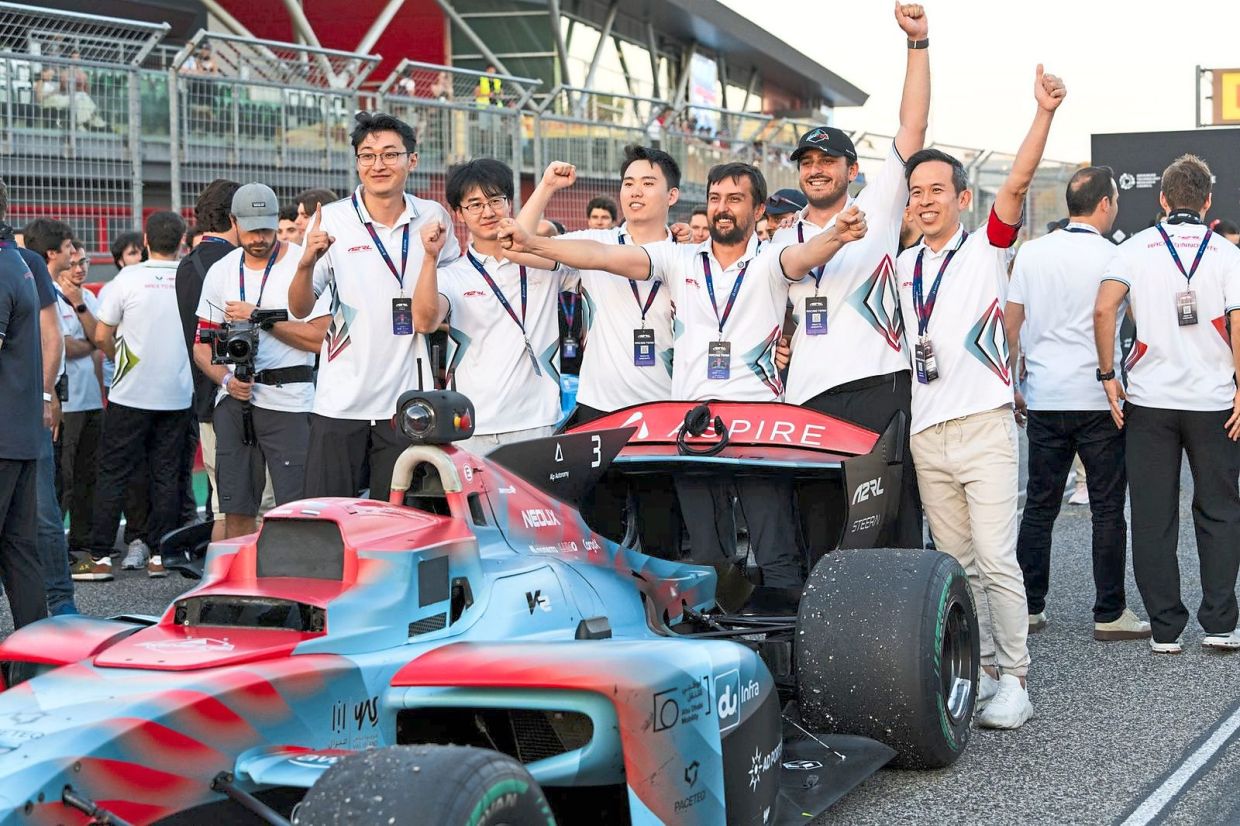
What makes each of them different from one another is the autonomous driving software deployed by the 11 teams from 10 countries, including the United States, Germany, China, Singapore, Italy, and the UAE, currently members of the league.
While motorsports teams are traditionally associated with major motoring brands, the teams involved in A2RL are largely technical universities, researchers, and artificial intelligence (AI)-centred startups.
That is to say, despite there not being a human at the wheel during the actual races, this does not make it any less of a competition, with the software side of things being where it becomes a hands-on affair for the teams, determining the behaviour of each individual autonomous racer.
A2RL technical director, Nicola Palarchi, outlined the impact that a car’s software can have on its performance in The Athletic report.
“There is a team that is very strong under braking, but not so strong in car control or loses time under acceleration.
“Even in terms of the corner trajectories that they take, you will see there are different lines. Everybody is doing it a bit differently and comes to different conclusions,” he says.
Making progress
In terms of the software being used, the teams have already been making significant gains since the league’s launch in 2024.
During an exhibition match last November, former Red Bull and AlphaTauri Formula 1 driver Daniil Kvyat took on the A2RL’s back-to-back Season One and Two champion, the Technical University of Munich.
The race ended with a 1.58-second gap in favour of Kvyat, but just 18 months earlier, there had been a massive 10-second difference between man and machine. Palarchi adds in The Athletic report that autonomous race cars have the potential to be faster than a human driver.
“When and if, it’s going to take some time. Because you get to the point where it’s easy to remove the seconds, it’s very difficult to remove the tenths, and the thousands is the toughest,” he says.
Despite the gains in performance, autonomous racing can still result in some unexpected moments on track.
At the Imola Circuit, for instance, the leading Unimore car slowed to a near-stop after a corner before being hit by the PoliMOVE car, allowing eventual winner Kinetiz to take the lead.
Following the Imola race, A2RL is slated to return home at the Yas Marina Circuit in Abu Dhabi to close out the 2026 season, with Forbes reporting in mid-September that potential international venues for the 2027 season are currently being discussed.