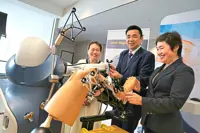
Honor Device Co demonstrated a humanoid robot and its so-called robot phone at MWC Barcelona 2026 on Sunday, as the Chinese device maker seeks to reinvent itself as an artificial intelligence-driven hardware company.
Shenzhen-based Honor spun out from Huawei Technologies Co in 2020. Originally a budget brand, it expanded into premium devices and foldable phones. Last year, the company said it would spend US$10bil (RM39.1bil) over five years to create AI devices.
Its humanoid robot, unveiled during a gala event on the eve of MWC, is its first own-brand android. It performed remote-controlled gestures and poses.
Honor is yet to give details of the robot’s specifications, pricing or production rollout. It’s intended to be deployed in customer service roles, the company said earlier.
The company also demoed the Honor Robot phone, which will go on sale in China in the second half of 2026.
The "robot” aspect of the phone is a 200-megapixel camera mounted on an articulating arm attached to the top of the device. The system can gesture and interact with the user, as well as capture impressive footage.
The camera moves in sync with music playback, gives responses akin to nods and head shakes, and serves as a sophisticated stabiliser for creative video capture. In one example, Honor showed it doing a steady cinematic pan that would be difficult to achieve with handheld operation.
Honor didn’t give details of pricing.
The phone’s design is intended to give AI a more human-like, expressive form, Honor said. It includes intelligent subject tracking and the ability to identify voice commands and user gestures. The advanced gimbal system supporting the camera is possible because Honor developed a micro-motor that’s about 70% smaller than what’s currently on the market, the company said. Three such motors power the phone’s arm.
Honor’s release sets the tone for the mobile industry’s annual gathering, heavily geared this year toward AI and the technology’s potential to boost device sales and cut inefficiencies.
But that promise is overshadowed by an AI-driven memory supply crunch that is now estimated to contract the smartphone market by a historic 13%. Honor and its Chinese peers such as Oppo and Vivo are expected to look for ways to push consumers toward more expensive, premium devices as one way to offset rising costs. – Bloomberg