BERLIN: "If we were to send the autonomous robot towards a fire now, it would simply walk through it and be destroyed."
Pirk, as head of the "Wildfire Twins" research project, aims to teach machines to autonomously navigate wildfires and extinguish them using artificial intelligence (AI) in the coming years.
Based at Kiel's Christian-Albrechts University, the project receives some €2mil (US$2.3mil/RM9.72mil) in European funding.
But unfortunately the robot is still far from deployment despite the destruction wrought by multiple wildfires that recently tore through southern Europe.
Firefighters were stretched to their limits in countries like Spain or Greece, with other nations lending expertise and equipment to ease the load.
Pirk and his team are still busy doing basic research and at first glance, the simulation images on Pirk's screen resemble video games.
The researchers simulate burning trees, undergrowth and entire forests in their software.
"We need to generate data in our simulation that looks as if it comes from a real wildfire scenario," says Pirk. "The whole thing should look photorealistic, like a real wildfire. It's similar to a video game, only more realistic."
Video cameras alone are not sufficient as images provide the machine with too little information about the fire. "At the moment, the robot still doesn't know what exactly to do when it detects flames," Pirk says.
"It simply has no template for solutions. It doesn't know whether to extinguish the flame in front of it directly or how much distance it should maintain."
Virtual training
The researchers aim to teach the AI to find safe paths through realistic fire scenarios using a virtual training environment.
"While I can easily construct a forest from a satellite image, it's much harder to model the undergrowth," Pirk says.
Satellite images do not provide information on whether the fire could be contained. But this is crucial for a plausible forest model. "That's why we're working on mathematical models and building 3D models of individual trees, undergrowth and grasses, similar to a computer game."
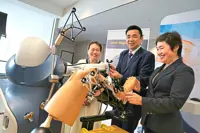
Currently, Pirk is working with four young scientists on the project. Training robot Byte, who which costs approximately €100,000 (RM492,170) and weighs 25 kilograms, is intended to provide firefighters with detailed information about fire scenarios in the future.
For the training simulation, a large number of photorealistic images of wildfire situations are required, which will be used to train the AI.
"We hope to have a virtual training environment in five years. However, Byte will not yet be able to carry out firefighting missions," Pirk says.
Originally from East Frisia, Pirk came up with the idea for his research project while working for a tech company in the United States.
Fire testing
Practical experiments are also necessary. Byte collects data on fires of varying intensities at a fire brigade school in Schleswig-Holstein, Germany's most northern state.
Once the technology is fully developed, it could be used in vegetation fires, says group leader René Heyse. "These are becoming more and more frequent."
Heyse shows in a fire container how smoke can ignite during a fire. "We are first trying to understand the fire with the robot," Pirk says. The AI must learn to interpret flames. "Just as we humans learn not to get too close to a fire."
Fire expert Heyse hopes the technology will help humans in assessing fires. "Where is the fire coming from, in which direction is it spreading, and are there people in the area?"
AI might even be able to recommend initial measures, having calculated how the fire is likely to develop. An AI-supported platform – whether drones or robots – could also be a valuable tool to keep emergency responders out of harm's way, he says.
Can AI help?
"The crucial phase is really the situation assessment," Heyse says. In an emergency, such decisions must be made at top speed.
AI could help identify areas at risk of collapse or extreme fire phenomena, such as hot smoke layers that are about to ignite. "If an AI-supported platform can already tell me all this, I have much more time outside to, for example, spot people at windows and immediately take action," he says.
In the long term, computer scientist Pirk envisions autonomous systems that can independently combat fires, as these rage through the world's forests. – dpa