A remote driver steers a Kia electric vehicle from Vay during a live demonstration of remote driving on city streets, seen from the company's control center prior to the Consumer Electronics Show in Las Vegas, Nevada, on Jan 6, 2025. — AFP
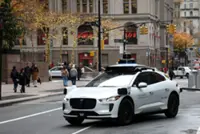
LAS VEGAS: With no one in the driver seat, the SUV pulling up resembles an autonomous robotaxi like those becoming increasingly present in some cities – but the car from German startup Vay is something else.
One of a number of emerging players aiming to disrupt road transportation, the seven-year-old company is built around remote driving, where a human is very much present, though sitting in an office using TV monitors to guide the car.
Over the last year, riders in Las Vegas have been able to test drive Vay, and the company was demonstrating its technology ahead of the Consumer Electronics Show (CES), the world’s most important tech show.
Thomas von der Ohe, chief executive and co-founder of Vay, said his was a lower-cost approach “that has nothing to do with autonomous driving”.
 Thomas von der Ohe, CEO and Co-Founder Vay Technology GmbH, stands for a portrait with a Vay remote driving Kia electric vehicle ahead of the Consumer Electronics Show (CES) in Las Vegas, Nevada on Jan 6, 2025. — AFP
Von der Ohe, who previously worked at Zoox, the Amazon-owned autonomous driving company, said that unlike autonomous driving companies, Vay doesn’t have to “run massive amounts of simulations” to be safe.
“Our core safety principle is that the (human driver) can make the decision,” he said.
And unlike a Tesla or Waymo, there is no dream at Vay of one day shedding the steering wheel, which twists and turns during rides as if manoeuvred by the Invisible Man.
 A Kia Vay remote-drive electric vehicle cruises during a live demonstration of remote driving on city streets ahead of CES in Las Vegas, Nevada. On a cosmetic level’s service resembles autonomous robotaxis, where a customer orders up a ride on a smartphone and is picked up, driven and dropped off by a vehicle with no visible driver. — AFP
The remote driving approach also employs fairly inexpensive camera technology, which costs a fraction of the envelope-pushing Lidar sensing systems favoured by leading autonomous companies.
A demonstration of the remote driving technology showed someone watching three screens – which included live imagery from front, side and rear-view cameras – as they operated a system similar to at-home racing simulators, with a steering wheel and pedals.
 A Kia Vay remote-drive electric vehicle cruises during a live demonstration of remote driving on city streets ahead of CES in Las Vegas, Nevada. Over the last year, consumers in Las Vegas have been able to test drive Vay, one of a number of emerging players aiming to disrupt road transport with driverless mobility. — AFP
Vay is offering rides for half the price of Uber or Lyft. Von der Ohe hopes to reach profitability in the next year or two, depending on how quickly the company can scale.
Since launching 12 months ago, Vay’s Las Vegas fleet has grown from two to 30 vehicles, completing 6,000 rides, von der Ohe said.
But Von der Ohe believes the company’s cash cow will not be ride-hailing, but the delivery of autos to consumers who then drive the vehicles.
 The mobile application to order a Vay remote driving Kia electric vehicle is demonstrated ahead of the Consumer Electronics Show (CES) in Las Vegas, Nevada on Jan 6, 2025. — AFP
In this way, Vay resembles a car rental company.
Since the launch in Las Vegas, some customers have ordered up Vay vehicles for home delivery and then driven them themselves.
That flexibility is one reason “we believe this can be a real alternative to private cars”, von der Ohe said. – AFP