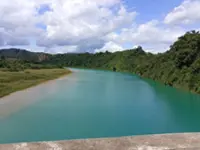
TANJUNG Aru Beach, located on the outskirts of Kota Kinabalu, is very popular both with locals and visitors. A visit to the place will show you why it is much loved.
It is an idyllic beach with tall, old casuarina trees, lovely sand, and some of the most magnificent sunsets in the world. Its proximity to Kota Kinabalu makes the beach a great place to take the family to for a peaceful day out. Many tourists visit the site daily.
Equally important is that Tan-jung Aru Beach is home to an endangered bird, the blue-naped parrot (Tanygnathus lucionensis). These uncommon parrots can be found around Tanjung Aru Beach and regularly draw many local and international bird watchers.
BirdLife International lists this species as near threatened. Esti-mates of the population size of this narrow-range parrot are very old and probably inaccurate but could be as low as 1,500 worldwide. BirdLife International states that population numbers are decreasing due to trapping and forest loss. The population of the blue-naped parrot at Tanjung Aru Beach is small, only around 30-50, due to competition with other birds for the nesting holes in the old beach-side casuarina trees.
Many other birds also use the location, including hornbills and imperial pigeons. Tanjung Aru Beach also serves as a “safe harbour” and first point of land for many bird species, some rare ones, during the annual bird migration from China, Japan, South Korea, and Russia.
There have been a number of attempts to “develop” the location with plans for many hotels, a golf resort, and a marina. Local conservation groups have frequently raised concerns about this project, its environmental impact, and how it is unfriendly to the public.
Sabah’s Environment Protection Department has an environmental impact assessment document for the Tanjung Aru Beach development. The report acknowledges that development at the site will significantly and irreversibly impact birds and other wildlife during construction.
The suggestion has been to relocate the parrots and hornbills, transplant the old trees, and offer nesting boxes at an alternate site. It is uncertain if this will succeed and at the very least will require years of work and considerable expertise.
We call on the local authorities and Sabah state government to cancel all projects in the Tanjung Aru Beach area. We can always get a new site for hotels, golf courses, and marinas but we cannot afford to lose both this rare parrot species and a wonderful location for people to have a day out for free.
It would be good for Malaysia to be recognised as a country that saves endangered species rather than one that destroys the environment.
DATUK DR AMAR-SINGH HSS
Editor, Malaysian Bird Report
RON PUDIN
President, Sabah Bird Watchers Association
Already a subscriber? Log in
Get 20% OFF The Star Digital Access
Cancel anytime. Ad-free. Unlimited access with perks.