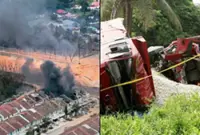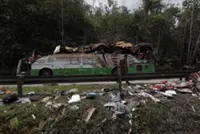
WE, along with the rest of the nation, are heartbroken over the loss of the lives of 15 young students from UPSI (Universiti Pendidikan Sultan Idris) who perished in the devastating bus crash near Gerik, Perak.
These were sons, daughters, friends and future educators. They had dreams, and families waiting for their safe return.
What was meant to be a journey back to campus turned into a national tragedy. To their families and loved ones, no words can ease this pain, but we extend our deepest condolences and pledge to do our part in helping ensure this never happens again.
The bus involved was said to be well maintained, driven by an experienced operator. Yet yesterday, the driver came forward with a harrowing account: a sudden and total failure of the braking system. According to his statement, both service and air brakes failed, the handbrake did not respond, and the gearbox locked, all while descending a hilly stretch of road.
This was not just mechanical failure; it was also an unimaginable loss of control. Importantly, this description matches known failure modes in air-braked buses, where leaks, worn-out components, or overheating under heavy use can render even a well-serviced system useless in moments.
It is therefore critical that a detailed forensic investigation of the bus’ pneumatic, mechanical and hydraulic systems be conducted to determine the root cause of the crash.
We acknowledge and appreciate the swift action of the Royal Malaysia Police in setting up a multi-agency task force involving the Road Transport Department (JPJ), Puspakom, Malaysian Institute of Road Safety Research (Miros) and Public Works Department to investigate the incident.
Dashcam footage supports the narrative of high speed, a rear-end collision and loss of control, reinforcing the need to examine all contributing factors, including driver behaviour and mechanical integrity.
But there is another aspect we cannot ignore. Survivors and visual evidence indicate that the roadside guardrail may have breached the bus cabin.
Guardrails are meant to shield and absorb impact, not turn into weapons. If the barrier’s design, condition, or installation was flawed, this must be uncovered.
Every guardrail on a federal highway must perform to standard, particularly MASH TL-3 specifications, which Malaysia has committed to adopting. We must ask: Did this barrier fail to perform when lives depended on it?
The crash site at KM53 of the East-West Highway presents another layer of risk. A poorly lit, winding descent with minimal shoulder space, it is the kind of terrain that demands exceptional braking systems and robust roadside infrastructure.
The combination of high stress on the bus’ mechanics and a potentially unforgiving crash environment may have created the conditions for this tragedy. We believe this incident calls for more than investigation; it calls for accountability, transparency and reform.
The authorities must expand the technical scope of their inquiry to include not only the bus’ mechanical systems but also the guardrail’s certification, maintenance and placement.
Malaysia’s road safety systems must be examined not just for compliance on paper but for real-world resilience under pressure as well.
Let this not be another moment of public grief that fades into silence. These students deserve better. Their families deserve answers. And the public deserves reassurance that we are learning from this urgently and thoroughly.
The best way to honour those we lost is to rebuild trust in the systems that were meant to protect them.
WAN AGYL WAN HASSAN
Founder & CEO
MY Mobility Vision
Already a subscriber? Log in
Get 20% OFF The Star Digital Access
Cancel anytime. Ad-free. Unlimited access with perks.