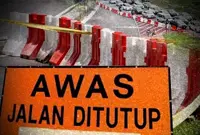
The back to the city rush is on again this weekend. With so many vehicles around, we could do with some signs of harmony on the roads.
A FRIEND of mine had a nasty accident on the North-South Expressway some years back. He rammed into a cow.

The bumper was ripped and the car was in a nasty state. The cow, meanwhile, ambled happily on.
Luckily for the friend, his insurance covered the damage, but he had to do without a car for a bit. He says he did not see the signboard warning him of cows on the highway.
Yes, they do have warning signs on the highway with pictures of a bull.
In fact, if you use the East-West Highway linking Gerik in Perak to Jeli in Kelantan, there will be signboards that show a leaping deer or elephants.
And a driver had better be aware of those elephants crossing. When it comes to the jumbo’s trunk against the trunk of your car, there can only be one winner.
If you thought cows, deer and elephants - and even tapirs - on signboards are quaint, you have seen nothing yet.
In Cape Town, South Africa, there are signboards that say “Please look under your vehicle for Penguins” – with cute pictures of the flightless birds.
Yes, those little fellas like to get under cars and enjoy the warmth there. They have them in Australia, too.

But the one that takes the cake is a signboard in Scotland that has an octopus playing with a car out at sea. No, the octopuses do not come out to land to kidnap cars. The sign just means you are driving close to the sea.
In Malaysia, we have (or had) a signboard close to the sea, too. It was in Penang, on a road leading to a man-made island. But there was no octopus or any other marine animal on it.
Instead, it had what looked like a round-bottomed flask – fully stoppered – leaning on its side while standing on a laboratory tripod, with only two legs of the tripod visible.
At least that’s what I saw. I probably have a clean mind (yeah, right!). Those with dirtier minds saw something far more sinister, or sexual – they saw a man’s genitals!
Anyway, that signboard with a stylised phallus drew wide attention and photos of it went viral. Sheepishly, the local council had to take it down.
I drove past the signboard onto the man-made island and back during Thaipusam recently. And I think the sign was wrong anyway.
The road leading from the roundabout does not make a U-turn and loop back to the rounabout. Instead, after you cross the bridge over the sea onto the smaller island, you drive on until you reach another bridge, which takes you to Straits Quay on the main island.
You then enter an inner road before you come to Jalan Tanjung Bungah. Only then do you get back to the roundabout.
I really wonder how they came up with the artwork for the signboard. They must have set up a meeting of some clever “signboarders” so they could brainstorm.
And a man’s organ, in stylised form, may have seemed like music to the ears, especially for a sign at the entrance to an island called Andaman!
After a song and dance on social media, the sign is now gone. Talking of music and songs, Mumbai in India just unveiled a road that sings, or at least hums a tune.
Launched on Feb 11, the northbound stretch of the Coastal Road is special. Tyres on the road produce music, and you can hear AR. Rahman’s Oscar-winning Jai Ho as you drive. The composer himself has driven on the road and found it awesome.
It’s not an Indian invention, though. It was a Japanese who discovered what is now called “melody roads”.
After bulldozers had scraped a road, leaving grooves in them, Shizuo Sinoda of Hokkaido noticed that cars going over it made a musical note.
He studied the phenomenon and came up with melody roads by making the right grooves. You could say he was really in the groove. There are now many such roads in Japan, the United States and South Korea.
The one that really captivates me is in Fukushima. On a quiet rural road, going past rivers and mountains, you can hear your tyres rolling out the tune of John Denver’s Take Me Home, Country Roads. It seems so apt.
But it’s not just about music. You see, the tune can only be heard if you drive over the grooves at a certain speed, about 70kph to 80kph.
So, these musical roads also serve to help slow traffic down. Motorists cut their speed to enjoy the tune from the road.
Sure, you can listen to music on radio, but where’s the fun in that? Listening to your car sing? Now, that’s special.
We in Malaysia could borrow that idea. Imagine, instead of those big yellow signboards with frowning “Zon Operasi Kamera” on our highways, we could have “Lagu P. Ramlee di hadapan, Kelajuan 70kph”.
I certainly would slow down to enjoy the tune. In fact, that is what many in Japan, South Korea and the US are doing.
But India is a bit different. There can be too much of a good thing there.
Just days after the launch, residents at the heavily-populated Coastal Road in Mumbai are complaining that they are tired of listening to the Jai Ho tune all day and want the road resurfaced.
Perhaps anyone who wants to build melody roads should just stick to highways and country roads.
Note: To all those on the roads back to KL today and tomorrow after the Chinese New Year holidays, stay safe and obey all the road signs.
Already a subscriber? Log in
Get 20% OFF The Star Digital Access
Cancel anytime. Ad-free. Unlimited access with perks.