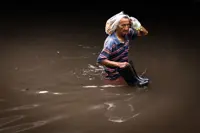
It’s often called sky juice, but what comes from our taps is a commodity that’s becoming ever more precious. We need to think about how to conserve water and our food too.
MY nephew’s house was a mess. There were boxes everywhere, with those black rubbish bags all filled with water. Elsewhere, pots and pans were stacked high, also filled to the brim with water.
All over the house, there were dozens of bottles of drinking water.
This was the scene on Wednesday, day one of the four-day water cut in Penang, which left more than half a million people with dry taps.
Bathing was a luxury, washing clothes was a no-no, and even washing dishes after meals was discouraged.
Instead, paper plates and utensils were used. Food shops were closed, as were factories. Many stayed home, miserable and with no water.
It was hardship for so many. And there were those who exploited this hardship to make a profit.
Many had to pay exorbitant prices for pails and drums to store water (RM65 drums were being sold at RM140), and drinking water was hard to come by at the shops.
Worse, there were stories of some people who ordered the drums online but never received them. The delivery guys decided to keep the drums for themselves!
It was chaos. And it was just for four days. Now, imagine if this was everyday life.
It could be. A water crisis is a real threat, not just in the country but throughout the world. And it’s not just water; we may be running out of food soon, too.
Malaysia is blessed with so much rain – we have floods every year – but we have been taking the commodity for granted for far too long.
We do not store enough of the excess water and much of it goes down the drain, literally.
Where I live in Petaling Jaya, they are building retention ponds under playgrounds and roads as flood mitigation projects. But what will happen to the stored water when the rain stops? Will it flow into the Klang River and on to the sea? Or can it be diverted elsewhere to be used fruitfully?
There is a new water treatment plant coming up in Rasau in Banting that could put the water to good use, but that will only come into service later this year, if we are lucky.
Meanwhile, Malaysians are using too much water. It is estimated that each person uses about 230 litres per day, much higher than the World Health Organisation’s (WHO) recommended daily water use of 165 litres per person.
That’s just too much. Consider this: some 1.1 billion people worldwide lack access to water, and some 2.7 billion find water scarce for at least one month of the year.
Inadequate sanitation is also a problem for 2.4 billion people, and two million, mostly children, die due to water-borne illnesses each year, according to the World Wildlife Fund.
We need to wake up to a new, dry reality.
Like National Water Services Commission (SPAN) chairman Charles Santiago said, treated water is not something meant to be used without a care, for things like washing cars.
Yet, there are those who wash their cars every week, if not every day, using water from taps. Rainwater should do for that.
Rainwater harvesting must be encouraged. Schools, universities and factories – even homes – have to start looking at rainwater as a viable alternative. It can be used for gardening, flushing toilets and even for washing.
Treated water will get more expensive – Penang and Melaka, for instance, are planning on raising rates – and it should be used conservatively.
Santiago said water sources are being depleted and river levels are falling. Water levels at Sungai Muda in Kedah, which provides drinking water to much of Kedah and Penang, have fallen by 7%. And a drought is predicted for this year and the next.
On top of that, factories are dumping waste into water sources. It costs too much to treat the water to make it potable.
“We just need to cut down (on consumption),” said Santiago.
He’s right. And it’s not just water. We also eat too much.
Just take the last few months. They have been all about festivals and feasting, haven’t they? There was Deepavali in November, Christmas in December, followed by the New Year celebrations.
Then, there is Chinese New Year less than a month away. And Ponggal on Monday.
But here’s something to chew on. By 2030, we could be looking at food scarcity throughout the world as the population explodes. We could hit 10 billion by 2050 and the madness will really begin, with the Earth unable to cope.
Nations like India and Ukraine, and even Thailand and China, will balk at exporting their foodstuff because they would need more for themselves. And food could cost an arm and a leg.
Remember, more than a quarter of Malaysia’s food supply comes from imports.
Common items such as chillies, onions, potatoes and even rice are all imported. Two-thirds of our chillies come from Thailand while about 30% of our rice is imported.
We need to plant more crops for ourselves.
But then, agriculture needs a lot of water resources too.
There is one thing we need to remember: water may be something that just falls from the sky, but there is no reason to take it for granted. In the not too distant future, some say, wars may be fought over access to water, not oil.
I’m glad the month of Ramadan will be upon us soon, just a month after Chinese New Year. We could all do with some fasting – without the extravagant evening feasting, of course.
Already a subscriber? Log in
Get 20% OFF The Star Digital Access
Cancel anytime. Ad-free. Unlimited access with perks.