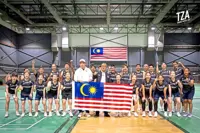
THERE is no such thing as a stroll in the park for Tengku Datuk Seri Zafrul Tengku Abdul Aziz.
After all, being the Minister of Investment, Trade and Industry is no easy task, especially not when the United States is bent on imposing tariffs and other economic barriers.
But the ever busy as a bee Zafrul, who is also the newly appointed president of the Badminton Association of Malaysia (BAM), wore a huge smile when he stepped into a casual gathering with sports editors on Thursday.
After exchanging pleasantries, we got straight to business and talked Malaysian badminton.
He seemed determined, sincere, and most importantly, willing to listen.
Every BAM president before Zafrul has done something similar: meet the stakeholders before laying out their plans. But not all have finished the race well.
I’ve seen BAM evolve under the leadership of Abdullah Fadzil Che Wan at his tailend (1993–2000), Mohd Nadzmi Mohd Salleh (2000–2013), Tengku Mahaleel Tengku Ariff (2013–2017), Tan Sri Mohd Norza Zakaria (2017–2024), and V. Subramaniam (acting, 2024–2025).
In fact, the late Tan Sri Elyas Omar (1985–1993) was also generous with insights after his retirement and made major contributions to the sport.
Every leader brought something good to the table but each faced their own struggles and shortcomings.
We won the Thomas Cup under Elyas in 1992 at Stadium Negara, and saw Malaysia’s first world champions in Aaron Chia–Soh Wooi Yik in 2022 under Norza. Datuk Lee Chong Wei dominated for almost two decades across different presidencies.
But sadly, the divide between BAM and professional clubs or players has remained since the time of Elyas.
Players have often left to form pro clubs or turn independent by seeking a space where they could flourish.
This model has worked in Denmark, and to some extent, in Japan and Indonesia.
Yet the talent pipeline in Malaysia has long shown cracks. The transition from junior to senior level has remained one of our weakest links.
States, meanwhile, continue to struggle without state-of-the-art training centres.
I remember the late Datuk Sieh Kok Chi once said that BAM’s system needed to change. Right now, it is top-heavy like an inverted pyramid. Kok Chi believed the focus should shift to the base: strengthening states and expanding grassroots development.
That means investing more in state coaches, facilities, and junior players.
So, can Zafrul add more bite as the 15th president of BAM since their inception in 1934?
Can we envision an ecosystem where BAM allow players like Pearly Tan-M. Thinaah to turn professional, while still having multiple batches of top-level players ready to step up within the national set-up?
Pearly–Thinaah were on the verge of leaving, only to stay on after being offered a better remuneration package.
Can we revive quality local tournaments where club players can challenge national players?
Zafrul’s first 100 days aren’t up yet, but he has promised a strategic plan to elevate BAM from their current position. Will he bring something bold, perhaps even untested to the table?
To succeed, he’ll need strong backing from all stakeholders.
Zafrul has promised transparency, and by the end of August, we’ll have a clearer picture of where Malaysian badminton is heading.
Hopefully, by then, he would have learned the tricks of the trade and lead the sport further than ever before.
Already a subscriber? Log in
Get 20% OFF The Star Digital Access
Cancel anytime. Ad-free. Unlimited access with perks.