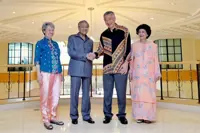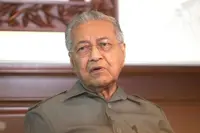
As the wife of the country’s longest serving prime minister, she was the epitome of grace, dignity, intelligence and elegance
SINCE her passing on Monday at the grand old age of 100, condolences and accolades have poured in for Tun Dr Siti Hasmah Mohamad Ali, who was widely loved, respected and admired.
I had the privilege and honour of being granted exclusive interviews with her, during which I experienced first-hand her talent for storytelling, kindness and gentleness, her wit and self-deprecating humour.

She will be best remembered as Tun Dr Mahathir Mohamad’s wife, a role she took very seriously.
As she noted in her memoir, My Name is Hasmah, the PM’s wife “was expected to be a role model, a positive influence, an inspiration to the people.”
And indeed she was.
Throughout her long and eventful life, she had a very clear sense of self with her own remarkable achievements as a government doctor and advocate for causes.
Yet, she was not entirely spared from detractors. She told me in an interview in 1996 that she and the family could not be totally protected from attempts to smear their reputation.
“There have been nasty remarks passed about me, like I am not Islamic enough.
“But they are usually anonymous letters, so why should I bother with them. I do gladly reply to one or two who write their names and give their addresses.
“I thank them for their advice and tell them it’s what’s inside that is important. If you believe in God, you don’t have to express it by covering from head to toe, it’s what‘s in your heart.
“Religion has always been part of my life. I pray, I fast and I believe in The Almighty. I also believe that if you do good, God will bless you instantly, not next year.”
This was among the many insights she shared with me in that remarkable interview, the first she had ever granted to a journalist.
My next interview was on the rather perilous and exciting holiday she and Dr Mahathir had in Antarctica and Argentina in 2002. I would interview her again when Dr Mahathir retired in 2003.
My last article on her was 10 years ago in this column after I attended her 90th birthday party and the launch of her memoir in 2016.
Whatever one might think of Dr Mahathir, none can cast aspersions on the love story he shared with his wife who was his rock.
She told me, “I always correct people when they say ‘Behind every successful man is a woman.’ I say no, not a woman, not any woman, it’s the wife.”
Before she played that role full-time, she carved out an impressive career for herself.
She was one of the first Malay women doctors, first woman to be appointed state maternal and child health officer in Kedah, and author of several articles on family medicine and socioeconomic factors associated with pregnancy and childbearing in Malaysia.
Mothering and caring for others was something that came early to her.
“Whenever there were any cuts or wounds in the family, I would be the one bandaging them up.
“I was always the brave one at home where looking at blood and stuff like that were concerned. I was quick at reacting, too, and that’s what put me in the medical line,” she said in the 1996 interview.
She admitted that attending medical school was a tough struggle for her: “It was very hard for me because I got in with only one science subject – Biology. It was just after the war and I didn’t have the opportunity to do Chemistry or Physics. Because of inadequacies, I had to repeat my first year. That was a great disappointment.
“But I was very determined and I was given the chance to repeat.”
Dr Siti Hasmah was born and raised in Kuala Lumpur and, in many ways, her family was more accomplished than her husband’s.
Her parents, despite being very conservative, were determined to educate all seven sons and three daughters, Dr Siti Hasmah being the youngest girl.
She and her sisters attended St Mary’s Girls School in Kuala Lumpur while her brothers went to Batu Road School before enrolling in Victoria Institution.
Her outstanding siblings included Tun Ismail, Bank Negara’s longest-serving governor who was also the first chairman of Permodalan Nasional Berhad (PNB); Tan Sri Ahmad Razali, who was Selangor mentri besar; Tan Sri Hashim, who was chief of staff of the armed forces and executive chairman of Sukom ’98 Bhd; and Tan Sri Dr Saleha, who was well known for her social and welfare work.
Dr Siti Hasmah was the only Malay girl in her batch of medical students at the King Edward VII College of Medicine, University of Malaya, then in Singapore.
In her book, she candidly shared that she “became known among my classmates as the girl who had to sit for exams every six months, repeating the subjects that I had failed...”
But it was because she had such difficulties that she found her “knight in shining armour” in Dr Mahathir who stepped in to tutor her.
That was the start of their life-long love for each other, which is detailed in Part 3 of her book titled “Sayang”, meaning love in Malay.
In our 1996 interview, she said she liked his personality and described him as “persistent and possessive.” They were in university together until 1953 when he graduated first and went to work in Penang.
They married when she was 30 (“which was considered quite old at that time”) and quickly started their family.
Marina was born in 1957, followed by Mirzan, Mokhzani and Mukhriz. The couple also adopted Melinda, and Mazhar and Maizura from Pakistan in 1984.
That was an open secret but during the 1996 interview, Dr Siti Hasmah asked me not to make public the details, possibly to protect their privacy as the two were still young.
As to why all her children have names starting with the letter M, she told me it’s because of her father-in-law: “He was a headmaster and all his sons have ‘M’ names.
“He explained that if a child had a name starting with ‘A’ and there were oral exams, he would be the first to go.
“So he didn’t want his children to go through the nervousness of being the first, but he didn’t want ‘Z’ names either because the child would have to wait the longest. The best thing, then, he said, was to stick to the middle of the alphabet.
“Also, when they needed to look for their exam results, all they had to do was to look in the middle of the list!”
Learning was a life-long habit for Dr Siti Hasmah who was the ultimate opsimath.
She learned conversational French in her 70s, picked up the traditional Chinese instrument erhu in her 80s, and got back to playing the violin, which she first learned at age 15, to perform at charity events 70 years later.
In her twilight years, her eyesight became very poor and she became increasingly frail. In her book, she wrote, “I have osteoporosis, so if you hug me, please hug me gently.”
But I never thought we would lose her before Dr Mahathir, who has had several heart attacks and was hospitalised for hip and head injuries in January this year.
She was blessed with the gift of a long life, but it was time she returned to The Almighty. I mourn her passing and I only wish I could have given her one last gentle hug and thank her for being who she was – the mother of our nation.
The views expressed here are the writer’s own.
Already a subscriber? Log in
Get 20% OFF The Star Digital Access
Cancel anytime. Ad-free. Unlimited access with perks.