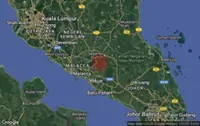
WE were spared. Sadly, not so for Afghanistan. The several mini earthquakes that occurred last week in Johor were nothing compared to what happened in Afghanistan on Sunday.
At the time of writing this, more than 800 people had been killed and at least 2,800 injured, most of them in the remote province of Kunar, which is in the mountainous eastern region of the country.

It is being described as one of Afghanistan’s worst earthquakes, and the casualties will surely mount as search and rescue efforts get underway.
The already beleaguered government is calling for international humanitarian assistance, and in the weeks ahead, the crisis will be extensively covered by the media.
Afghanistan is indeed very prone to earthquakes because of its location on top of several fault lines where the Indian and Eurasian plates meet.
Earthquakes occur when such tectonic plates that make up the Earth’s surface suddenly move and collide.
According to the BBC, earthquakes in Herat and Paktika provinces in 2022 and 2023, respectively, killed more than 2,000 people in total.
The country is prone to shallow quakes, which are said to be more destructive as the seismic waves travel shorter distances to the Earth’s surface and are therefore able to retain much of their power.
That destructive force can demolish everything in its way, especially where buildings and structures are made of timber, mud brick or weak concrete, which are not quake-resistant, as in the case of Afghanistan.
That is food for thought for us in Malaysia. The Johor tremors may seem like child’s play, but they indeed shook us out of complacency and the long-held belief that we on the peninsula are immune from earthquakes.
This is because, unlike other Asean nations like Indonesia and the Philippines, it is not within the so-called Ring of Fire, the arc of seismic fault lines that curves around the Pacific Ocean.
Actually, that sense of security was rocked in 2015 when a 6.0 magnitude earthquake struck Mount Kinabalu in Sabah, killing 18 people. While it was shocking and unexpected, it kind of made sense because the region is the part of Malaysia that is closest to the Philippines.
But when the Johor quakes occurred, alarm bells went off among Malaysians and Singaporeans.
There were four tremors, ranging in magnitude from 4.1 to 2.5, within a span of five days that were felt in other states, including Melaka and Negri Sembilan.
Media in both countries interviewed experts to explain the science behind the quakes.
Suddenly, we were learning that an old fault line, inactive for hundreds of years, is believed to be the cause of the quakes. It is called the Mersing Fault Zone.
And shockingly, there are other major fault belts on the peninsula, like Bukit Tinggi, Kuala Lumpur, Lebir, Bok Bak, Bentong and Lepar.
Singapore’s The Straits Times reported that the first quake was unusual, as it did not take place at the boundaries of tectonic plates, where most seismic and volcanic activity usually happens.
It quoted National University of Singapore senior lecturer of geography Muhammad Nawaz as saying the Johor quake was likely an “intraplate” one that happened within one tectonic plate, meaning it was caused by stress release along a minor fault within the Sunda Plate located in South-East Asia, traversing Vietnam, Cambodia, Malaysia, Singapore, Indonesia and parts of the South China Sea and Andaman Sea.
The quakes have shown, as Azlan Adnan, a fellow with the Academy of Sciences Malaysia (ASM) told CNA, that the Mersing fault had become active.
He added, “Considering the Mersing Fault (Zone), which could be at least 20km long, if it ruptures in full, a magnitude of up to 6.5 could occur. This means that the possibility of a larger earthquake does exist.”
His views are reinforced by other experts who cite quakes with magnitudes of 5.0 and 5.4 that took place in 1922 with epicentres also in Johor.
Even Singapore was shaken by an earthquake in December 1948 that was felt in several parts, including Geylang, Bukit Timah and Sentosa Island.
Even though intraplate earthquakes are usually milder, they can have a devastating effect, as was the case when a 6.3-magnitude intraplate quake hit Christchurch in New Zealand in 2011, killing 185 people. That was a rupture of a previously unknown fault line.
That’s why experts see the Mersing fault situation as serious and are calling for more monitoring resources of earthquake activities to mitigate risks to public safety.
What is also important is to ensure that building structures must comply with the EN 1998 Eurocode 8 on the design and construction of buildings and other civil engineering works in seismic regions, which was adopted after the Sabah quake.
Older buildings should also be inspected and reinforced as much as possible.
Even road and rail systems can be adversely affected by ground deformation resulting from the shaking generated by earthquakes.
Disaster Management Programme coordinator and senior lecturer Dr Rabieahtul Abu Bakar was quoted by Bernama as urging the government and the people to be more proactive in earthquake preparedness.
Here, we can take a leaf from Japan and China’s manuals on how schools train their children on disaster preparedness and effective evacuation drills.
Indeed, there is much to do if we are to take the Johor quakes as an early warning sign to act. But realistically, after the initial wave of enthusiasm and expert advice, the interest will die down and little, if anything, will be done.
We will follow the news on the rescue efforts in Afghanistan and most likely we will send our Special Malaysian Disaster Assistance and Rescue Team to help, like what we did with the Turkiye earthquake in 2016. And many good-hearted Malaysians and groups will raise funds and humanitarian aid for the victims.
But, as with previous tragedies, that interest will also wane over time and we will forget again, until the next disaster. We can only pray the victims won’t be us.
The views expressed here are the writer’s own.
Already a subscriber? Log in
Get 20% OFF The Star Digital Access
Cancel anytime. Ad-free. Unlimited access with perks.