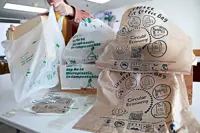
THIS will be my 10th column on a topic I wish I could ignore but simply cannot – the global plastic scourge.
The last time I wrote about it was June 12, 2024, on how plastic was simply everywhere, including in our bodies in the form of very tiny bits called microplastics and nanoplastics.
I am back on the subject because last month, Natural Resources and Environmental Sustainability Minister Nik Nazmi Nik Ahmad announced a nationwide ban on the use of single-use plastic bags in many places, including forest reserves, national and state parks, marine parks and certain business premises like supermarkets, convenience stores, petrol stations, fast food restaurants and pharmacies.
Implementation, however, will vary across the states, depending on their state of readiness and capacity.
As always, this sounds very good, but effective enforcement and compliance remain to be seen.
On a personal level, I have been quite smug about trying to live a less plastic life by always using cloth bags to pack my groceries and replacing my cooking utensils and water bottles with glass and metal ones.
But all this has been in vain. I am a plastic addict after all. In a recent mad online shopping spree, I bought numerous items that were made of mostly plastic materials, including a can opener, a rotary butter stick applicator, a fruit peeler, hair bands, and, horror of horrors, a bag of 100 disposable plastic food covers.
All of them were at ridiculously low prices that made buying them mindlessly irresistible.
Now, after receiving the goods, I am filled with regret and shame, especially over the food covers. What was I thinking?
Perhaps that was it: I wasn’t thinking!
Nanoplastics coursing through my blood have addled my brain. And as I whined almost a year ago, that stuff in my blood is probably mucking up my arteries more than plaque, and there is nothing I can take to dissolve or expel it.
This is no joke. The latest published findings, like in Nature Medicine on Feb 3, 2025, showed that about 7gm of microplastics and nanoplastics were found in the brains of human cadavers.
That’s equivalent to the disposable spoon we often get with takeaway meals.
The findings get even scarier because there is a possible correlation between high levels of microplastics in the brain and dementia.
But if we ban it, will it actually work?

According to Britannica.com, single-use plastic bans in many countries have shown results.
Plastic has long promoted a culture of convenience and laziness.
For example, it’s so much easier to throw away disposable cutlery instead of washing metal ones. So, when single-use plastic is banned, it forces people to take responsibility and find alternatives. We have seen how it’s now almost the norm to bring your own shopping bags to the supermarket.
“The bottom line is that plastic bag bans work. Millions... have realised that it’s easy to live without plastic bags and get used to bringing a bag from home or skipping a bag when they can. That means less waste and less litter.
For our children to inherit a less polluted earth, that’s exactly what we need,” says Faran Savitz of the PennEnvironment Research & Policy Centre.
While our government seems bent on tackling single-use plastic bags, attention should also be paid to the danger posed by plastic bottles and food containers.
This is because experts say these items are usually reused repeatedly and they can release chemicals that can cause hormonal disruptions.
But don’t we all have these “enemies” stacked up in our kitchen cupboards? How do we wean ourselves off plastic?
That’s why the Consumers’ Association of Penang (CAP) has called for the state and federal governments to do more and take the lead to remove plastic bottled water from their offices and events, following what states like Bihar, Maharashtra and Gujarat in India and Bali in Indonesia have done.
CAP adds that schools, colleges and universities should also do the same. I second this, as I absolutely agree with CAP president Mohideen Abdul Kader’s observation that “Gone are the days when water was served from a jug”, and those days should be brought back.
Hotels and convention centres, too, should bring back the jugs and glasses for their events and seminars.
Surely, such a move would be easier to implement and enforce, especially if there are water fountains and refill stations provided as well.
I will go further to urge the authorities to make it mandatory for all shopping malls to have such facilities at convenient and visible locations on their premises.
I do hope Nik Nazmi’s announcement of the nationwide single-use plastic ban will be properly implemented so that we can achieve our goal of total elimination by 2030.
Let it not be a farce like Selangor’s ban on drinking straws that was launched in July 2019. Those straws are back everywhere.
Admittedly, we can’t get rid of all plastics, but we must reduce its use and find alternatives. While there are replacements for many everyday plastic items, like cotton shopping bags, glass food containers, paper or metal straws, and bamboo cutlery, not all are really widely available and certainly not as cheap as plastic.
While the promise of recyclable and biodegradable plastic has turned out to be mostly false, as most types cannot be easily recycled and the biodegradable ones actually crumble into microplastics, I hold out hope for research into bioplastics, which use other materials like cellulose and starch that can make the ubiquitous shopping bag.
I am also awaiting news of further developments from scientists who are investigating how enzymes from plastic-eating bacteria and fungi can be used to biologically degrade plastic in global waste management systems.
If 20th-century scientists got us into this present mess by inventing plastic from crude oil and natural gas, here’s hoping and praying their 21st-century counterparts can find the solutions in time to get us out of it.
In the meantime, I promise not to use those disposable food covers.
The views expressed here are the writer’s own.
Already a subscriber? Log in
Get 20% OFF The Star Digital Access
Cancel anytime. Ad-free. Unlimited access with perks.