Losing heart over mandatory AEDs?


NOW that was embarrassing! There I was with a bunch of strangers when we were asked this question: “Where is the heart located? Put your hand up if you think it’s on the left.”

Up went my hand. After all, all my romcoms show the love-struck hero/heroine clutching their left chest because their heart is beating extra fast during a romantic encounter. What’s more, people – from MAS air stewardesses to leaders – wanting to show heartfelt sincerity or patriotism would place their hand on the left, not right or centre.

Dang! Wrong response. The heart is actually in the middle, between the lungs, behind and slightly to the left of the sternum which is the breastbone.

And that’s why when you perform cardiopulmonary resuscitation, or CPR, you place your hands on the middle of the person’s chest just below the nipples.

This I learned when I attended a free two-hour CPR + AED course that St John’s Ambulance Malaysia holds on the last Sunday of every month. It’s very popular, with full capacity attendance, with many coming with friends and family. I went with my two adult daughters.

We were taught the DRSABCD “manual” on performing CPR. This acronym stands for Danger, Response, Send for help by calling 999 (and not 911), Airway, Breathing, Cardiopulmonary resuscitation, and Defibrillation. By following these steps, you can help keep a person whose heart has stopped beating alive until an ambulance arrives.

After a detailed briefing, we moved to our practical training. But first we had to download a CPR training app linked by Bluetooth that would show us whether we were doing the compressions and recoils correctly and at the right pace on the plastic dummies. It would also rate us and we were encouraged to get as close to 100% as possible.

And so we took turns pumping the collapsible plastic chest on our Resusci Annie – as these CPR dummies are called – trying our best to get a 100% score.

We participants asked our trainers many questions and learned a great deal. After it ended, we went home feeling quite pumped up ourselves: We can save lives now! So we thought ...

A few hours later, we weren’t feeling so confident. As we reviewed what we learned, we realised we were so busy checking our performance on our phones, we barely focused on what we were doing on the dummy itself.

Of course, a dummy is just that. It doesn’t respond and we didn’t even look at its face because part of the procedure is to cover the face with a cloth.

I had assumed the dummy was male since it’s bald and doesn’t have breasts but here’s an interesting fact: It’s called Resusci Anne because the face is actually modelled on the death mask of a young girl who drowned in the Seine River in Paris in the late 1880s. Just Google “Unknown Woman of the Seine” to find out more of this fascinating background story.

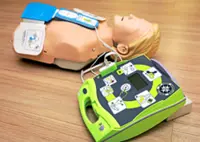
After CPR, we went to the final step in DRSABCD: how to use an automated external defibrillator, or AED.

According to the American Heart Association, a person’s chance of surviving a sudden cardiac arrest drops by 7% to 10% every minute a normal heartbeat isn’t restored. Applying CPR alone gives a person a 5% survival rate but combine it with an AED and the survival rate jumps to 75%. That’s how important an AED is.

Even an untrained person should be able to use an AED as once it’s turned on, there are voice prompts on what to do. But experiencing it first-hand with Resusci Anne does boost one’s confidence.

Its undisputed effectiveness in saving lives, coupled with the high incidence of cardiac arrests in Malaysia – reportedly about 29,000 cases a year – are what prompted former health minister Khairy Jamaludin to announce last year that it would be mandatory for all public facilities and transportation services to have AEDs available by 2025 (The Star, March 25, 2022; online at bit.ly/star_aed).

He added that the first phase would be for all public and private facilities to provide the device on a voluntary basis, and that under the MyAED Community project 100 AEDs would be placed around the country beginning June 1, 2022, and that number would be “increased from time to time”. MyAED Community is the ministry’s joint initiative with St John’s Ambulance and the Malaysian Red Crescent Society.

But 100 units throughout the country seems rather paltry, especially when compared with what Penang has achieved. As of September 2022, working with NGOs like Penang Heart Safe Society, 163 AEDs have been installed throughout the state.

Well, Khairy is gone and there doesn’t seem to be any new development on whether AEDs will be mandatory by 2025. Perhaps his initiative has gone on the backburner since there are plenty of issues and problems like overwhelmed emergency departments and severe manpower and equipment shortages in public hospitals his successor, Dr Zaliha Mustafa, has to tackle.

Indeed, coming up with a law on compulsory installation of AEDs is complex but there are several detailed papers such as Penang Heart Safe Programme Toolkits and CodeBlue’s Improving First Aid In Malaysia: Difference Between A Life Saved And Lost by the Emir think tank researchers on what is needed for a law on mandatory AEDs to be effective and enforceable.

Also, many places in other countries, like South Australia and Ontario in Canada, have formulated AED laws and all 50 US states have enacted laws on it too.

Some of the key points in most of the legislations are to establish the intent that any person can use an AED for the purpose of saving the life of another person in cardiac arrest; to encourage or require training in the use of AEDs devices; require the devices to be properly maintained and tested regularly; set up a location registry of all AEDs; and provide exemption from liability for any individual who renders emergency treatment with a defibrillator by enacting a “Good Samaritan” law.

Health NGO CodeBlue’s report emphasises the importance of first aid training, as research shows that such training increases confidence and trained individuals are almost three times more likely to feel confident in performing CPR than non-trained individuals.

That’s what my cardiologist says too when I meet him for my annual checkup. He believes awareness and public education are vital and should start in schools.

Indeed, studies confirm that a person is more likely to attempt CPR after watching a 60-second CPR video than someone who hadn’t watched the video.

Not only that, children as young as nine can pick up theoretical knowledge, practical skills and confidence to provide first aid.

Despite such findings, somehow this Aunty still feels unsure whether she can confidently swing into action. My cardiologist is sympathetic as he understands a two-hour training session on a dummy can be very different from a real-life situation.

He says doing compressions on a real person can be unnerving as one may feel or hear the ribs cracking or if the victim starts throwing up blood or vomit.

He also warns that CPR done right is exhausting and unless one is supremely fit, it is extremely tough to continue with the cycles of 100 to 120 compressions a minute.

I still am glad I attended the two-hour session and St John’s Ambulance does encourage participants to consider signing up for proper certified first aid training courses. That way, people like me will have no hesitation in saving a loved one or even a stranger.

My heart will definitely be in the right place.

But can our Health Ministry get back on track with mandatory AEDs? YB Minister, how?

The views expressed here are entirely the writer’s own.

Get 20% OFF The Star Digital Access

Monthly Plan

RM 13.90/month

RM 11.12/month

Billed as RM 11.12 for the 1st month, RM 13.90 thereafter.

Best Value

Annual Plan

RM 12.33/month

RM 9.87/month

Billed as RM 118.40 for the 1st year, RM 148 thereafter.

Follow us on our official WhatsApp channel for breaking news alerts and key updates!

Next In Columnists

The incredible star power rising from the East
Make Penang AI plan a bridge for majority
Giants fall, England survive – World Cup quarter-finals take shape
Who shapes global AI rules: Asean-China cooperation role
Why the Johor election is good for Malaysian democracy
Confessions of a durian season sinner
Looming threat to social security
More predictable than the World Cup
America at 250
Coexistence with wildlife key for public safety

Others Also Read