
Preserve unique lingo as it’s part of cultural identity
DURING my childhood days in the 1990s, it can be safely said that Hokkien was the undisputed lingua franca among the Chinese in Penang.
We were raised to speak the dialect, be it at home or out among friends.
Never mind that Malaysia’s northern Hokkien per se has been creolised ever since the early Chinese settlers arrived.

For example, we said tuala instead of mo kin; batu instead of chiok tao and bui for rice instead of p’ng (the more widely accepted Hokkien word for rice, especially in southern parts of the peninsula).
The distinctness of northern Hokkien is very much a part of a Penangite’s life.
My childhood friends, including two who have since resided in England and Australia, still speak in Hokkien whenever we have our annual gatherings.
The unique lingo brought the camaraderie and kinship closer, and punctuated both with warmth and cordiality.
Then came the Chinese Mandarin lessons at school, plus growing up watching Hong Kong movies and TVB series that allowed us to master Cantonese.
In public places, I tend to hear local Chinese folk, especially the younger generation, chattering away in Mandarin.
In restaurants, young waiters ask what we would like in Mandarin.
At times, I reply in Hokkien, and though my instinct tells me the person I am speaking with is a local, that person continues in Mandarin.
I am lamenting about how things have changed.
A slow death of the northern Hokkien seems to be an irreversible trend as nowadays, the younger generation is more comfortable with Mandarin because of their poor command of, or complete inability to speak, the dialect.
Learning the dialect, especially the intonation, can be tough and parents do not want to burden their children with an extra dialect of non-economic value.
But language is a window to the mind.
In conversational Mandarin, my perception is that its sentence structures and semantics connote a sense of formality.
But in Penang Hokkien, certain conjunctions and prepositions are sometimes done away with, leaving only the key words, allowing the speaker to punctuate and emphasise their points with intonation alone.
Embedded into this crisp way of describing something is a large degree of wry humour with perhaps a touch of benign cynicism.
And that, in essence, is the societal mentality of Penang Chinese folk; we laugh off life’s inconveniences in a good-humoured way with a light touch of boastfulness expressed in such a way that our peers know we are purposely and playfully faking it.
It is how, from what I see, we Penangites appear to be relaxed and boisterous at the same time.
All this is taken away when we use other languages or dialects in daily life, bearing in mind that all languages are cultural expressions.
During a Mid-Autumn Festival potluck session, I said to my four-year-old daughter: “Chiak ka liao ka gia” (Finish the one on your plate first before taking another piece).
She was eating a piece of jelly at a kindergarten gathering.
A parent sitting next to us was taken by surprise that I spoke to my child in Penang Hokkien.
I realise that most, especially the older generation, would be delighted to hear Penang Hokkien chattering in full swing.
At home, I still speak in our hybrid dialect with mum and my wife.
And naturally, my two daughters (the other one is six) picked up the dialect from there.
My children speak decent Hokkien, with sentences often beginning with “Hamisu” (What’s happening?), “Hamilai” (What’s that?) and “Uu hami boon tay” (What’s the problem?).
My young daughter’s favourite phrase has always been, “Wa mai ga lu lang gong ua liao” (I don’t want to talk to you all), when she gets angry.
Dialects matter because they are an essential part of linguistic diversity.
They reflect the unique histories, cultures and identities of different communities around the world.
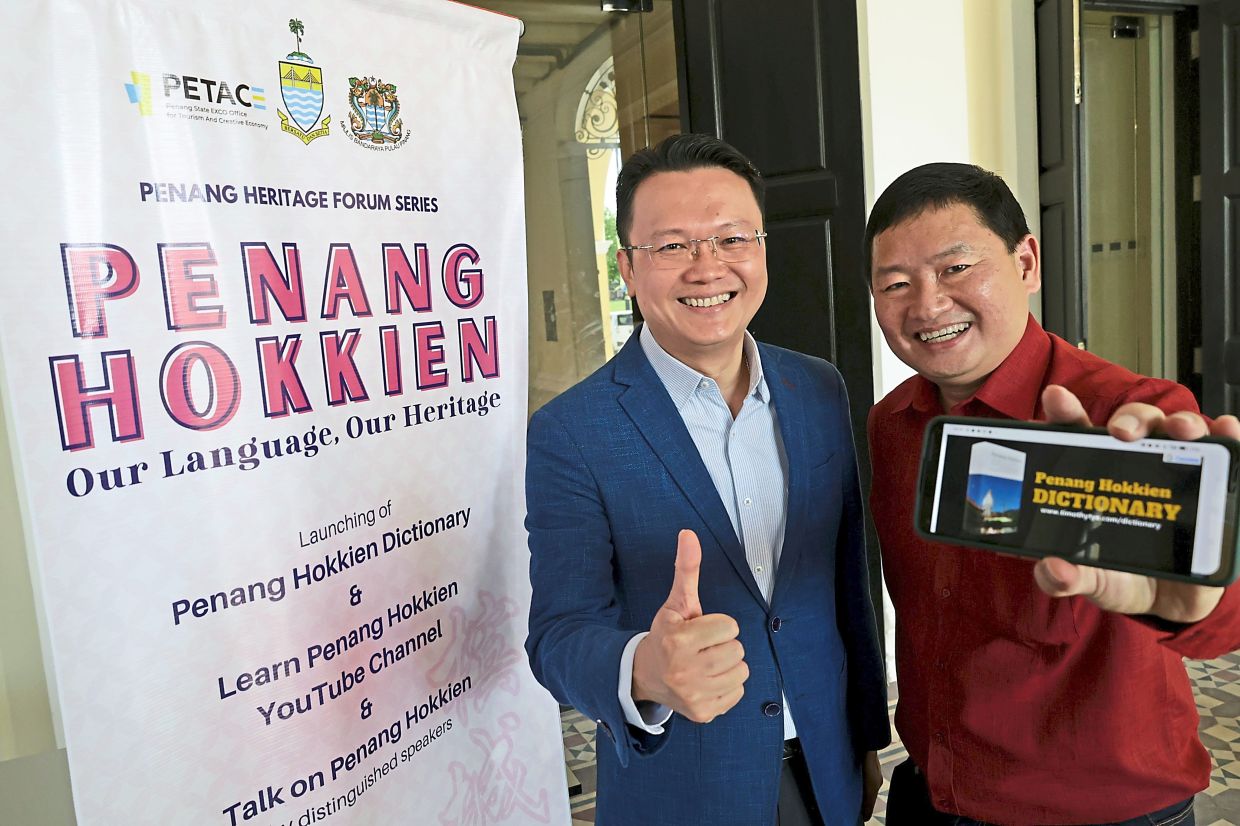
I am glad that the Penang government has proposed that our dialect, which has been used for over 300 years, be gazetted as a state heritage under the Penang Heritage Enactment 2011.
And Hokkien dialect activist Timothy Tye even created a Penang Hokkien Dictionary (https://www.penang-traveltips.com/dictionary/index.htm) and “Learn Penang Hokkien” YouTube channel (https://m.youtube.com/c/learnpenanghokkien).
To me, these are vital steps in preserving the dialect for generations to come and ensuring Penang’s strong Hokkien identity is rooted here.
For parents out there, you too can play a part in encouraging the young people to inherit this proud tradition.
Already a subscriber? Log in
Get 20% OFF The Star Digital Access
Cancel anytime. Ad-free. Unlimited access with perks.

