GIBRAN Rakabuming Raka’s resignation as Indonesian vice-president on Thursday reminds me of what I had predicted in 2024: after Joko Widodo helped him become president, Prabowo Subianto would dismantle his predecessor’s power and influence.
It was a learning experience to observe the three-way fight between Prabowo, former Central Java governor Ganjar Pranowo and former Jakarta governor Anies Baswedan. They were the candidates, but it felt like President Jokowi was on the ballot. And whoever he supported would win the race to be the president of the world’s most populous Islamic-majority nation.
During and after the Indonesian polls, I gave presentations to public audiences and politicians in private. I titled my presentation: “The fall, fall, fall and rise of Prabowo: How the 73-year-old ex-general increased his ‘elektabilitas’”. The Indonesian word elektabilitas means electability.
Prabowo fell three times: when Megawati Sukarnoputri ran unsuccessfully for Indonesian president against Susilo Bambang Yudhoyono, with him as her running mate, in 2009; and when he lost twice to Jokowi in the 2014 and 2019 presidential polls.
His rise occurred during several months of campaigning, when Prabowo’s numbers rose, especially against the main contender, Ganjar, whom many thought would be president. After polling on Feb 14 2024, Prabowo rose to become president.
During the campaign, the Jokowi effect clearly propelled Prabowo higher.
In my presentation, I showed Prabowo’s rebranding and social media strategy. In the 2014 and 2019 presidential elections, the ex-general’s image was that of a hardline, charismatic, hot-headed and tegas (assertive) leader.
It didn’t work. So he pivoted to a bapak-bapak friendly (uncle-next-door vibe), gemoy (cute) and cat-lover persona for the 2024 election. This was the image the young – who made up 56%, or about 116 million voters – loved.
Social media campaigns portrayed Prabowo as a Jokowi loyalist who always walked behind the president. This was meant to convince Jokowi voters – who also supported PDI-P, the party of Jokowi, Ganjar and Megawati – to back Prabowo of the Gerindra Party.
The Jokowi effect worked. Without the then-president’s high approval ratings (above 75%) and his son, Gibran, on the ballot as his running mate, Prabowo’s baseline popularity hovered around 35%. Most credible Indonesian pollsters attribute an additional 20 to 25 percentage points of his final vote share directly to Jokowi’s enduring popularity.
Gibran stepped down following a prolonged controversy over his high school qualifications, after a constitutional court ruling found no convincing evidence that he possessed the high school diploma or equivalent certificate legally required to run for office.
In news coverage following Gibran’s resignation, Jokowi said he viewed the development as “normal” and part of normal “political dynamics.” He also noted that he had previously reminded his son that political positions and public offices are only temporary.
It was a textbook Javanese politik alus – the politics of refinement – at play. Jokowi was masking tension with grace; rather than showing panic or fighting back against political enemies, he disarmed them with a serene, unbothered demeanour.
Beyond studying rebranding and digital campaigns, my political tourism trips to Java taught me another local lesson over cups of single-origin coffee: good coffee isn’t bitter; it is complex and flavourful.
That subtlety is the essence of Javanese politics and Jokowi is its master. Through indirectness and by refusing to overreact publicly, the former president maintained absolute control while denying his opponents a target to strike back at.
This reflects control through calm, embodying the Javanese political philosophy that the most powerful leader is often the one who appears quietest, calmest and most detached from ambition (aja dumeh – don’t get carried away by power).
Wayang kulit serves as the ultimate metaphor for politik alus because its structural mechanics mirror traditional Javanese power dynamics. Just as audiences watch two-dimensional shadows while the dalang (puppeteer) pulls the strings unseen behind the screen, public political optics mask the real bargaining occurring in the hidden inner realm.
In contrast to Jokowi’s veiled wayang kulit style of choreography, Prabowo’s approach to dealing with Gibran is better captured by the traditional martial art of pencak silat. Rather than meeting a powerful opponent with brute force, a silat practitioner steps aside, lets the adversary’s momentum carry them off-balance and delivers a sharp, decisive sweep.
When Gibran and the Jokowi camp built a wall of institutional power and protection, Prabowo did not try to shatter it head-on. Instead, when legal vulnerabilities around Gibran’s school credentials surfaced, Prabowo’s camp let the courts and parliament take their course.
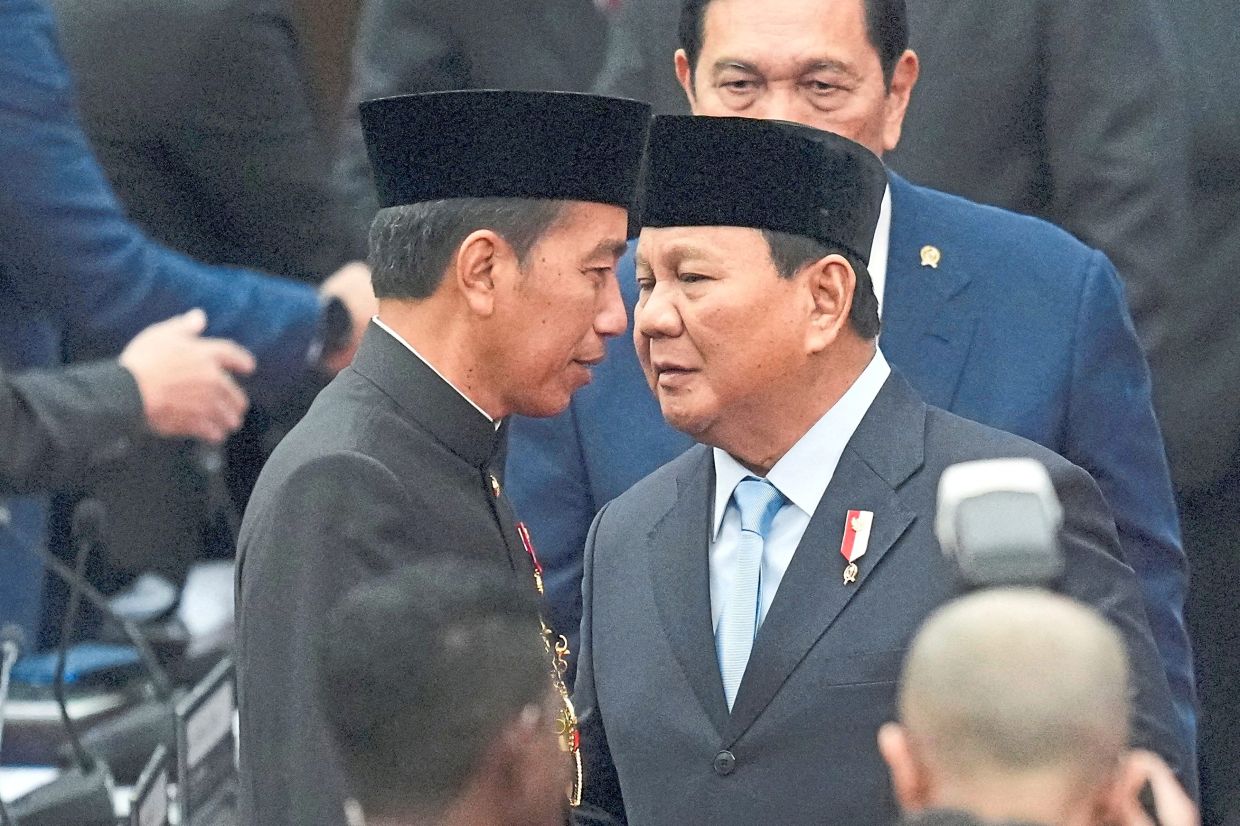
Ultimately, Gibran’s own political baggage – the persistent controversy over his eligibility – became the very thing that tripped him up. Prabowo merely stood back, let the system process the legal reality and watched the momentum collapse under Gibran’s own feet.
The vice-president’s fall is one of the masterstrokes Indonesian political watchers see as Prabowo dismantling Jokowi’s power. The others include the president conducting cabinet reshuffles that moved key Jokowi loyalists from powerful positions to advisory roles, as well as exploiting a major national security and intelligence fallout: the high-stakes wiretapping scandal.
Political analysts point to several strategic motives behind Prabowo’s efforts to clip the wings of Jokowi, the very figure who enabled his presidential victory.
They note that as long as Jokowi retained massive influence over key cabinet portfolios, the legislature and the political machinery, Indonesia effectively operated under a dual power structure. To govern autonomously and establish his own political legacy, Prabowo had to assert absolute authority.
Jokowi had embedded his loyalists across strategic state institutions, law enforcement and political parties, hence, weakening this network allowed Prabowo to consolidate control over his ruling coalition and prevent the former president from acting as an ultimate power broker behind the scenes (the dalang behind the wayang kulit screen).
Relying so heavily on the “Jokowi effect” also left Prabowo politically indebted and vulnerable to external pressure, making the systematic dismantling of that influence essential to neutralising the risk of his administration being co-opted or overshadowed by his predecessor.
I had predicted that Prabowo would eventually turn against Jokowi because his friendly, gemoy persona was merely rebranding. Beneath the cuddly campaign facade lay the unyielding, assertive ex-general the public saw in the 2014 and 2019 presidential polls.
But never underestimate the quiet master of the Javanese politik alus. The dalang sits behind the wayang kulit screen, and from the shadows, his puppet might pull out a political keris, and the pencak silat opponent falls.
Already a subscriber? Log in
Get 20% OFF The Star Digital Access
Cancel anytime. Ad-free. Unlimited access with perks.