This was a shock to me since he is in a private school that offers advantages like smaller classes so students get enough attention and help.
This got me wondering, and two questions came to mind: How do teachers set exam questions, and do teachers teach our children how to study, not just what to study?
When I began my career as a lecturer at Universiti Teknologi Malaysia in 1987, I had to set questions for exams in the course I was teaching, of course.
But I had no knowledge of how to do so, and the only guide I had were the previous questions set by an Engineering lecturer – which were completely disastrous and led to many failures.
Luckily I remembered what happened in my first year at the University of Wisconsin in Green Bay, in the United States. In the first semester – I remember it was cold, in autumn – I and two other wide-eyed Malay boys, all of 18 years old, sat for our first class in a foreign country. It was Calculus 1 and it was held for an hour from 9am, four days a week, and was a course of four credits.
The lecturer was an elderly gentleman always dressed in a chequered blazer. Prof Dr Loomer was probably in his 70s or 80s. He was always courteous and patient, thorough in his explanations of mathematical concepts and solutions.
The following is how he conducted his classes and held examinations, and I think this should be THE way for setting exams in Malaysian schools and universities.
Prof Loomer walked in on the first day and started explaining a mathematical concept directly similar to the textbook listed for the class. He gave many examples of his own but they all converged on the explanation given in the textbook.
This, I believe, is a lesson Malaysian educators must learn: There must be a main text, and you must not veer too far from it, please! Teachers here have textbooks, of course, but most ignore them and take the knowledge from other ulangkaji, or reference, books. Apart from me, most lecturers, as far as I know, do not have main textbooks.
Back to my class: Prof Loomer would give out exercises for homework from the textbook. He would say: “OK guys, could you try out the exercises on page X and X, from numbers so and so to such and such”. He would identify seven to 10 questions for us to practice.
Then he’d always say: “Now, after you have tried them all, please list the hard questions you could not solve on the white board tomorrow, in the left corner”.
So my friends and I would work on the questions as instructed, and the next morning we would list out the questions that we could not solve, usually one or two, as did the other students. Once, though, one student just sauntered in and listed ALL the questions set by Prof Loomer!
Prof Loomer would walk in the next morning and check the questions we had listed, and he would proceed to show the workings in resolving them. He would spend about two-thirds of the period on this before beginning or continuing the topic for the day.
At the end of each week, Prof Loomer would give us a quiz of three or four questions to solve in the hour-long class.
Now, the quizzes would contain exactly the type of practice exercises that we had done from the textbook, so for whoever had done the exercises, they were a walk in the park. Those who did not do the exercises on their own would struggle.
After three weekly quizzes, we had to sit for an exam in the fourth week. The exam would contain one or two questions similar to the type of questions set in the quizzes. If you flew through the quizzes, then you would do well in the exam.
There were three exams before the final big exam. Guess what? The final exam contained questions from the three small exams, to be completed in two hours.
The problem here is that our teachers do not use the assigned textbooks to set exam questions but rely on those reference books produced by private companies.
I went to public school for six years and I know this for a fact. I had five children go through public schools and private schools, pun sama juga. The teachers do not use the textbooks.
Secondly, exam questions are not prepped in class exercises or assignments.
Thirdly, there are no mock or trial exams to acclimate the students to the type of questions that would be asked.
So now I have to spend my time prepping my grandchildren and grandnephews when they visit my home during the school holidays.
My wife and I have to be the tuition teachers to prepare them for exams and teach them how to study so they will pass the SPM exam in the Malaysian way.
Apparently, neither public nor private schools teach our children how to study for exams (except maybe the elite Mara Junior Science Colleges) or prep them with questions.
For lecturers and academics, my advice is NEVER ask questions in the exam that you have not discussed or assigned as an exercise.
Our children are not stupid, so perhaps they do badly because our teachers do not know how to set proper exam questions or don’t prep them for exams.
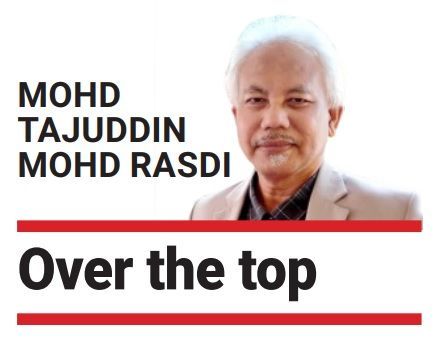
Prof Dr Mohd Tajuddin Mohd Rasdi is Professor of Architecture at the Tan Sri Omar Centre for Science, Technology and Innovation Policy Studies at UCSI University. The views expressed here are entirely the writer’s own.
Already a subscriber? Log in
Get 20% OFF The Star Digital Access
Cancel anytime. Ad-free. Unlimited access with perks.