Universities shouldn’t stand as ivory towers with no connection to wider society. If they do, then what is their purpose beyond churning out students with degrees but no vision?
THE Doctor of Philosophy – the PhD – degree is supposed to be the crowning achievement of tertiary education. Professionally, it is supposed to be the beginning of an important career in developing new and existing knowledge for the betterment of humanity.
However, after 35 years in Malaysian academia, I am sad to see that graduate degrees have deteriorated to the mere completion of a thesis followed by an uninspiring career of writing papers and chasing research grants and empty titles.
I also hear many sad stories of neglectful PhD supervisors who treat students as “paper factories” (they add their names to papers students generate) and don’t even comment on their work for six months. Atrocious!
This is, of course, a rather niche subject that the general public might not be concerned about. Yet, universities should not be elitist towers of academia, they should be a part of wider society, involved in bettering all our lives. The public should know how the system works – or doesn’t work as the case may be.
Hence I ask your indulgence, dear reader, as I examine the process of getting a PhD and how students and supervisors alike should approach it.
To begin with, finding a good PhD supervisor is absolutely vital. Most students just read the institute’s basic entry requirements and then apply and hope to get a good adviser. That is not the way.
With so much information available online, the aspiring graduate student should search for a supervisor with a detailed CV and the right background in their field of study. Attitudes are not online, unfortunately, but perhaps examining past writing can give you an idea which supervisor values students as future colleagues, partners and even future bosses. My first PhD graduate is now my colleague in research and he is my boss as head of postgraduate studies. He signs my contract of service papers. I became a professor at the age of 43, he at the age of 41.
I also maintain close contact with all my PhD graduates, which allows me to forge strong relationships that link a lot of work and private projects. Through them, I can access research webs and teams. I can always count on them for moral, academic and professional support. And with international students, global contacts are possible too. So supervisors, value your students and treat them well.
From the other side of the equation, supervisors should also look for good students. I do so by giving many public talks where I meet most of my potential grad students. If a supervisor waits for a student to be assigned by the faculty, there is little chance that he or she would be a good fit.
Supervisors should also make time at least once every two weeks to meet with each student, come what may. “Oh, I’m too busy” with whatever is an unacceptable reason not to do this. If a student cannot get an appointment within two weeks, the university should take note of it and advise the supervisor appropriately.
Similarly, if a student submits written work and cannot get an evaluating response within two or three weeks, I believe it is a sign that the supervisor does not respect the student and is not according him or her proper dignity. I always try to comment within a week. Reading papers is not difficult as I look for the structures of argument and not with the detailed eye of a language editor.
I train my students to be scholars, not just researchers completing theses. I do this by, among others, giving them opportunities to conduct public talks and encouraging them to write to the media with their opinions and ideas.
I would say that 95% of supervisors do not do this and only train grad students to write obscure journal and research papers. Of course, these have value within academia but the public and the country do not get anything out them directly, no introduction to new ideas and developments, no sharing of knowledge.
To me, knowledge that is elitist and kept within a small circle is almost a sin against humanity.
The mark of humanity is its progress. In Malaysia, the same race and religious issues have been plaguing the nation for 70 years and show no sign of letting up. Why? Try looking at newspaper columnists and see how many have PhDs after their names or in their bios. Malaysian academicians do not share their knowledge, and neither do PhD students. They might be making great progress in addressing the issues that plague the country but no one knows about it outside the ivory towers.
I am most disappointed that the talk among academicians focuses largely on research grants and getting published in high impact journals – there’s no serious discussions of public discourse and developing our society. So what happens is that people – entire generations! – are unaccustomed to public intellectual debate and many unthinkingly follow the sentiments of politicians wanting to win votes by selling cheap but effective identity politics using race and religion.
Based on the unchanging narrative in 15 general elections to date, I can only conclude that our universities have failed to shine a light on progress for the nation.
We miss the boat as professors of economics, science, and planning keep within their circles and the public does not grow in knowledge about how to make the country sustainable and economically secure, how to live with nature-city harmony. We are nowhere in these three areas, and, worse, are failing in building social trust and understanding.
Sadly, nowadays, it seems like the pursuit of a PhD has been reduced to writing to order without any effort to reach out to wider society, without being inspired by supervisors to think broadly. For supervisors, the scholarly pursuit has become all about hollow titles in a career bereft of awakenings and high spiritual aspirations that could benefit the nation.
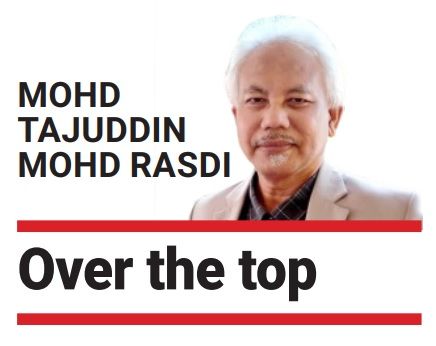
Prof Dr Mohd Tajuddin Mohd Rasdi is Professor of Architecture at the Tan Sri Omar Centre for Science, Technology and Innovation Policy Studies at UCSI University. The views expressed here are entirely the writer’s own.
Already a subscriber? Log in
Get 20% OFF The Star Digital Access
Cancel anytime. Ad-free. Unlimited access with perks.