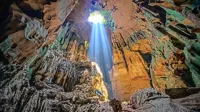
Why Malaysians should experience Gunung Mulu National Park.
ACHIEVEMENT unlocked. I finally made it to Gunung Mulu National Park.
Last year I wrote about my bucket list for Visit Malaysia 2026 – https://www.thestar.com.my/opinion/columnists/on-your-side/2025/09/12/bucket-list-destinations-for-msians – and with a few friends in tow, made the trip to Sarawak to see one of six Unesco World Heritage Sites that Malaysia has.
Getting to the national park isn’t as straightforward as visiting Langkawi. Mulu is in an isolated region in the vast interior of Sarawak. It is hundreds of kilometres from any sizeable town but is accessible by air via Kuching or Miri. We chose the latter and after the two-and-a-half-hour flight from Kuala Lumpur, we transferred into an Air Borneo plane for the short 25-minute hop to Mulu.
From the right-hand window seat of a flight from Miri to Mulu, you are looking over the vast, winding expanses of the deep Bornean rainforest. The mighty river you see snaking for many kilometres below is the Baram River.
Eventually, as you approach the tiny Mulu airport, the meandering river directly near the park headquarters becomes the smaller Melinau River.
Gunung Mulu National Park spans over 52,000ha of pristine tropical rainforest. Dominated by the 2,377m Gunung Mulu sandstone peak, the park features dramatic limestone karst formations, sheer pinnacles, deep canyons and one of the world’s most spectacular cave systems.
It is the most studied tropical karst area on Earth, with at least 295km of explored caves. Highlights include the massive Deer Cave – the largest cave passage in the world – and Clearwater Cave, part of South-East Asia’s longest cave system. Every evening, millions of bats stream out in a swirling spectacle that defies description, a nightly reminder of nature’s raw power.
We only had three days and two nights to explore the park and had to skip a visit to the Pinnacles (look at the back of your RM100 bill) but we managed to cram in two guided tours that allowed us to explore all the major caves plus take a cruise along the Melinau River.
Beyond the caves, Mulu’s biodiversity is staggering. The park hosts 17 vegetation zones, some 3,500 species of vascular plants (including an exceptional diversity of palms), and rich wildlife: hundreds of bird species, mammals like orang utan and clouded leopards, and unique cave-dwelling creatures. Many species are endemic or threatened. This is a living laboratory of evolution, offering insights into Earth’s geological and biological history spanning millions of years.
Why should Malaysians make the effort to visit? First, national pride and identity. Experiencing Mulu reconnects us with the ancient rainforests that define Borneo and much of our ecological story. It is a place that took 60 million years to shape – one of South-East Asia’s most important natural sites. As Malaysians, we inherit this treasure; visiting it deepens our appreciation and commitment to protecting it.
Second, education and inspiration. Schoolchildren, families and students of all ages can learn firsthand about conservation, geology, and ecology. Guided walks, canopy skywalks and river journeys reveal the intricate web of life. The park’s trails cater to various fitness levels – from easy cave explorations and night walks spotting frogs and insects to challenging treks to the Pinnacles or the summit. These experiences foster environmental stewardship in a way textbooks never can.
Third, economic and community benefits. Tourism supports local Berawan and other indigenous communities through guiding, homestays and services. While international visitors have historically dominated, greater domestic tourism helps sustain the park’s management, funds conservation and boosts Sarawak’s economy without over-reliance on foreign arrivals. With potential new road access on the horizon, now is the ideal time for Malaysians to lead in responsible visitation, ensuring growth doesn’t compromise the site’s integrity.
Finally, personal renewal. In Mulu, the stresses of city life fade amid towering trees, crystal rivers, and the hum of the rainforest. Whether marvelling at the Garden of Eden (a collapsed doline filled with jungle), cruising rivers or simply breathing in the ancient air, visitors leave transformed – more aware, more grateful and more motivated to advocate for nature.
Of course, challenges exist. Access still involves at least two separate flights. And costs, including accommodation and guided tours do add up but with planning, it’s achievable. Park authorities offer various packages and the experience far outweighs any inconvenience.
Malaysia is a country blessed with stunning natural diversity, but few places capture the imagination quite like Gunung Mulu National Park. Yet, for many Malaysians, especially those on the peninsula, Mulu remains a distant name rather than a personal memory. It’s time we changed that. Visiting Mulu isn’t just a holiday; it’s a profound connection to our shared natural heritage and a reminder of why conservation matters.
As we celebrate our nation’s beauty, let us not overlook this crown jewel in Borneo. Pack your bags, support sustainable tourism and witness one of the planet’s great wonders. Your country – and future generations – will thank you for it.
Already a subscriber? Log in
Get 20% OFF The Star Digital Access
Cancel anytime. Ad-free. Unlimited access with perks.

Brian Martin
Brian Martin is the managing editor of The Star.