Out of this world cultural relics


Buried treasures: A team working at a pit believed to be used for sacrificial ceremonies.

UFO buffs have been buzzing over the recent excavation of a figurine with alien-like features at the mysterious Sanxingdui ruins, believing it is the site of the remains of extraterrestrial life.

Measuring 115cm-tall, the bronze figurine is seen with its hands clasped in front of the body and a square plate on its head.

This is one of the latest discoveries of the Sanxingdui archaeological excavation project, aside from the thousands of relics and fragments unearthed before.

“It is definitely a star artefact and precious collection,” announced the National Cultural Heritage Administration at the Sanxingdui Culture: A Threshold to Chinese Civilisation recently.

The discovery makes a great present to the country as it celebrates the 100th anniversary of Chinese archaeology.

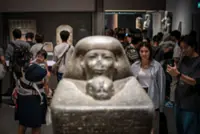
This statue is not the only one with protruding eyes, square face, big ears, wide mouth and sharp nose. There were more at the Sanxingdui Museum, including a slew of busts, a figurine with a human head and bird body and a bronze item that resembles a car steering wheel.

A bronze figurine with clasping hands at the Sanxingdui ruins in Sichuan province.


Such discoveries have led some people to believe the ruins were left behind by aliens but experts gave a definite “No”.

“We are not at all linking it to extraterrestrial life,” said Lei Yu, director of the excavation project.

Located at a riverbank in Guanghan district about 40km from Chengdu city in southwestern Sichuan province, Sanxingdui shot to popularity following the discovery of 500-plus cultural relics, particularly the gold and bronze masks, in late March.

This is a major find which experts believe could help to complete the diverse and long history of Chinese civilisation.

Dubbed as one of the greatest archaeological discoveries of mankind, the ruins were found when a local villager dug out some jade and stone artworks while making a ditch near his house in 1929.

Excavation began five years later but there was not much progress until 1980 when archaeologists found some tombs and building structures, followed by the city walls.The Sanxingdui Museum was opened in 1997 to display the artefacts unearthed.

Today, thousands of relics and fragments including pottery, jade items, bronze wares, ivory tusks and textiles have been discovered.

During the five-day Labour Day break last month, more than 80,000 tourists visited the Sanxingdui Museum and spent 5.31mil yuan (RM3.42mil) on entrance fees and souvenirs. This is a three-fold jump compared to 2019 despite Covid-19 limitations.

I headed to the legendary Sanxingdui site recently and met with the experts there.

Sanxingdui, one of the largest and well-preserved ancient cities in the history of China, spans over an area of 12km.

Experts confirm it was the capital, economic and cultural centre of the Shu Kingdom, a highly developed and prosperous culture around the Xia (2,070 BC to 1,600 BC) and Shang (1,600 BC to 1,046 BC) dynasties.

So far, city walls, building foundations and burial grounds have been found.

Currently, the archaeological team is working on six pits believed to be used for sacrificial ceremonies, in which they have dug out over 1,000 items including an abundance of ivory.

As the items in the sacrificial pits were stacked, they could not work the normal way.

Archaeologists set up a platform on top of the pits before carefully digging out the relics.

“It’s a pity that we have not found any written records,” said Lei Yu.

He believed the written characters were probably jotted down on textiles or materials which had decayed over the centuries.

“I hope I will find it one day,” he added.

However, Wang Wei – director of the Institute of Archaeology at the Chinese Academy of Social Science – has a different view.

“In the past, people usually passed down knowledge, stories and messages by word-of-mouth, so it is possible the kingdom did not leave behind any written records,” he pointed out.

Among the star artefacts at the Sanxingdui Museum are a 286g gold mask, a 395cm-high bronze tree, a head sculpture which features a pair of slanted eyes with two cylindrical eyeballs protruding from them.There is also a 260.8cm-tall standing figurine of a man, believed to be the Shu King, clad in clothing decorated with a dragon pattern.

Another one is a 15.3cm-tall statue of a semi-naked person kneeling on a platform and carrying a pot on his head.

Experts believe it shows a sorcerer performing a ritual.

Get 20% OFF The Star Digital Access

Monthly Plan

RM 13.90/month

RM 11.12/month

Billed as RM 11.12 for the 1st month, RM 13.90 thereafter.

Best Value

Annual Plan

RM 12.33/month

RM 9.87/month

Billed as RM 118.40 for the 1st year, RM 148 thereafter.

Follow us on our official WhatsApp channel for breaking news alerts and key updates!

Next In Columnists

The incredible star power rising from the East
Make Penang AI plan a bridge for majority
Giants fall, England survive – World Cup quarter-finals take shape
Who shapes global AI rules: Asean-China cooperation role
Why the Johor election is good for Malaysian democracy
Confessions of a durian season sinner
Looming threat to social security
More predictable than the World Cup
America at 250
Coexistence with wildlife key for public safety

Others Also Read