IN ANY complex transportation network, unforeseen issues are a fact of life.
Technical gremlins can appear, and while delays can be frustrating, these are sometimes an unavoidable consequence.
Most Malaysians are reasonable enough to accept this.
The true measure of a transport service provider is not whether problems occur, but how it responds when they do.
This is the acid test of service excellence and respect for the customer.
On June 9, I found myself, along with hundreds of other passengers including young children and the elderly, witnessing how a transport service provider failed that test.

A single three-and-a-half-hour train journey between Butterworth station in Penang and KL Sentral that cost me RM110, morphed into more than a six-hour test of patience, where passenger care could have been a lot better.
While announcements about the delay were made, they became hollow echoes in a carriage where no other comfort – not even a complimentary bottle of water – was offered, at least for us in the regular B to F, non-Business Class coaches.
Business Class passengers who pay between RM150 and RM170 (one-way) receive complimentary meals including bottled water with their tickets.
Last year, I managed to get the Business Class coach to Penang for Hari Raya after it was announced that Keretapi Tanah Melayu Bhd (KTMB) decided to provide additional northbound trains.
Tickets for Business Class are costly, and I was disappointed that I still had to go to the regular class coach to use the (filthy) toilet.
Even the so-called “personal entertainment” screens were a letdown with “unavailable” music and movies, besides the “out-of-stock” food.
Be warned – onboard WiFi is mind-numbingly slow.
There are signs that say “no outside food is allowed”, but this is obviously not realistic at the risk of regular class passengers going hungry.
It raises a critical question: When a train journey gets disrupted, does KTMB’s duty of care get left behind at the station?
Even at the Butterworth station, while we passengers were waiting in the searing 35°C heat at the platform for the train to arrive (40 minutes later), customer care was disappointing, aside from the “please stand behind the yellow line” announcements.
We were supposed to leave the station at 1.10pm, but the train left at 1.50pm.
Instead of arriving at KL Sentral at 4.40pm, we arrived at about 7.30pm.
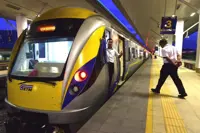
The Electric Train Service (ETS) is, by design, one of the shining symbols of modern Malaysia.
It represents a leap forward, a promise of seamless connectivity that links our towns and cities with speed and comfort.
For a premium price, we buy into this vision: a quiet, air-conditioned escape from the snarl of highway traffic, arriving at our destination refreshed, safe and on time.
It is a service we want to be proud of, a testament to our nation’s progress.
That vision was replaced by the sight of filthy toilets with wet floor and small wastebins overflowing with used toilet paper.
And when our train arrived at the KL Sentral platform, there was only one functioning escalator for us to go up and exit.
The lift was out of order, and to make matters worse, the two stairs in the station were sealed off so able-bodied passengers couldn’t use that alternative to ease the escalator congestion.
One is left to wonder what exactly we are paying for – a modern rail service or just a more expensive gamble?
KTMB has announced that theft of cables for signalling and communication systems on three KTMB northern routes caused the disruption and train delays for the northern Komuter and ETS.
The company also announced a plan to upgrade its signalling network.
However, when customers pay a premium, they deserve a premium response to crises, especially when the service is expected to operate on the Gemas-Johor Baru route and new routes from Johor Baru to Butterworth and Padang Besar (Perlis).
Already a subscriber? Log in
Get 20% OFF The Star Digital Access
Cancel anytime. Ad-free. Unlimited access with perks.