
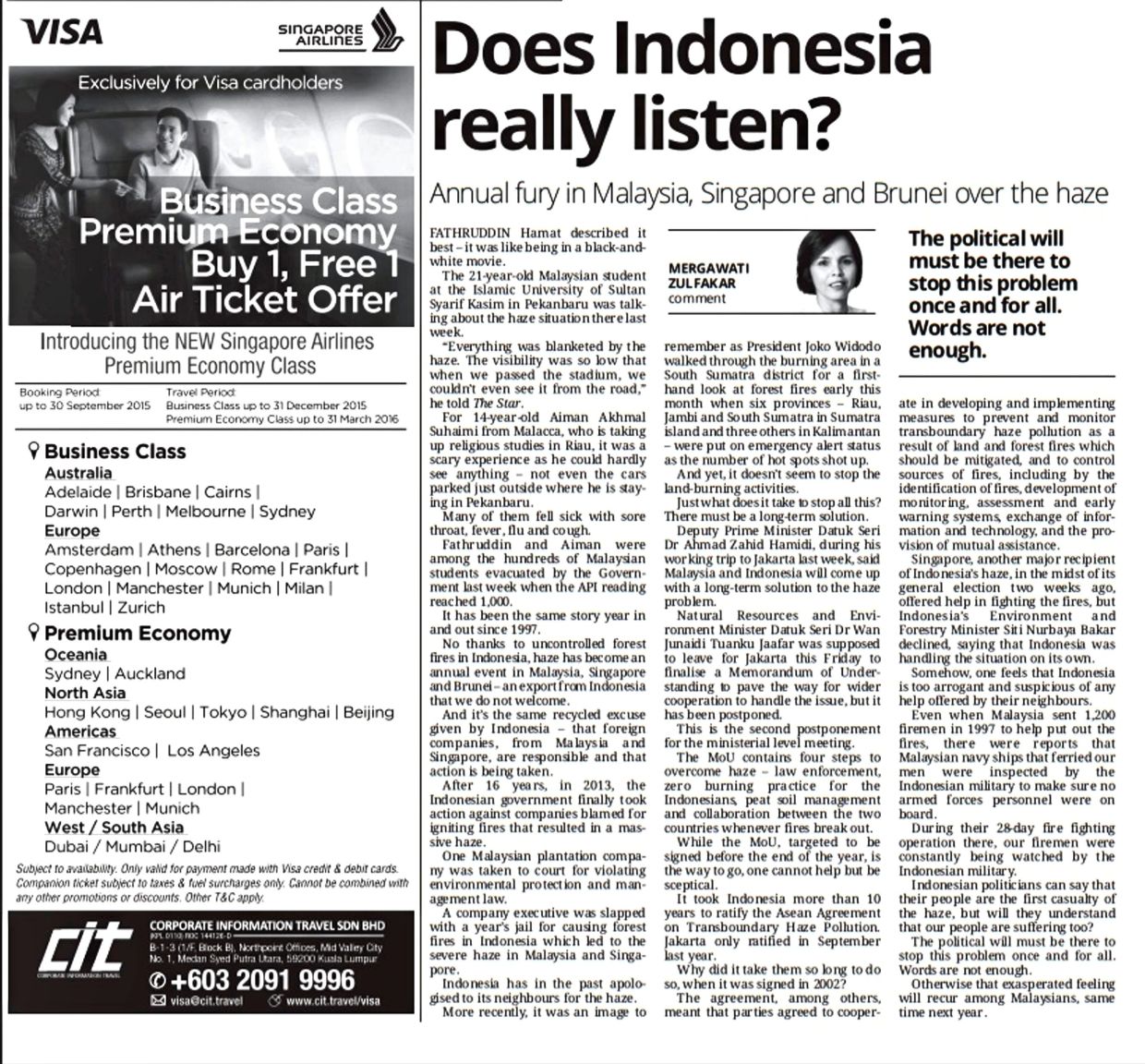
IN 2015, several hundred Malaysian students had to be evacuated from Indonesia’s Riau province after the Air Pollutant Index (API) hit a catastrophic 1,000. Many fell sick with sore throats, fever, flu, and cough. The Indonesian government declared a state of emergency, and the Malaysian government brought the students back.

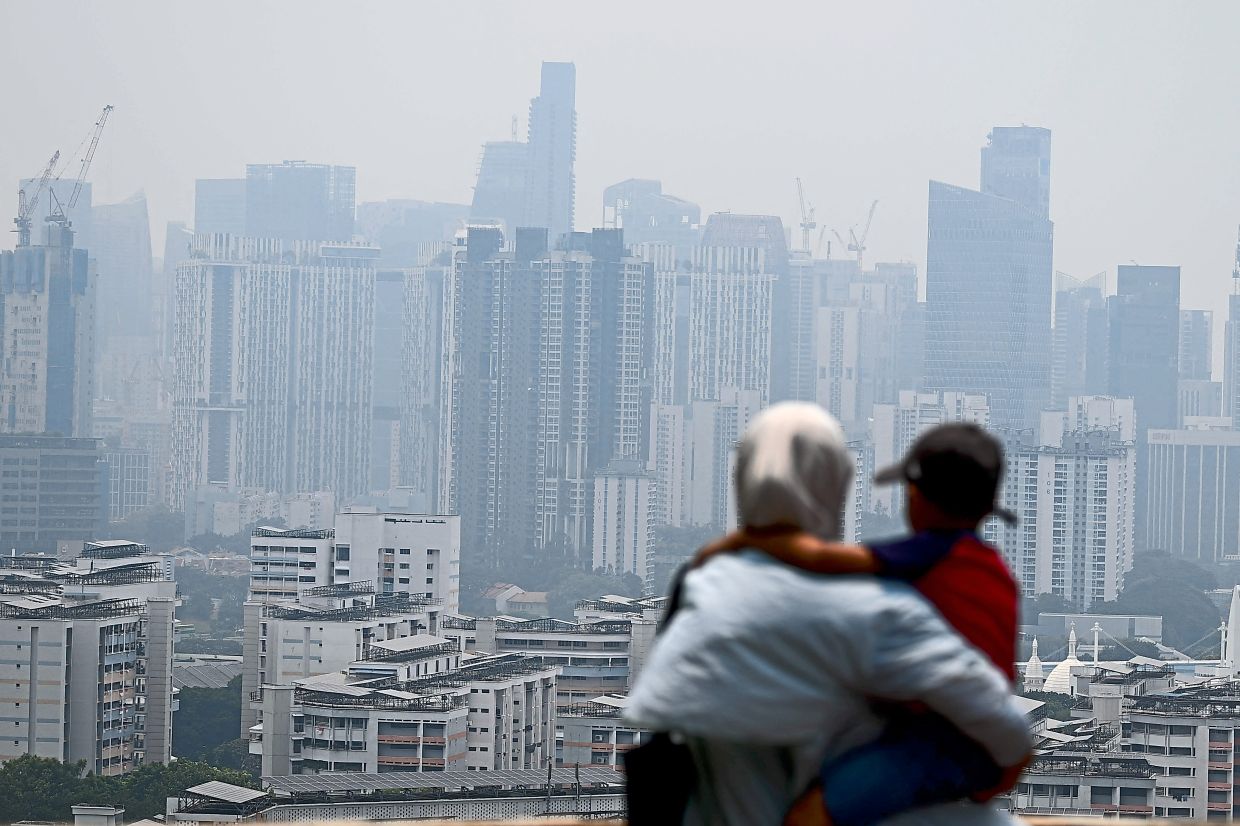
For a few weeks now several areas around Malaysia have been feeling the effects of the Indonesian fires. With the increasing number of hotspots, haze began appearing everywhere from Sarawak to Peninsular Malaysia just before we celebrated our National Day.
It was only a matter of time before an emergency declaration was announced for Serian in Sarawak as the API reached 519, shutting down schools, offices, and businesses. Malaysia’s Environment Department classifies API readings of between 301 and 500 as hazardous, while readings above 500 are categorised as an emergency. The emergency was lifted after several days but the API was still unhealthy yesterday.
When haze affects our daily lives, everybody has an opinion on what’s going on. Some Indo-nesian citizens apologised for their country being the source of the pollution.
We are quite sure many Malaysians agree with former minister Khairy Jamaludin when he slammed Indonesia.
“I apologise firstly to my friends in Indonesia, but unfortunately, we live next to a Third World country. I’m not saying that we don’t have problems when it comes to enforcement, but this is a proper, proper banana republic,” he said on his Keluar Sekejap podcast.
Khairy doesn’t hold a government post so he doesn’t need to hold back, unlike politicians holding official posts who have to maintain a certain decorum in case what they say offends our neighbours.
What has the Malaysian government done to help reduce the haze? Natural Resources and Environmental Sustainability Minister Datuk Seri Arthur Joseph Kurup said Malaysia is prepared to extend assistance if Indonesia needs it to tackle forest and land fires to reduce the risk of transboundary haze pollution.
Assistance Malaysia has offered ranges from aerial firefighting capabilities, including “water bombing” operations using helicopters, firefighting support using amphibious aircraft, and cloud seeding operations. This is the good neighbourly reaction only to be expected from Malaysia.
But the bigger question is: What are we doing to stop haze from Indonesia from crossing the border in future?
Datuk Seri Anwar Ibrahim must have been feeling exasperated when he said Asean needs to review existing mechanisms for dealing with transboundary haze to avoid adverse impacts on the people’s health. The Prime Minister said Asean ministers need to pay serious attention to the matter as the haze can directly impact people’s health and lives, especially children’s.
We can’t help but feel there is no sense of urgency on the part of the “exporter” – Indonesia took more than 10 years to ratify the Asean Agreement on Trans-boundary Haze Pollution after it was signed in 2002.
The agreement means that parties agree to cooperate in developing and implementing measures to prevent and monitor transboundary haze pollution as a result of land and forest fires. These measures include mitigating the fires; controlling their sources through fire identification; developing monitoring, assessment and early warning systems; exchanging information and technology; and providing mutual assistance.
But the agreement remains toothless when it comes to stopping the annual practice of burning land to clear it for agriculture. As one Asean diplomat said, the agreement is a product of consensus that gives the platform to the weakest link to dictate to the rest of the grouping.
Does that mean the rest of us should continue to suffer?
In 2021, Asean leaders convened an emergency summit in Jakarta after a coup d’etat in Myanmar that sparked a political and humanitarian crisis.
Why can’t a similar meeting be called to tackle this problem? Although it only affects some parts of the region, that is enough to impact the health of millions and our access to clean air. Who should make that effort to take the lead and address this problem?
Indonesia’s President Prabowo Subianto has called for a list of corporations allegedly involved in forest and land fires, and stressed that the operating permits of companies found guilty will be revoked.
Anwar has said Malaysia will neither intervene nor protect any Malaysian company if investigations prove it is responsible for open burning or other violations of the law in neighbouring countries.
Under Malaysia’s Asean chairmanship last year, regional leaders adopted a landmark declaration recognising a safe, clean, healthy, and sustainable environment as a human right.
The Star recently reported that environmental groups are calling for Malaysia to introduce a comprehensive Clean Air Act to hold citizens and businesses accountable when their overseas operations contribute to air pollution.
“Malaysia can demonstrate regional leadership by promoting responsible plantation practices and ensuring Malaysia-linked companies uphold the highest environmental standards wherever they operate,” said Greenpeace Malaysia country representative Heng Kiah Chun.
Why are we denied our right to clean air?
Pity the children who missed education due to school shutdowns or businesses suffering losses. The effects of haze have far-reaching consequences.
The haze will clear eventually but with the expected super El Nino causing rising temperatures, a significant reduction in rainfall, and very dry weather, we may just face a higher risk of high-intensity haze from open burning.
And since El Nino is forecasted to peak in early 2027, the haze may just come sooner than the usual land burning season in September in Indonesia.