China has ‘the cards’


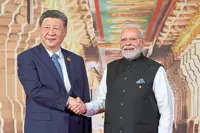
Trump and Xi shaking hands as they arrive for talks at the Gimhae Air Base, located next to the Gimhae International Airport in Busan recently. — AFP

‘WHO won?’ is the question many are asking or would like to ask, after Presidents Donald Trump and Xi Jinping met in Busan, South Korea 10 days ago.
The leaders of the world’s two largest economies last met six years ago in a rapidly changing era of great economic power competition. The Busan summit naturally prompted questions of victory and defeat between the competitors, but reality frustrates such simple questions.

The Bush Jr and Obama administrations had already imposed tariffs and sanctions on China two decades ago. Trump ‘officially’ launched the trade war in 2018, Biden escalated it, and Trump 2.0 now has to deal with the mess.

Nobody really wins a trade war. The questions after Busan should instead be who lost by how much, where exactly, and when can the final results be in.

Officially, the trade war is not over. Where Trump had previously suspended punitive tariffs by 90 days, often extending the period, he and Xi have merely agreed to quadruple the reprieve by declaring a year-long truce.

Many things can happen in a one-year trade ceasefire. Multiple issues are still unfolding as each side continues to size up the other’s strengths and weaknesses.

Some key issues had already been decided between officials on both sides in the weeks and months before the Busan summit. These decisions will determine what will occur in the years and decades ahead.

Among these are China’s grip on rare earth elements (REEs) in world markets, and its buying power for US agricultural produce. Trump’s negotiating team has had to contend with China’s size and scale of operations whether they like it or not.

China’s market for soybeans alone is considerable, as is its appetite for other farm imports. It has traditionally soaked up some 25% of US produce, but seamlessly switched to Brazil for soybeans in retaliation against Trump’s tariffs.

In one stroke, this left US farm exporters including Trump loyalists on the sidelines. Some US own goals compounded the mess – Trump’s empathy for Brazil’s opposition leader Jair Bolsonaro made President Lula even more keen to supply China.

Trump’s US$40bil (RM167.1bil) bailout package for President Javier Milei’s troubled Argentina led to the latter’s re-election. It also made US exporters subjected to China’s retaliatory boycott and US taxpayers penalised with Trump’s tariffs more disgruntled.

Is Argentina grateful for Trump’s generosity? US policymakers who assume gratitude as a given have reason for concern.

After Trump’s announcement of a bailout, Argentina joined Brazil in exporting soybeans to China, further undercutting US farmers. Argentine beef exporters also happily supplied the US market, challenging US beef producers.

Any evaluation of US-China rivalry will also need to consider their sense of policymaking, or their lack thereof. A more sober and prudent China is not so prone to such self-defeating policy blowbacks.

Besides the immense scale of China’s operations, it also adopts the long view that necessitates wisdom beyond mere operational competence.

China’s statecraft has been honed over thousands of years of unbroken administration. The US is a country with still less than 250 years of history.

The differences are evident in just about any sector, including REEs. Occasional reports of new Western discoveries of REE deposits are still insignificant because China handles more than 70% of global mining and in excess of 90% of total processing.

Western powers could have embarked on REEs earlier and even come to dominate it, but decided not to. The industry is capital-intensive, requires patience and offers low returns on investment.

China’s long view saw early and serious investments in the industry because of its strategic importance. The same applies to battery electric vehicles (BEVs), which developed countries have now marginalised over shallow, short-term considerations.

These differences in policy outlook have afforded China more resilience in weathering Trump’s tariffs and better leverage in countering them. Beijing’s greater endurance in withstanding trade conflicts has meant Trump being more anxious to end the trade war since last year, and being more keen to visit China to ensure trade peace.

In Trump’s unabashed assessment of national strength in terms of size, length and duration, China’s extensive scale, historical scope and unequalled endurance come across as formidable. That would explain Trump’s glowing tribute to his Chinese counterpart in Busan in talks over reciprocal tariffs, a gesture which was not reciprocated.

After Trump’s many handshakes with Xi, he would also have noticed that the size of Xi’s hands is not inconsiderable. They are significantly larger than Ukrainian President Volodymyr Zelenskiy’s or European Commission President Ursula von der Leyen’s.

For Trump, that is of great significance.

Until last year, he had prioritised ending the Ukraine war before the trade war with China. The order of those tasks has now changed in accordance with their revised priorities.

Bunn Nagara is Director and Senior Fellow at the Renaissance Strategic Research Institute, and Honorary Fellow at the Perak Academy. The views expressed here are solely the writer’s own.

Get 20% OFF The Star Digital Access

Monthly Plan

RM 13.90/month

RM 11.12/month

Billed as RM 11.12 for the 1st month, RM 13.90 thereafter.

Best Value

Annual Plan

RM 12.33/month

RM 9.87/month

Billed as RM 118.40 for the 1st year, RM 148 thereafter.

Follow us on our official WhatsApp channel for breaking news alerts and key updates!

Next In Columnists

The Battle Royale for Political Control
The incredible star power rising from the East
Make Penang AI plan a bridge for majority
Giants fall, England survive – World Cup quarter-finals take shape
Who shapes global AI rules: Asean-China cooperation role
Why the Johor election is good for Malaysian democracy
Confessions of a durian season sinner
Looming threat to social security
More predictable than the World Cup
America at 250

Others Also Read