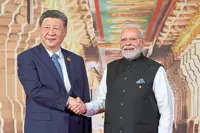
GLOBAL attention is on Kuala Lumpur where world leaders are now converging for the 47th Asean Summit and related summits.

Nonetheless, the international spectacle that grew from one Asean Summit into a glamorous star-studded extravaganza of global government glitterati is not without advantages. It affirms Malaysia’s established reputation as a gracious and competent host of important international events, while Trump can also add to his collection of “peace deals” fresh from deadly US attacks on Venezuela and Iran.
Formalising Thai-Cambodian peace is not insignificant even if the conflict should never have occurred. This summit comes pointedly at a time of global trade dislocation, the Gaza genocide, and uncertainty everywhere.
Fickle global attention is apt to shift elsewhere within 48 hours, so it pays to stay focused on Asean’s interests, concerns, and prospects at Asean events. A common failure to appreciate Asean for what it is only makes this an ever pressing need.
Among the Asean myths that need dispelling is how it used to be a pro-US organisation. What-ever residual affinities some Asean countries may have with their former colonial masters were never replaced with Cold War partisanship upon independence.
A more recent myth concerns how Asean is splitting between its mainland and more littoral or archipelagic states. Another myth rejects this in favour of a three-way split, with faultlines that are equally imaginative and insubstantial.
Asean is more focused on developments like welcoming Timor-Leste as its first new member in 26 years. Timorese leaders might have been exasperated at their 14-year wait, but some countries have waited longer with virtually no prospect of ever joining.
Timor-Leste’s case for membership is also cause for not granting it to Papua New Guinea or Sri Lanka, despite the latter seeking to join even before Asean was formally established. Timorese people and their territory have been part of Indonesia as East Timor province, and therefore part of South-East Asia and Asean, while the other countries lie outside the region.
Turkey and Mongolia have even reportedly expressed interest in joining Asean. That prospect is highly improbable, so the anxieties of some about an unwieldy Asean expansion causing dilution and drift are unwarranted.
Asean is a South-East Asian community of nations whose members share multiple diversities in cultures and systems, buoyed by an understanding that national interests are implicit in common regional aspirations and concerns. That implies certain foundational principles that are core, without these being unique to the region.
Non-intervention in the internal affairs of sovereign states, a principle enshrined in the UN Charter, has special resonance in Asean. A formal association of sovereign nations, following their hard-won independence with territorial disputes intact, would not have been possible were mutual intervention permitted.
Asean decision-making by consensus is also sometimes criticised, but without good reason. Consensus is also how a 15-member UN Security Council and an even larger 27-member EU are governed, but consensualism is not blamed for their challenges and shortcomings.
Asean’s challenges typically originate outside its control and should be mitigated progressively as Asean centrality takes root. This is a forward-looking region invested in the future.
All Asean member states have joined the Non-Aligned Move-ment (NAM), while Asean as a collective entity is functionally non-aligned. This accords with the region’s sense of realism and pragmatism.
Any external party lamenting Asean’s non-partisanship in great power rivalry should appreciate that neutrality also means never taking any side that can work against it. Asean respects the legitimate rights and interests of all other nations.
Within Asean, the individual national prerogatives of member states are also respected. This explains why an equivalent of Brexit has never happened in Asean and is unlikely to occur.
Asean accepts the national prerogative of each member to interpret its NAM membership within the limits also acceptable to NAM. South-East Asia is richly endowed with geopolitical nuances which are never advisable to ignore.
Where Western-led institutions – such as Aukus (security partnership of Australia, UK, and US) and Quad (Quadrilateral Security Dialogue involving Australia, India, Japan, and US) – and the Indo-Pacific as an alternative to the Asia-Pacific have slowed in gaining traction, it should be remembered that these creations of major powers outside the region cut across Asean territory without consulting Asean when its centrality has been prioritised.
This situation parallels the 1950s when Western powers established the South-East Asia Treaty Organisation (Seato) as a Cold War instrument. Of its eight members, Thailand and the Philippines, which hosted US military bases, were the only members from the region throughout Seato’s three decades of existence.
Asean countries are no less protective of regional sovereignty as they are of their respective national sovereignties. Their bilateral differences help keep Asean unified through a unique combination of centrifugal and centripetal forces tending towards greater coherence, convergence and centrality.
Bunn Nagara is director and senior Fellow at the Renaissance Strategic Research Institute, and honorary Fellow of the Perak Academy. The views expressed here are solely the writer’s own.
Already a subscriber? Log in
Get 20% OFF The Star Digital Access
Cancel anytime. Ad-free. Unlimited access with perks.