


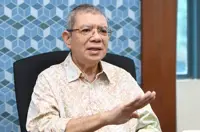
Helming contemporary major developments


FROM Sept 13 to 27, various meetings will be held at the 77th Session of the UN General Assembly.

Malaysia is attending at a time when we have to confront the challenges of contemporary major developments, namely climate change that is man-made, the advent of technologies that are of great benefit but also involve humanistic issues, and unjust international architectures.

In terms of climate change – which has become a "climate crisis" - it is the result of human actions. Since the 19th century, due to the effects of the Industrial Revolution, the rapid development of various technologies and industries has generated intensive Greenhouse Gas (GHG) emissions.

The biggest contributors to climate change are the rich countries. But, now, they are the ones who are loudly voicing "Climate Action". Whereas the developing countries, which have just stepped towards a more equitable national development agenda and free themselves from poverty, are restricted and condemned for allegedly violating the principles of environmental preservation and conservation.

Malaysia has to be practical. We must honour the pledge to keep more than half of its landmass green; apply the principles of Environmental Social Governance (ESG); collectively limit global warming to at least 2 degrees Celsius, and achieve zero net GHG emissions by 2050. On the international stage, we need to continue to uphold the principle of equal responsibility common with differentiated capabilities.

To succeed, we need to be futurists; that is by following and as much as possible influencing the ideas and thoughts of science and technology of the future. The speed of technological advancement will happen faster. The question is our ability to provide a geo-political, cultural and generational ecosystem that triggers and controls it.

In terms of the ecosystem, we need to be open. And we need to have a robust digital generation. The momentum of digital technology is unstoppable. We have to accept it openly.

But, that doesn't mean we take a resigned attitude. Legislation and regulations remain important. We also need to overcome its negative effects, for example, cyber security, privacy, the dominance of social media giants, ethics, and clash of ideas related to international internet governance.

The international architectures that exist today, namely in finance, trade, economy, politics, security, and others, are unjust for small and developing countries. For example, the IMF, the World Bank, and the UN were formed by the winners of the Second World War.

And the most recent ones such as the RCEP, CPTPP, and IPEF were formed by the beneficiaries of some of the previous ones.

What actually happens is that a small minority of the world's wealthiest, influential and well- connected wrote the terms, most of which are biased against the vast majority.

Therefore, our diplomats need to be brave in facing these developments.

Get 20% OFF The Star Digital Access

Monthly Plan

RM 13.90/month

RM 11.12/month

Billed as RM 11.12 for the 1st month, RM 13.90 thereafter.

Best Value

Annual Plan

RM 12.33/month

RM 9.87/month

Billed as RM 118.40 for the 1st year, RM 148 thereafter.

Follow us on our official WhatsApp channel for breaking news alerts and key updates!
Datuk Seri Saifuddin Abdullah

Datuk Seri Saifuddin Abdullah

Datuk Seri Saifuddin Abdullah is the Foreign Minister of Malaysia. Views expressed are the writer’s own.

Next In Columnists

Spain’s beautiful game survives Argentina’s ugly antics
Tarnishing the white uniform
Asean-Russia Summit in Kazan: celebrating 35 years of unity in diversity
Strengthening China-Malaysia ties: A powerful boost for a shared future amongst neighbouring nations
Penang’s ‘kapcai’ culture holds key to rail future
La Roja reign supreme – why Spain’s World Cup win was no fluke
China’s Global Development Initiative and Malaysia’s rail transformation
Controversy over Melaka’s reps
Many Israelis' dual citizenship makes entry ban harder to enforce
Ice, ice, baby: Is freezing the answer to your biological clock?

Others Also Read
