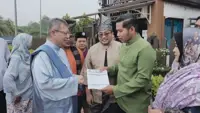
On Aug 13, I hosted the annual event of celebrating teachers by organising the Indera Mahkota Parliament Excellence Awards Night and Teacher's Day. It was attended by 400 teachers, students, and parents from 42 secondary and primary schools.
In the field of education, I often discussed the importance of educating the digital generation.
It is driven by ideas, which are divided into four levels: 'ideas that already exist', 'ideas that are being developed', 'ideas that are being debated', and 'ideas that need to be anticipated'.
The future of the country depends on our ability to work on 'ideas that are being debated' and 'ideas that need to be anticipated'.
As a consequence, we need to be futurists, by following, and as much as possible, influencing future science and technology thoughts, for example, robotics, advanced life sciences, codification of money, cyber security, and big data.
Technological change will happen much faster than anticipated. The leading technologies that will dominate our lives in the next 20-30 years have yet to be invented.
While new technologies will constantly be updated, they will be replaced even before we have the time to master it. We will be forced to learn newer technologies then.
The main question is our ability to provide a geopolitical, cultural and generational ecosystem.
This is because we had a bitter experience not so long ago, when Malaysians created new technologies that changed the way of life of humans worldwide, made other countries the place of their development and launch.
Why? Because our ecosystem was not ready to facilitate it.
From the aspect of geopolitics, we need to be open to the outside world. We need to welcome the presence of professionals and experts from all over the world, support freedom of thought, create and develop a culture of knowledge, provide first-class science and technology infrastructure, adopt open social, economic, and political systems and embrace reform.
We need to have a digital generation. They should master languages as well as scientific and technical skills; be cultured, master various languages, multi-disciplinary and able to deal with advances that are hybrid and convergent in nature.
The advent of technology is inevitable. We should embrace it openly.
But that doesn't mean we take a resigned attitude. Legislation and regulations remain essential for the technology and its content to be inclusive, do not create new gaps in the community and are compatible with our history, tradition, and culture.
We also must overcome its adverse effects, such as cyber security, privacy, and ethics.
This means we need a digital generation that is humanistic, which is spiritually, intellectually, physically, and psychologically integrated.
Already a subscriber? Log in
Get 20% OFF The Star Digital Access
Cancel anytime. Ad-free. Unlimited access with perks.