Ruminations on life over yee sang


I WAS astonished to discover – and wondered why I didn’t realise this 12 years ago – that it’s the Year of the Cat in Vietnam, where the arrival of spring is known as Tet.

I was told this auspicious news by Vietnamese friends familiar with my affinity for felines, although ironically I was born in the Year of the Dog, and the supposed historical reason for this is confusion between the Chinese word for rabbit and the Vietnamese word for cat meo.

Various Chinese horoscopes online say the rabbit is associated with “grace, mercy, auspiciousness and good luck” but also “lechery and fertility due to its prolific reproductive performance”.

The cat, on the other hand, is “composed, patient, kind-hearted and esteemed by many others”. Of course, Islam does not have any tradition of horoscopes – scholars of the Golden Age celebrated astronomy rather than astrology – but cats are generally loved by Muslims based on numerous hadiths as well.

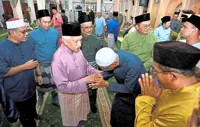
I have enjoyed sharing this news at yee sang sessions and open houses this year, which have felt particularly celebratory as confidence in social gatherings returns to pre-Covid-19 levels.

I can’t be the only one wondering how so many people got hold of the mountains of fireworks that flashed and popped perpetually across the Klang Valley as midnight struck.

The presence of foreign guests provided the opportunity to explain the true origins of the yee sang.

Unfortunately, many people are still misled by propaganda claiming that it was invented in Singapore when, in fact, it’s actually from Negri Sembilan.

In the 1940s, Loke Ching Fatt, whose grandson is Anthony Loke, the current MP and Minister of Transport, formulated the recipe in Seremban.

That coincidental political connection hasn’t prevented politicians of all sides from embracing it today, and as with any Malaysian public holiday, politics is never far away.

There are the customary pictures of politicians enthusiastically tossing yee sang to show their commitment to cultural diversity, sometimes eliciting scepticism when their usual political positions seem to champion only one race, culture or religion.

The optics of this are heightened with six state elections due this year and political leaders openly talking about deals between parties and preparing for campaigns.

Naturally, there will be many enticements being made both to voters and to political actors, which is why the Political Financing Bill ought to be a legislative priority.

Among friends and acquaintances at open houses, opinions about the unity government are also being sought and shared. From my observations, most people form their views based on their feelings towards the Prime Minister and then towards individual ministers.

Several ministers universally rank terribly, perceived as appointed for specific political reasons, but others are appreciated for working hard on their new briefs and taking the initiative to engage with civil society, businesses and other stakeholders.

Another ubiquitous feature of this year’s open houses are the young people. There are so many of them – including those born during the pandemic – and conversations (especially between new parents) often turn to their offspring’s future prospects. Education is the number one topic, ranging from general views about which type of system is the best, to specific schools and tutors for tuition.

My contribution to this discussion was in praising the government’s decision to appoint an independent commissioner for children, in light of recent and high-profile cases of abuse involving children in schools, orphanages and during sporting activities.

However, since the creation of a new commission requires an Act of Parliament, in the meantime, a children’s commissioner will (again) be appointed under the Human Rights Commission of Malaysia (Suhakam).

Once the relevant legislation is drafted, I hope it does give the commissioner the power of enforcement, as many organisations have already called for. I also hope it envisages protection for refugee and stateless children, whose position in the law and the provision of services has always been especially precarious.

Young people, too, have also provided some of the most mesmerising lion dance performers I have ever seen. On the one hand, I wonder about the health and safety standards being applied, but on the other hand, the synchronised acrobatics of two people wearing lion costumes jumping on wobbly poles is indeed thrilling.

Not to forget, of course, the percussive accompaniment – increasingly played by non-Chinese – that narrates the tension and release of the whole drama.

These things take discipline and commitment, making these young Malaysians truly authentic and valuable for the continuity of our diverse cultural traditions – especially when compared to political photo opportunities! Gong xi fa cai!

Tunku Zain Al-‘Abidin is founding president of the Institute for Democracy and Economic Affairs (Ideas). The views expressed here are the writer’s own.

Get 20% OFF The Star Digital Access

Monthly Plan

RM 13.90/month

RM 11.12/month

Billed as RM 11.12 for the 1st month, RM 13.90 thereafter.

Best Value

Annual Plan

RM 12.33/month

RM 9.87/month

Billed as RM 118.40 for the 1st year, RM 148 thereafter.

Follow us on our official WhatsApp channel for breaking news alerts and key updates!
Tunku Zain Al-‘Abidin ,

Next In Columnists

Federal funds and fiscal capacity
Chinese wind blowing in Johor
The incredible star power rising from the East
Make Penang AI plan a bridge for majority
Giants fall, England survive – World Cup quarter-finals take shape
Who shapes global AI rules: Asean-China cooperation role
Why the Johor election is good for Malaysian democracy
Confessions of a durian season sinner
Looming threat to social security
More predictable than the World Cup

Others Also Read