PETALING JAYA: The reintroduction of the Goods and Services Tax (GST) should not be made conditional on Malaysians earning a minimum income of RM4,000, says Datuk Lawrence Low.
The MCA vice-president said the Government should instead assess which tax system could better reduce the overall burden on businesses and consumers, particularly lower-income households.
Responding to Prime Minister Datuk Seri Anwar Ibrahim's remarks that GST could be reconsidered when the minimum income reached RM4,000, Low said the argument that GST taxed consumers while the Sales and Services Tax (SST) affected only businesses was misleading.
“Although SST is imposed on businesses, its costs can be reflected in consumer prices. Anwar has acknowledged that part of the SST burden is passed on to the public,” he said in a statement.
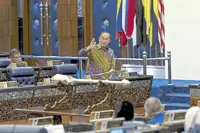
Anwar had said during Prime Minister's Question Time in the Dewan Rakyat on Thursday (Nov 12) that current income levels remained too low for GST, which he described as a broad-based tax that could burden ordinary Malaysians.
He said the Government could consider the tax if the minimum income reached RM4,000, as it would then be less burdensome while generating better revenue.
Low said businesses supported GST partly because its input tax credit mechanism allowed eligible registered companies to recover taxes paid on business inputs, reducing the accumulation of tax costs along the supply chain.
Under SST, he said, taxes on business inputs that were not exempted or eligible for credits could become operating costs and eventually be passed on to consumers.
He cited the Finance Ministry's Fiscal Outlook 2024, which acknowledged that SST could be embedded in costs and accumulate along the supply chain.
He also referred to a Federation of Malaysian Manufacturers survey in the first half of 2026, which found that 60% of manufacturers surveyed reported higher production costs due to embedded taxes, while 59% cited unrecoverable taxes on business inputs.
“If businesses absorb the costs, profits and cash flow suffer. When they pass them on through prices, consumers bear the burden too,” he said.
Low also questioned why the Government had yet to disclose its full proposal despite adopting certain GST mechanisms, saying businesses needed clarity on input tax credit eligibility, refunds, compliance costs and the likely impact on consumer prices.
“MCA had previously proposed an improved GST model with a lower initial rate, zero-rated essential goods, safeguards for low-income households, simpler compliance for micro and small businesses, and clear deadlines for tax refunds,” he said
Low said the impact of GST would depend on its rate, scope, household assistance and implementation, urging the Government to assess both systems based on their ability to protect businesses and consumers.