
KUALA LUMPUR: Malaysians should earn at least RM4,000 before the government considers reintroducing the Goods and Services Tax (GST), says Datuk Seri Anwar Ibrahim.
The Prime Minister said reintroducing the GST will not be viable while income remained low, as the broad-based tax could burden households despite its potential to generate more revenue.
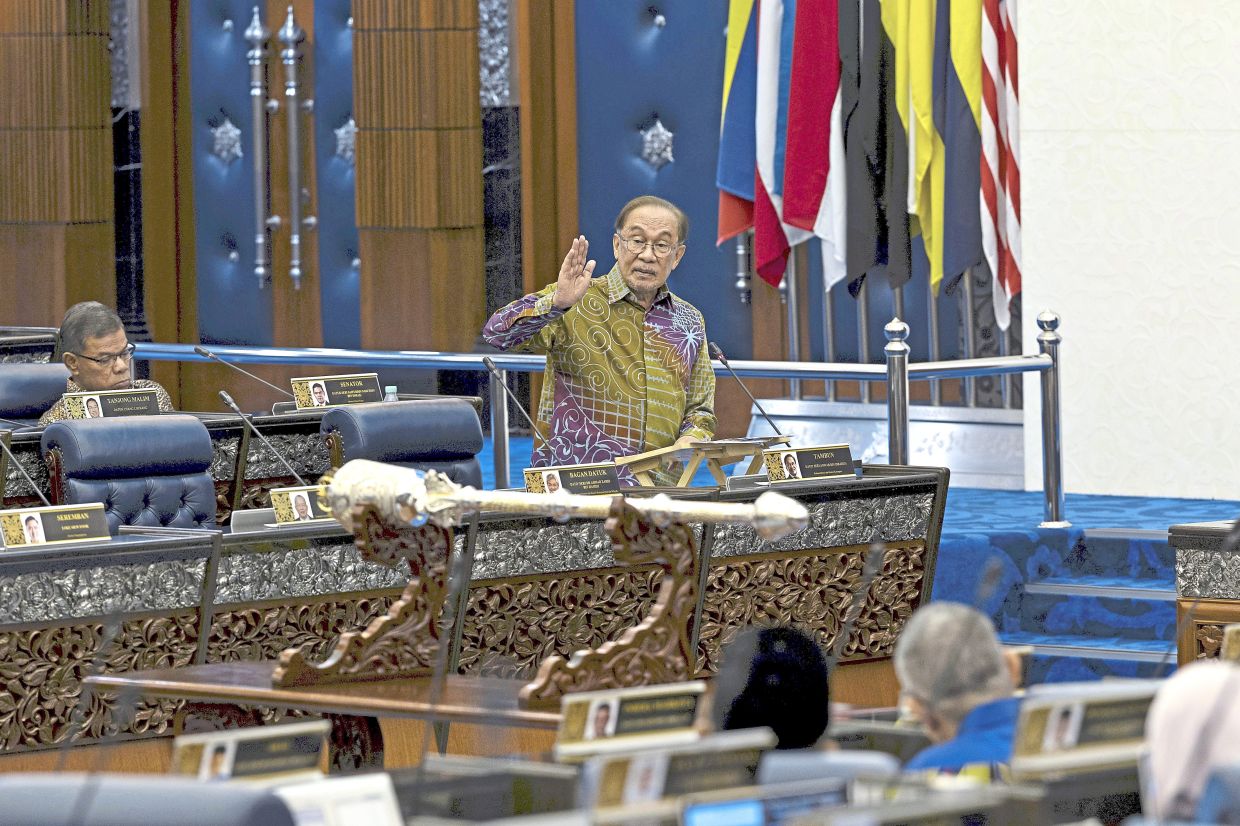
“If the minimum income of our people reaches RM4,000, we can consider it because, although the tax is imposed at a lower rate, it would not be considered too burdensome and we could ensure better revenue,” he said during the Prime Minister’s Question Time in the Dewan Rakyat yesterday.
Anwar was responding to Ipoh Timor MP Howard Lee who asked whether the GST could generate more revenue than the existing Sales and Service Tax (SST) to help reduce national debt and fund development, as well as whether it would be better for businesses.
Anwar, who is also the Finance Minister, maintained that his administration had no intention of reintroducing the GST, saying the existing SST placed the tax burden primarily on businesses, while the GST applied more broadly to consumers.
“GST is a tax on everyone, while SST is a tax on businesses,” he said.
Anwar added that SST revenue currently stood at 3.2% of gross domestic product (GDP), equivalent to the revenue generated by the GST in 2017.
He also said the SST exempted about 2,000 items, compared with around 750 under the GST.
The GST also affected about 700,000 businesses when it was in place in 2018, compared with 130,000 under the current SST system, he explained.
Anwar said specific cases of double taxation under the SST could be addressed through adjustments, adding that his position was based on concerns over the impact on the public rather than political considerations.
Separately, he said Malaysia was borrowing less even as government spending continued to rise to support households and civil servants.
A total of RM16bil had been allocated for Sumbangan Tunai Rahmah (STR) and Sumbangan Asas Rahmah (Sara), RM18bil for civil service salary increases and more than RM40bil for fuel subsidies, he said.
He also revealed that government borrowing had declined from RM100bil in 2021 and 2022 to RM92.6bil in 2023, RM76.8bil in 2024 and RM75.6bil in 2025.
“Although our debt is decreasing, we are borrowing less, while spending is still increasing,” he said.
Anwar added that the fiscal deficit had fallen from 6.4% in 2021 to a projected 3.3% in 2027, while the Federal Government’s debt-to-GDP ratio was expected to decline from 65.2% to 64% in 2026 and 63.7% in 2027.
He also said the ratio of Federal Government debt and liabilities to GDP had eased from 80.9% at the end of 2022 to 80.7% at the end of June 2026.
He added that the government was working with government-linked investment companies to channel funding towards projects benefiting the country and bumiputra businesses.